
23 cards




Shogakukan's six school magazines, one for each year of Japanese elementary school, produced 25 Pokémon cards: 15 promos bundled with issues from February 2003 to August 2006, and 10 cards printed in 2009 and 2010 from the winning drawings of each grade's design contest. In real completed sales as of September 24, 2026, the dearest raw are two anime cards of 2003, Brock's Mudkip at $118 (10 sales) and Ash's Treecko at $108 (5 sales), then Mew 091/PCG-P at $78.53 (5 sales) and May's Torchic at $78.40 (9 sales). In PSA 10, Mew leads at $13,770 est. (1 sale).
No card names its magazine. An insert is identified by the number at the bottom right (008/ADV-P, 091/PCG-P), a contest card by its credit line, which carries the winning child's name. The six titles ran from Shōgaku Ichinensei (first grade) to Shōgaku Rokunensei (sixth grade), and readers moved up one title with each school year, so each title reached a single age group and the publisher chose which grades got each card.
The 15 inserts, grade by grade
| Card | Number | Grades and issue | English version, same art | Raw | PSA 10 |
|---|---|---|---|---|---|
| Grovyle | 008/ADV-P | Grades 1-2 in March 2003, grades 3-6 in April 2003 | Nintendo Black Star Promo 4 | $6.99 (12 sales) | no sale |
| Combusken | 009/ADV-P | February 2003, grades not recorded | Nintendo Black Star Promo 9 | $4.95 (9 sales) | no sale |
| Marshtomp | 010/ADV-P | February 2003, grades not recorded | Nintendo Black Star Promo 11 | $9 (5 sales) | no sale |
| Ash's Treecko | 036/ADV-P | September 2003 issue, grades 3 and 4 | none | $108 (5 sales) | $6,340 est. (1 sale) |
| May's Torchic | 037/ADV-P | September 2003 issue, grade 1 | none | $78.40 (9 sales) | $3,898 est. (1 sale) |
| Brock's Mudkip | 038/ADV-P | September 2003 issue, grades 2 and 5 | none | $118 (10 sales) | $7,803 est. (1 sale) |
| Beldum | 045/ADV-P | February 2004 issue (announced December 12, 2003), grades 1-4 | Nintendo Black Star Promo 22 | $3.98 (9 sales) | $484 est. (2 sales) |
| Deoxys (Defense Forme) | 017/PCG-P | August 2004 issue, grades 1-5 | EX Deoxys 18/107 | $12.14 (7 sales) | no sale |
| LaRousse's Munchlax | 020/PCG-P | September 2004 issue, grades 1-5 | none | $19.67 (5 sales) | $4,548 est. (1 sale) |
| Aura's Lucario | 092/PCG-P | August 2005 issue for grades 1, 3, 5; September 2005 for grades 2, 4, 6 | none | $10.65 (5 sales) | no sale |
| Mew | 091/PCG-P | August 2005 issue for grades 2, 4, 6; September 2005 for grades 1, 3, 5 | POP Series 4, 4/17 | $78.53 (5 sales) | $13,770 est. (1 sale) |
| Charmander δ | 132/PCG-P | May 2006 issue for grades 1, 3, 5; June 2006 for grades 2, 4, 6 | POP Series 5, 10/17 | $12.44 (9 sales) | no sale |
| Charmeleon δ | 133/PCG-P | May 2006 issue for grades 2, 4, 6; June 2006 for grades 1, 3, 5 | POP Series 5, 5/17 | $11.38 (11 sales) | no sale |
| Sea's Manaphy | 150/PCG-P | August 2006 issue for grades 1, 3, 5; September 2006 for grades 2, 4, 6 | none | no sale | no sale |
| Samiya's Buizel | 151/PCG-P | August 2006 issue for grades 2, 4, 6; September 2006 for grades 1, 3, 5 | none | $7.95 (11 sales) | no sale |
Medians of real completed sales of the Japanese card, in US dollars, as of September 24, 2026, with the number of sales; "est." marks a median resting on one or two sales. Issues went on sale around the first day of the month before their cover date: the September 2003 issues on August 1 and 2, 2003, for example.
Early 2003 brought three cards: Grovyle for all six grades, grades 1 and 2 a month before the others, and Combusken and Marshtomp in February 2003, for grades that are not recorded. All three were reprinted in English, with the same art, as Nintendo Black Star Promos.


In August 2003 the September issues carried three cards drawn from the anime, each for different grades: May's Torchic for grade 1, Brock's Mudkip for grades 2 and 5, Ash's Treecko for grades 3 and 4, and nothing for grade 6. The official announcement presented them as originals found nowhere else, released to mark the Movie Commemoration VS Pack. Each prints a Pikachu Project copyright where the illustrator's name usually sits.


That round began a gap for the sixth-grade magazine, which got nothing for four rounds in a row: the 2003 trio, Beldum (grades 1 to 4), Deoxys and LaRousse's Munchlax (grades 1 to 5 both). Munchlax, like the Lucario, Manaphy and Buizel that followed, is a Generation IV Pokémon, printed the summer of its film and before Diamond and Pearl came out in Japan on September 28, 2006. The films' own half decks carried the same characters, as our guide to Pokémon movie cards shows.

2005 and 2006: two cards, alternating by grade
From summer 2005 each round brought two cards over two issues, and odd and even grades got them in opposite order; the official announcement described the two cards as coming alternately, one per issue. In 2005 grades 1, 3 and 5 found Aura's Lucario in their August issue and Mew in September, while grades 2, 4 and 6 (the sixth grade back in the scheme) got Mew first. A child who bought both issues had both cards; a sibling one grade apart had the other card that month.
In 2006 the odd grades got the lower number first: Charmander δ in May and Charmeleon δ in June, both Lightning-type δ species drawn by Mitsuhiro Arita, then Sea's Manaphy in August and Samiya's Buizel in September. The September 2006 issues, on sale in early August 2006, carried the last inserts.
 Aura's Lucario#92/PCG-P
 Mew#91/PCG-P
 Charmander#132/PCG-P
 Charmeleon#133/PCG-P
 Sea's Manaphy#150/PCG-P
 Samiya's Buizel#151/PCG-P
2009 and 2010: the design contests
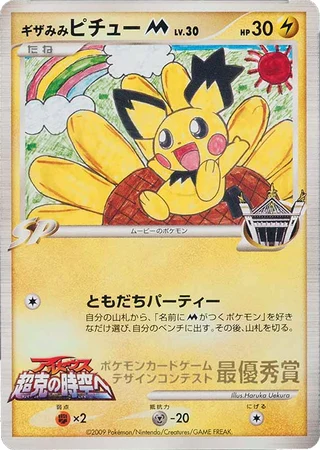
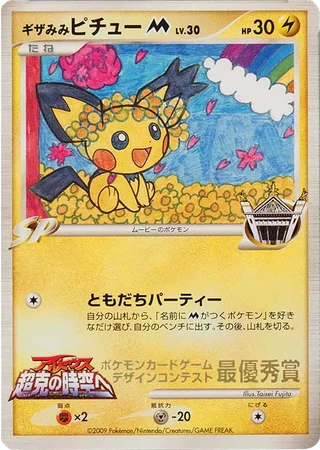
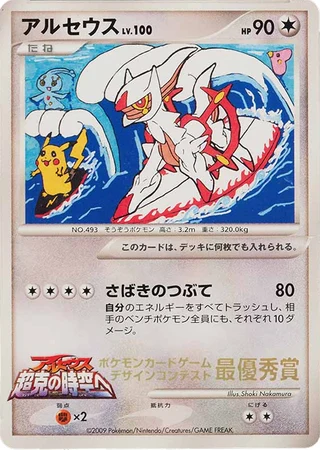
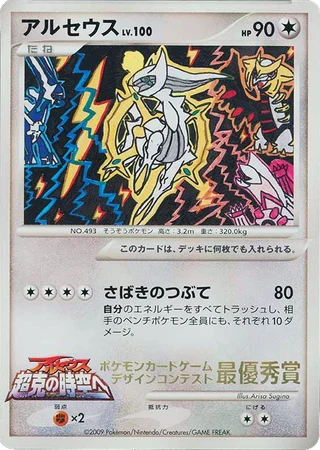
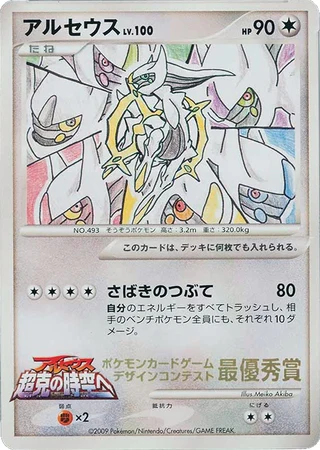
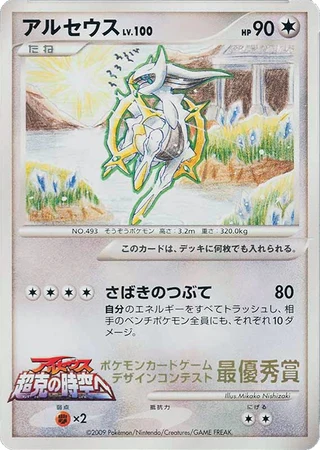
Shogakukan's Pokémon Card Game Design Contest turned each magazine's winning drawing into a real card. In 2009 twelve Shogakukan children's magazines took part; the grade magazines printed the entry form in their April issues (on sale February 28 for grade 1 and March 3 for the others), and children colored or drew over an outline of Spiky-eared Pichu M or Arceus. In 2010 ten magazines ran it with Illusion's Zorua and Illusion's Zoroark, and only four grade magazines were left: the fifth- and sixth-grade titles had closed.
Each winning card carries the film's logo and "Pokémon Card Game Design Contest, Highest Award" in Japanese, with the winner's name as the illustrator credit, and the winners were shown at the start of that summer's film. The announcements promised each winner 100 copies of his or her card, though the 2009 winners may instead have received sets of all the winning designs; one 2010 winner's pack is known to have held 200.
| Year | Card | Magazine | Credit on the card |
|---|---|---|---|
| 2009 | Spiky-eared Pichu M | Shōgaku Ichinensei (grade 1) | Haruka Uekura |
| 2009 | Spiky-eared Pichu M | Shōgaku Ninensei (grade 2) | Taisei Fujita |
| 2009 | Arceus | Shōgaku Sannensei (grade 3) | Shoki Nakamura |
| 2009 | Arceus | Shōgaku Yonensei (grade 4) | Arisa Sugino |
| 2009 | Arceus | Shōgaku Gonensei (grade 5) | Meiko Akiba |
| 2009 | Arceus | Shōgaku Rokunensei (grade 6) | Mikako Nishizaki |
| 2010 | Illusion's Zorua | Shōgaku Ichinensei (grade 1) | Mayumi Fujimura |
| 2010 | Illusion's Zorua | Shōgaku Ninensei (grade 2) | Kousuke Mori |
| 2010 | Illusion's Zoroark | Shōgaku Sannensei (grade 3) | Ryusuke Mori |
| 2010 | Illusion's Zoroark | Shōgaku Yonensei (grade 4) | Kozue Omi |
All 660 prize winners of 2010, across the ten magazines, also received the regular prints of Illusion's Zorua and Illusion's Zoroark. The CoroCoro and CoroCoro Ichiban! winners are in our CoroCoro guide. Our data records no sale of any contest card as of September 24, 2026.
 Spiky-eared Pichu M (Movie's) (Pokemon Card Design Contest 2009)
 Spiky-eared Pichu M (Movie's) (Pokemon Card Design Contest 2009)
 Arceus (Pokemon Card Design Contest 2009)
 Arceus (Pokemon Card Design Contest 2009)
 Arceus (Pokemon Card Design Contest 2009)
 Arceus (Pokemon Card Design Contest 2009)
Telling them apart from their namesakes
Several inserts share a name with promos of the same years, with different art and a different number. The namesakes came from Meiji chocolate, McDonald's, ANA, PokéPark, the Pokémon Center, Battle Road, Pokémon Wonderland, a film half deck, card files, deck cases and other promotions:
| School magazine card | Namesakes, with a different number |
|---|---|
| Mew 091/PCG-P | 069 Meiji, 080 card file, 085 McDonald's (2005); Mew δ 148, Battle Road (2006) |
| Aura's Lucario 092/PCG-P | 075 Meiji, 079 deck case, 090 McDonald's, 093 PokéPark (2005) |
| Sea's Manaphy 150/PCG-P | 139 Meiji, 146 deck case, 147 card file, 154 ANA (2006) |
| Samiya's Buizel 151/PCG-P | 138 Meiji (2006) |
| LaRousse's Munchlax 020/PCG-P | 006/019 of the film's VS Pack and the holo 025, Pokémon Center Tokyo (2004), which share one art |
| Deoxys 017/PCG-P | Sky-Splitting Deoxys 018/PCG-P, Pokémon Wonderland Vol. 2 (2004), also Defense Forme; 011, 019 and 032 show other formes |
Deoxys 017/PCG-P is one of two Defense Forme Deoxys in the PCG-P series. The other, Sky-Splitting Deoxys 018/PCG-P, came with Pokémon Wonderland Vol. 2 on July 17, 2004, with different art, 80 HP instead of 70 and a different attack. The English EX Deoxys 18/107 prints the same art and attacks as 017/PCG-P.
 Deoxys#17/PCG-P
 Sky-Splitting Deoxys#18/PCG-P
 LaRousse's Munchlax#20/PCG-P
 LaRousse's Munchlax#25/PCG-P
Japanese listings are easier to search by number and Japanese name: サトシのキモリ (Ash's Treecko), ハルカのアチャモ (May's Torchic), タケシのミズゴロウ (Brock's Mudkip), ラルースのゴンベ (LaRousse's Munchlax), 波導のルカリオ (Aura's Lucario), 蒼海のマナフィ (Sea's Manaphy) and アクーシャのブイゼル (Samiya's Buizel, Akusha in Japanese). A listing that says only "Manaphy promo" says nothing: ask for a photo of the number.
The magazines today
The magazines closed after their last cards, from the top grade down:
| Title | Grade | Launched | Last issue on sale |
|---|---|---|---|
| Shōgaku Rokunensei | 6 | October 1922 | December 28, 2009 |
| Shōgaku Gonensei | 5 | October 1922 | February 3, 2010 |
| Shōgaku Yonensei | 4 | 1924 | February 3, 2012 |
| Shōgaku Sannensei | 3 | 1925 | February 3, 2012 |
| Shōgaku Ninensei | 2 | 1925 | December 26, 2016 |
| Shōgaku Ichinensei | 1 | 1925 | still published in 2026 |
Shōgaku Ichinensei still bundles Pokémon goods, such as the talking Captain Pikachu alarm clock of its April 2026 issue (on sale February 27, 2026), but no Pokémon card is recorded with a grade magazine since the 2010 contest.
FAQ
How many Pokémon cards came with Shogakukan's school magazines?
25: 15 promos bundled with the grade magazines from February 2003 to August 2006, and 10 design-contest cards, six from 2009 and four from 2010, each printed from one grade's winning drawing.
Which magazines gave the Mew 091/PCG-P?
All six: the August 2005 issues of the second-, fourth- and sixth-grade magazines and the September 2005 issues of the first-, third- and fifth-grade ones. As of September 24, 2026 it sells for $78.53 raw (5 sales) and $13,770 est. (1 sale) in PSA 10.
Is the Shogakukan Deoxys the same card as EX Deoxys 18?
Yes in art and attacks: 017/PCG-P is the Japanese print, EX Deoxys 18/107 the English one. Sky-Splitting Deoxys 018/PCG-P, from Pokémon Wonderland, also shows the Defense Forme but is a different card.
Did the sixth-grade magazine get every card?
No. Shōgaku Rokunensei missed four rounds in a row, from the anime trio of August 2003 to LaRousse's Munchlax in 2004, and got both 2005 cards and all four of 2006.
Does Shōgaku Ichinensei still come with Pokémon cards?
It is still published and still bundles Pokémon goods, but no Pokémon card is recorded with it since the 2010 design contest.
Which other Shogakukan magazines came with Pokémon cards?
Several: CoroCoro Comic and its sister titles (see our CoroCoro guide), Pokémon Fan, the Pokémon Wonderland specials, Weekly Shōnen Sunday, with a Spiky-eared Pichu M 042/DPt-P drawn by Gosho Aoyama in July 2009, and Comic GOTTA, a manga monthly for teenagers that bundled a glossy English Mew with its May 2000 issue and a French Pikachu with its August 2000 issue.
More Japanese promo series: CoroCoro, V Jump, the movie cards and, from Shogakukan's special issues, Pokémon Wonderland.


