
The best Pokémon card price app depends on the card in your hand. For English and Japanese cards, PriceCharting shows years of sold prices for free, back to December 2020 on English cards, and Collectr tracks a whole collection, raw, graded and sealed. For French, German or Simplified Chinese cards, folio.fyi prices each language from its own sales: a French copy sold for a median 1.40 times the English copy of the same card from July to October 2026, a gap that apps built on Cardmarket cannot show, since Cardmarket pools six languages and every condition in one price. folio.fyi's weak point is history: its sales charts begin between August 2025 and March 2026, depending on the card.
We read the pages and store listings of 55 apps and sites on October 19, 2026, and measured on folio.fyi's own sales how much the language of a copy moves its price. folio.fyi is this site: it is in the comparison, with its weak points said as plainly as anyone's.
| App | ||||||
|---|---|---|---|---|---|---|
| PriceChartingweb, iOS, Android | ||||||
| Collectrweb, iOS, Android | ||||||
| TCGplayerweb, iOS, Android | ||||||
| Cardmarketweb only | ||||||
| folio.fyiweb, iPhone | ||||||
| Dexweb, iOS, Android | ||||||
| PokeDataweb, iOS, Android | ||||||
| Card Ladderweb, iOS, Android | ||||||
| PSA appweb, iOS, Android | ||||||
| CollXweb, iOS, Android |
Sold, listed or averaged: what one price means
An app's price is one of three numbers, and which one is the first thing to check.
- Sold prices are what buyers paid. PriceCharting counts completed sales only, shipping excluded, with the grade read from the listing and lots and reproductions removed. TCGplayer's Market Price comes from recent sales on its own marketplace, and folio.fyi takes the median over the shortest of 7, 30 or 90 days that holds enough sales (its method).
- Asking prices are what sellers want, and they run high: in one of TCGplayer's own examples, the median listing was almost twice what copies actually sold for, because cheap copies sell and expensive ones stay listed. Pokellector shows store prices and the average of current listings; SNKRDUNK leads with the lowest listing.
- Marketplace averages are mostly Cardmarket's: its Price Trend, which it describes as a regression over a product's last 28 selling days, and its 1-, 7- and 30-day averages. At least a dozen of the apps we checked import them.
Condition is the second thing to check. TCGplayer filters its sales by condition, from Near Mint to Damaged. PriceCharting's Ungraded price, folio.fyi's ungraded median and Cardmarket's Trend all cover raw copies in whatever condition they sold. Collectr starts from Near Mint and takes fixed cuts for worn copies, 15% for Lightly Played up to 60% for Damaged, so those figures are estimates, not measured prices.
Cardmarket's price: one product, six languages, every condition
Cardmarket files the English, French, German, Spanish, Italian and Portuguese copies of a card as offers on one product. Japanese-numbered cards are other products, which they share with Korean, Traditional Chinese, Indonesian and Thai copies, and Simplified Chinese sets have their own.
Its Price Trend and averages are computed for the whole product. The daily price file it publishes has one row per product, with no field for language or condition. On its product pages, a filter by language, condition or 1st Edition changes the offers and the cheapest price, not the Trend: on April 27, 2026, M Rayquaza EX from Ancient Origins showed a Trend of €757.79 with and without a filter for English Near Mint copies, while the cheapest such copy was offered at €1,600 and the cheapest copy of all, in Poor condition, at €125.99. Slabs sell there as ordinary offers, the grade written in the comment, and 1st Edition copies sit on the same product as Unlimited ones. Reverse holos are the exception, with a Trend of their own (how to tell them apart).
So Cardmarket's Trend is a poor guide to what your own copy is worth: for a French Near Mint card it blends six languages, every condition from Mint to Poor, and some slabs, and an app built only on Cardmarket shows you that blend. Collectr uses Cardmarket, with other sales data, for users set in Europe; Dex, PokéCardex and many scanner apps import it too. folio.fyi uses it in two cases only, both labeled on the card page: cards worth under $3, which sell for a median of $0.21, and a card with no recorded sale yet. Neither counts toward a portfolio's value.
Same card, other language, other price
The same card does not sell for the same price in every language. We compared, on folio.fyi's sales, the French or German copy of each card with the English copy of the same card, over the same 90 days, from July 14 to October 12, 2026. To keep the comparison clean, the French and German medians count only sales whose listing shows the copy's language, by its local name or a mention of the language; a card needed at least ten such sales, or five in the second view, and its English copy at least ten sales.
French copies sold for a median 1.40 times the English copy of the same card, and for more on 84% of the 288 cards. German copies sold close to the English price at the median (1.03 times), but 41% of them sold for more than 1.25 times or less than 0.8 times the English price. As a yardstick, two halves of one card's own sales differ that much on 11% of cards. The gap shrinks as prices rise: French copies fetched a median 1.67 times the English price on the 107 cards whose English copy sold for under $5, but 1.16 times on the 15 above $100; above $100, German copies sold for less than the English copy on 17 of 19 cards. Italian copies are left out: Italian prints keep the English Pokémon names, so few listings show that a copy is Italian. The two languages also sell in different places, an English copy's price mostly reflects the US market and a French copy's the European one, so the gap measures what a copy of that language sells for: what yours can fetch when you sell it.

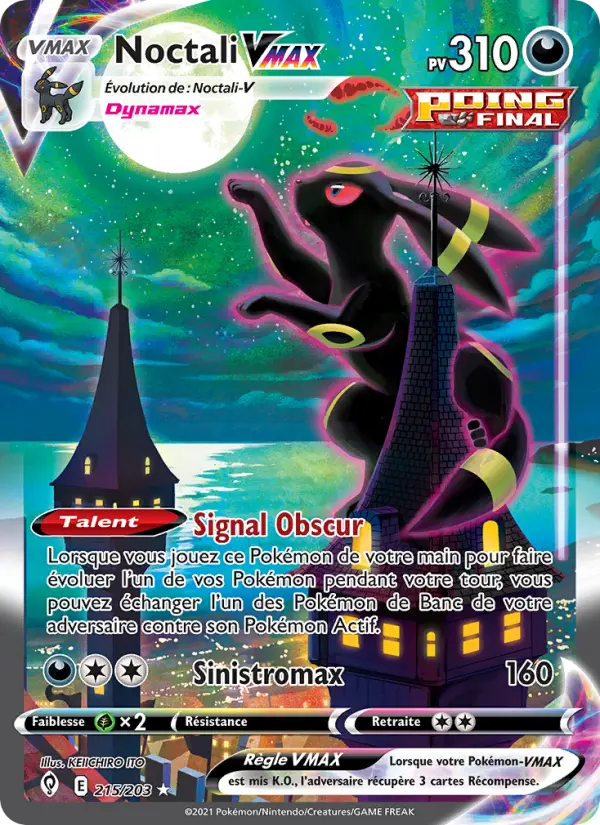
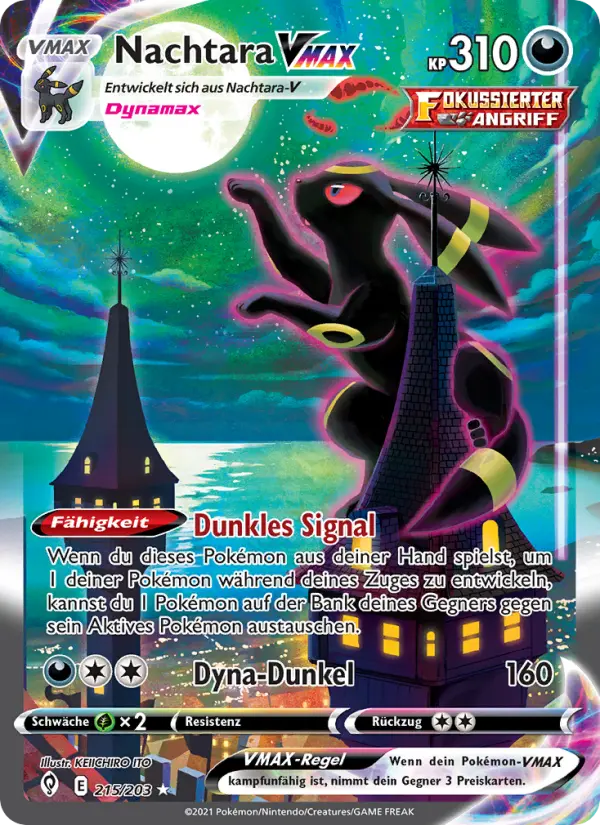
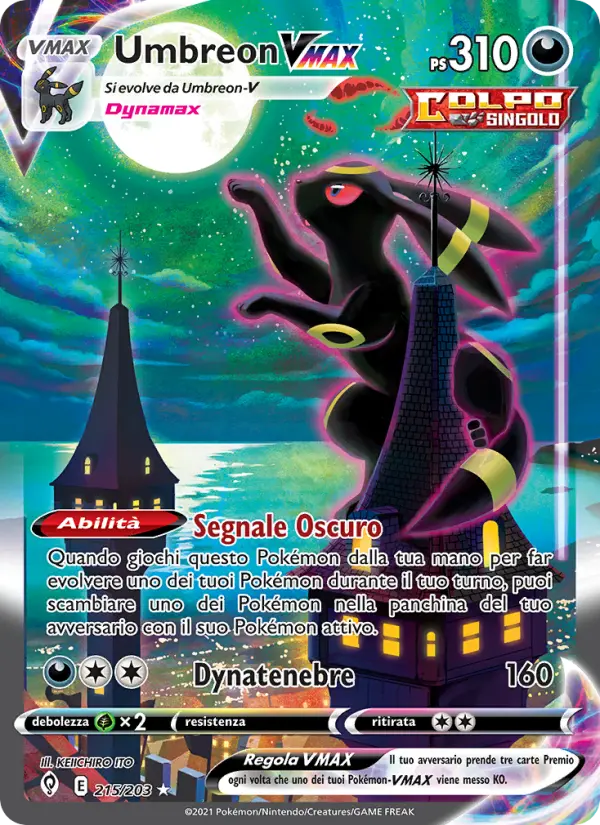
Medians of the last 90 days as of October 19, 2026, in US dollars; the number of sales is in parentheses. The French and German columns count only sales whose listing shows the copy's language, without slabs or reprints filed under the same card; a card page's own price also counts sales whose listing does not show the language, over the shortest window with enough sales, so it can differ.
| Card | English | French | German |
|---|---|---|---|
| Umbreon VMAX 215/203, Evolving Skies | $1,959 (122) | $1,557 est. (2) | $677 (8) |
| Umbreon ex 161/131, Prismatic Evolutions | $1,226 (251) | $810 (10) | $813 (14) |
| Mega Charizard X ex 130/094, Phantasmal Flames | $291 (177) | $324 (16) | $252 (21) |
| Pikachu 160/159, Crown Zenith | $45 (479) | $79 (15) | $51 (37) |
| Charizard ex 199/165, 151 | $340 (409) | $360 (19) | $329 (42) |
| Charizard 4/102, Base Set | $321 (428) | $235 (29) | $245 (46) |
Which languages each app prices
Most apps are built for English cards and add Japanese; few give a European-language copy a price of its own. In early October 2026, PriceCharting's 302 Pokémon sets were English, Japanese, Chinese and Korean. TCGplayer prices English cards and, since October 2024, a separate Japanese line. Dex groups six European languages in one "International" region, and TCG Collector says plainly that a card's language has no effect on its price calculation. PokéItem gives each language the lowest Near Mint offer on Cardmarket in that language, an asking price, plus its own index.
| App | ||||||||||
|---|---|---|---|---|---|---|---|---|---|---|
| PriceCharting | ||||||||||
| Collectr | ||||||||||
| TCGplayer | ||||||||||
| Cardmarket | ||||||||||
| folio.fyi | ||||||||||
| Dex | ||||||||||
| PokeData | ||||||||||
| TCG Collector | ||||||||||
| PokéCardex | ||||||||||
| Cardzia | ||||||||||
| PokéItem | ||||||||||
| SNKRDUNK |
How far back the price history goes
History is folio.fyi's weak point. Card Ladder says its database holds every public sale back to 2000, but it is built for sports cards and does not say how far back its Pokémon sales go. On Base Set Charizard, PriceCharting's chart starts in December 2020, a month before it added Pokémon cards; its Japanese sets came in May 2022. Collectr advertises "up to 5+ years". On the same card, folio.fyi's sales chart starts in February 2026; on the cards we checked, its sales charts begin between August 2025 and March 2026, with few sales a week before spring 2026, and the free plan shows the last three months. Dex keeps none, and a Cardmarket product page charts only its last 30 selling days.
What the apps cost
Most of these apps are free to use, with a paid plan for history, alerts or unlimited scans. On the US App Store on October 19, 2026, the cheapest monthly plans ran from $3.99 (Dex+) to $19.99 (Card Ladder Pro). folio.fyi's Premium costs $4.99 a month or $39.99 a year, and its free plan already shows every language's prices.
The apps, one by one
folio.fyi. This site, built around what the others miss: a price of its own for each card language. It follows six languages, English, Japanese, French, German, Italian and Simplified Chinese, each its own catalog: 123,177 Pokémon cards on October 12, 2026, in 225 English sets, 366 Japanese, 176 French, 132 German, 128 Italian and 53 Simplified Chinese, with more than 2,000 English and 2,700 Japanese promo cards. Every card worth $3 or more is priced from its own completed sales, language and printing apart, 1st Edition and reverse holo on their own: 84% of those cards had a sales price on October 12, 2026. It holds over 130,000 graded prices across its games, grader by grader and grade by grade, with the graders' population counts. Cards under $3, about six in ten, show Cardmarket's monthly trend, labeled; they sell for a median of $0.21. Weak points: a short history, with sales charts that begin between August 2025 and March 2026 depending on the card; ungraded copies are not split by condition; the iPhone app came out in October 2026, and there is no Android app yet. Free with three months of history and three price alerts; Premium $4.99 a month or $39.99 a year.
PriceCharting. The reference for English and Japanese cards with history. It counts completed sales from eBay and its own marketplace, with TCGplayer sales added since December 2025, which mostly lowered the values of common cards; it removes lots, reproductions and outliers, and reads the grade from the listing. It prices grades 1 to 10, with separate 10s for PSA, BGS, CGC, SGC, TAG and ACE; below 10, sales from different graders share a column, and Ungraded covers raw copies in any condition. Free account; Collector plan $5.99 a month in the app.
Collectr. Of the card apps we checked, the one with the most ratings on the US App Store: 68,154 on October 19, 2026. It values raw, graded and sealed items across more than 20 games, with a scanner and a portfolio chart. Prices come, in its words, "depending on the product" from TCGplayer, eBay or Cardmarket, and refresh every one to two days. Free; PRO $59.99 a year, or $7.99 a month in the app.
TCGplayer. The US marketplace's own free app, owned by eBay since 2022. Its Market Price comes from recent sales on TCGplayer, by printing and condition. Graded cards and copies in languages other than English and Japanese sell as listings with photos, which get no Market Price.
Cardmarket. The European marketplace has no official app. It is the place to see what is offered in each language and condition; read its Trend as a figure for the whole product.
Dex. A free, tidy tracker: every card, folders, and TCGplayer, Cardmarket, CardTrader and eBay prices side by side. It keeps no price history, tracks raw cards only and no sealed products. Dex+ adds the scanner and CSV export for $3.99 a month.
PokeData. A Pokémon price guide that shows sold listings next to TCGplayer and Cardmarket prices, with PSA and CGC prices. Six months of prices are free; Gold, $8 a month, lifts the limit and adds PSA population history.
PokemonPriceTracker. A price site and data API for more than 50,000 English and Japanese cards, from TCGplayer, eBay, Fanatics Collect and Cardmarket prices, with PSA, CGC, BGS and SGC grades. Three days of history free; paid plans from $9.99 a month.
Card Ladder, PSA and 130point. The references for slabs (how the graders compare). Card Ladder is a sales database built for sports cards that covers Pokémon too, with over 100 million sales across every category; Pro costs $20 a month. PSA's free app shows price estimates, and its auction prices list over 5 million results of PSA-graded items. 130point searches individual sold items across eBay, Goldin, Heritage and other auction sites, and computes no price.
CollX and Ludex. Scanners built for sports cards that read Pokémon cards too. CollX prices a card from the median of its last 10 sales within six months; Ludex from completed sales on eBay and other marketplaces. Neither says which Pokémon languages it covers.
The scanner wave. HoloDex, Card Value Scanner, Acorn TCG and FoilSnap, all launched since 2023, have between 14,000 and 25,000 US ratings each. Most name TCGplayer and Cardmarket as their price sources or name none, and several sell weekly plans (HoloDex: $4.99 a week).
In France: PokéCardex, Cardzia and PokéItem. On October 19, 2026, they were the three card apps in the top 25 of the French App Store's Reference chart. PokéCardex follows Cardmarket and TCGplayer prices; Cardzia says it uses real sales "on each language's market", without naming them or publishing a method; PokéItem shows the lowest Near Mint offer on Cardmarket in each language, next to its own index.
In Japan and China. Japanese prices are read on marketplaces, SNKRDUNK, Mercari and magi, and on shop buy and sell lists; SNKRDUNK leads with the lowest listing by condition and shows its sales history after a free sign-up. In mainland China, Jihuanshe (集换社) computes a price from its own orders.
How we compared
We read each service's own site, help pages and store listings on October 19, 2026, and earlier copies of the pages a security check kept us from loading. We created no account, started no trial and bought nothing. The language comparison uses folio.fyi's own sales; its method is described with the chart.
FAQ
What is the most accurate Pokémon card price app?
No app is the most accurate for every card. Prices built on completed sales, such as PriceCharting's, TCGplayer's Market Price and folio.fyi's, come closer to what a card fetches than asking prices, but each is only as precise as what it pools: languages on Cardmarket, conditions in most raw prices, graders below 10 on PriceCharting. Cards that rarely sell add a limit of their own: with five sales, the true median lies between the cheapest and the most expensive sale 94% of the time.
Is PriceCharting accurate?
For English and Japanese cards that sell regularly, yes: it counts completed sales only, removes lots and reproductions, and reviews outliers by hand. Its Ungraded price covers every raw condition, its grades below 10 pool graders, and it has no French, German or Italian sets.
Are Collectr prices accurate?
Collectr's prices come from TCGplayer, eBay or Cardmarket depending on the product and your region, refreshed every one to two days. Its worn-condition values are fixed cuts from Near Mint, not measured prices. In Europe its prices come from Cardmarket alongside eBay data, and Cardmarket pools six languages and every condition.
Which app has prices for Japanese Pokémon cards?
PriceCharting (118 Japanese sets in early October 2026), TCGplayer's Japanese line, Collectr, Dex, PokeData and folio.fyi (366 Japanese sets on October 19, 2026) all price Japanese cards; in Japan, collectors read SNKRDUNK, Mercari and the shops' buy lists. Cardmarket prices a Japanese card together with its Korean and Traditional Chinese copies.
Is there an official Pokémon card price app?
No. The Pokémon Company publishes no prices for cards on the secondary market, and its collection app, the Pokémon TCG Card Dex, closed on September 20, 2023; none of the apps in this comparison is made by The Pokémon Company.
Is there a free Pokémon card price app?
Yes. TCGplayer, Rare Candy and PSA's app are free, and PriceCharting, Collectr, Dex, PokeData and folio.fyi have free plans with prices; paid plans add history, alerts or unlimited scans.
Why does every app show a different price for the same card?
They read different markets, the US marketplace, Europe's or sales worldwide, and different numbers, sold, asked or averaged, over different windows. They also pool languages, conditions, editions and grades differently: a single Cardmarket Trend covers six languages and every condition.


