
Usually, yes. We compared 377 cards sold in both languages, each English card against the Japanese print of the same card, and the Japanese print was cheaper on 288 of them; at the median it cost 71% of the English price, as of September 24, 2026. The gap is widest on the cards collectors chase most: a Japanese Special Illustration Rare (SAR) cost 42% of its English twin at the median, an Illustration Rare (AR) 59%. Full-art Ultra Rares cost about the same in both languages, and the gold Mega Ultra Rares (MUR) usually cost more in Japanese.
Japanese against English, rarity by rarity
| Rarity (Japanese code) | Pairs | Japanese cheaper | Japanese price as a share of English, median |
|---|---|---|---|
| Special Illustration Rare (SAR) | 89 | 80 | 42% |
| Illustration Rare (AR) | 93 | 84 | 59% |
| Hyper Rare, gold (UR) | 7 | 5 | 70% |
| Mega Attack Rare (MA) | 7 | 7 | 76% |
| Double Rare (RR) | 82 | 61 | 88% |
| Ultra Rare, full art (SR) | 92 | 49 | 95% |
| Mega Hyper Rare, gold (MUR) | 7 | 2 | 138% |
| All pairs | 377 | 288 | 71% |
Medians of real completed sales, raw and ungraded, as of September 24, 2026. The pairs: the cards of Double Rare and above in eight English sets, Mega Evolution to Pitch Black (September 2025 to July 2026), 151 and Prismatic Evolutions, each matched to its print in the Japanese expansion that set carries, wherever both prints have a price. Each price counts only sales of that language's print. Limited to the 302 pairs whose two medians both come from sales in the 30 days to September 24, the result barely moves: 41% on Special Illustration Rares, 58% on Illustration Rares, 71% overall.
The saving is real money only at the top. At the median, the Japanese print saves $20.17 on a Special Illustration Rare, $2.07 on an Illustration Rare and $0.23 on a Double Rare.
The same card in both languages
| Card (English set / Japanese set) | English | Japanese |
|---|---|---|
| Umbreon ex, Special Illustration Rare (Prismatic Evolutions / Terastal Festival ex) | $1,192 (22 sales) | $350 (7 sales) |
| Mega Gengar ex, Special Illustration Rare (Ascended Heroes / MEGA Dream ex) | $795 (12 sales) | $268 (5 sales) |
| Mega Charizard X ex, Special Illustration Rare (Phantasmal Flames / Inferno X) | $683 (16 sales) | $615 (12 sales) |
| Pikachu ex, Special Illustration Rare (Ascended Heroes / MEGA Dream ex) | $313 (6 sales) | $188 (5 sales) |
| Charizard ex, Special Illustration Rare (151) | $307 (24 sales) | $359 (6 sales) |
| Mega Darkrai ex, Special Illustration Rare (Pitch Black / Abyss Eye) | $184 (34 sales) | $132 (8 sales) |
| Pikachu, Illustration Rare (151) | $74.90 (24 sales) | $30.93 (23 sales) |
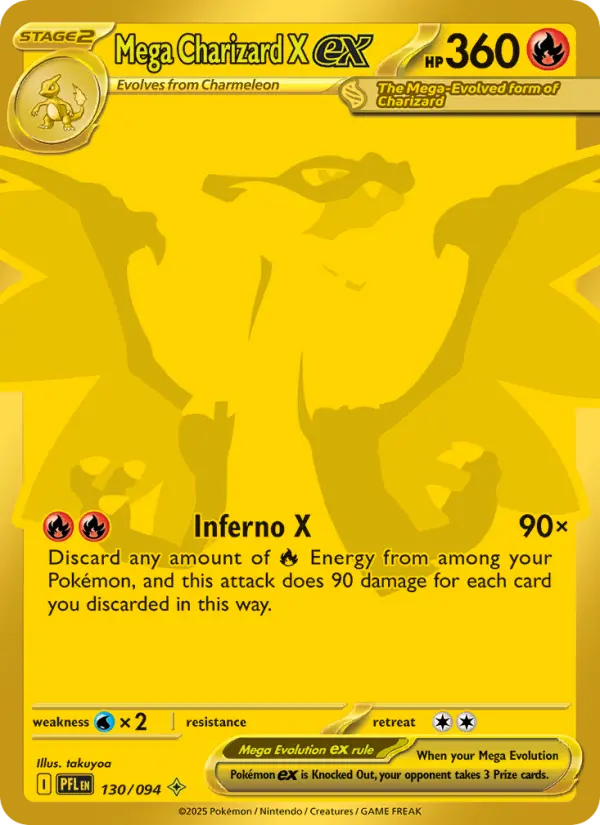
| Mega Charizard X ex, gold (Phantasmal Flames / Inferno X) | $248 (7 sales) | $701 (4 sales) |
| Mega Lucario ex, gold (Mega Evolution / Mega Brave) | $220 (13 sales) | $167 (8 sales) |
| Mega Greninja ex, gold (Chaos Rising / Ninja Spinner) | $145 (12 sales) | $422 (15 sales) |
Medians of real completed sales, raw and ungraded, as of September 24, 2026.



Where the Japanese card costs more
The Japanese print cost more on 86 of the 377 pairs, half of them full-art Ultra Rares. The exceptions follow no single rule. The gold Mega Ultra Rares cost more in Japanese on five pairs of seven. 151 is the one set of the eight where the chase cards reverse: six of its seven Special Illustration Rares, Charizard ex included, sold for more in Japanese.
The gap also depends on the set. Prismatic Evolutions is where buying Japanese saves the most: its Japanese twins, from Terastal Festival ex, cost 33% of the English price at the median. Perfect Order and Chaos Rising sit near parity, at 94% and 98%.
The likeliest reasons are supply and demand. At retail, a Japanese pack costs ¥200 for 5 cards, about $1.27 at the September 24, 2026 rate or 25 cents a card, against $4.49 for 10 cards in English, 45 cents a card. And outside Japan, English cards can be played at Play! Pokémon tournaments and Japanese cards cannot, which keeps demand for the English print higher.
Vintage: the first set
The first set points the same way, on thinner evidence. On 15 of the 16 Base Set holos, English Unlimited against the Japanese Expansion Pack of 1996 (Machamp is left out: its English holo exists only with a 1st Edition stamp), the Japanese copy sold for less on 11, at 83% of the English price at the median, but on one to six Japanese sales each, with the first Japanese print and later ones counted together. Four cost more in Japanese, Charizard among them: $308 (4 sales) against $209 in English (87 sales), as of September 24, 2026. English 1st Edition and Shadowless copies are a separate and dearer market.
Do Japanese cards grade better?
At CGC, usually. Of our 377 pairs, 315 have been graded there in both languages, and the Japanese print received a 10 (Gem Mint or Pristine) more often on 226 of them, in population counts of September 1, 2026: at the median, 74.5% of graded Japanese copies against 62.5% of English ones. Illustration Rares and the seven Mega Attack Rares are the exceptions: there, the English print received a 10 slightly more often. Graders only see the copies collectors choose to send, so this measures submitted cards, not every card printed.
Is it worth buying Japanese?
- Yes, for Special Illustration Rares and Illustration Rares you collect for the art: the Japanese print costs 42% to 59% of the English one at the median, and the saving grows with the price of the card.
- No, for cards under a few dollars: postage from Japan, a proxy or seller fee, and import duty or VAT where you live can erase a $2 saving.
- No, for gold Mega Ultra Rares and 151's chase cards: the English print is usually the cheaper one.
- No, if you play: Japanese cards are not allowed at Play! Pokémon tournaments (below).
In Japan itself, Pokémon Centers sell at list price, and most remove the shrink film from booster boxes at the counter. Pokémon Center Online delivers only within Japan, and it sells the 30th CELEBRATION box by lottery: entries closed on September 16, 2026. The stores are listed in our guide to Pokémon Centers around the world, and those of the capital in Pokémon in Tokyo. What each Japanese pack and box holds is in our guides to cards per pack and packs per box.
Can you play Japanese cards in tournaments?
Not at Play! Pokémon tournaments. Their rules, revised September 1, 2026, treat Japanese cards as marked because their back differs from that of every other Pokémon card, and marked cards may not be played; no rating zone lists Japanese among its legal languages either. A deck may mix languages only if all the backs match, which rules out Japanese. Casual games are up to the players. The two backs are compared in our guide to the Japanese Pokémon card back.
How Japanese sets line up with English ones
A Japanese set comes out first, and its cards reach English about two months later. In 2026, Perfect Order arrived 9 weeks after Nihil Zero, Chaos Rising 10 weeks after Ninja Spinner and Pitch Black 8 weeks after Abyss Eye; Delta Reign follows Storm Emeralda by 14 weeks, on November 6, 2026. Of the 2026 sets, only 30th Celebration came out on one day in both languages, September 16, 2026. Perfect Order, Chaos Rising and Pitch Black each carry a single Japanese set and are within seven cards of its size: Perfect Order has 124 cards, Nihil Zero 117. The full calendar is in Pokémon set release dates.
Japan also hands out cards through channels of its own: magazines such as CoroCoro, convenience-store campaigns such as 7-Eleven's and the promo packs of its Pokémon Card Gyms. The traffic rarely runs the other way. Dark Raichu, made by Wizards of the Coast for the English Team Rocket set of April 2000, was the first secret rare and the first card released outside Japan before it came out in Japan; its Japanese print followed in Crossing the Ruins... in July 2000.
Reading a Japanese rarity code
A Japanese card prints its rarity as a letter code right after the collector number, a system in use since the Black & White sets of December 2010. Since the Sun & Moon sets (December 2016), that line sits at the bottom left, after the regulation mark and the set code; before, it sat at the bottom right. A number above the set total, such as 075/063, marks a secret rare before you even read the code. Beware SR: it is the ordinary full art, the English Ultra Rare, while the gold card is UR.
| Code | Japanese name | English equivalent |
|---|---|---|
| C, U, R | Common, Uncommon, Rare | Common, Uncommon, Rare |
| RR | Double Rare | Double Rare (a regular Pokémon ex; a Pokémon GX or V in older sets) |
| AR | Art Rare | Illustration Rare |
| SR | Super Rare | Ultra Rare (full art) |
| SAR | Special Art Rare | Special Illustration Rare |
| UR | Ultra Rare | Hyper Rare, the gold card (a gold secret rare in Sun & Moon and Sword & Shield sets) |
| MUR | Mega Ultra Rare | Mega Hyper Rare, the gold card of Mega Evolution sets |
| MA | Mega Attack Rare | Mega Attack Rare |
| FUR | Futuristic Rare | Futuristic Rare (30th Celebration, 2026) |
| ACE | ACE SPEC, printed in pink | ACE SPEC Rare |
| BWR | Black White Rare | Black White Rare |
| S | Shiny | Shiny Rare |
| SSR | Shiny Super Rare | Shiny Ultra Rare |
| RRR | Triple Rare | VMAX and VSTAR cards (Sword & Shield) |
| HR | Hyper Rare | Rainbow secret rare (Sun & Moon, Sword & Shield) |
| CHR, CSR | Character Rare, Character Super Rare | Trainer Gallery cards (2022); in 2019, Cosmic Eclipse secret rares 237 to 248 |
 075/063 AR: an Art Rare numbered past the set's 63 cards, after the regulation mark I and the set code SV9a (Arven's Greedent, Heat Wave Arena, 2025).
 089/063 SAR: a Special Art Rare, the Japanese Special Illustration Rare (Ethan's Adventure, same set).


Every symbol, English and Japanese, is shown in our Pokémon card rarity guide.
FAQ
Are Japanese Pokémon cards worth less than English ones?
On most recent cards of Double Rare and above, yes: 288 of the 377 Japanese prints we compared sold for less than the English print of the same card, as of September 24, 2026. Full-art Ultra Rares sell for about the same, and gold Mega Ultra Rares usually for more.
Why are Japanese Pokémon cards cheaper?
The likeliest reasons: Japanese packs cost about 25 cents a card at retail against 45 cents in English, and outside Japan, English cards can be played at Play! Pokémon tournaments while Japanese cards cannot, which keeps demand for the English print higher.
Can you use Japanese Pokémon cards in tournaments?
Not at Play! Pokémon tournaments: their rules treat Japanese cards as marked because their back differs from every other language's. Casual games are up to the players.
What is the Japanese equivalent of a Special Illustration Rare?
SAR, Special Art Rare. The Illustration Rare is AR, the gold Hyper Rare is UR, and the gold card of the Mega Evolution sets is MUR.
Are Japanese Pokémon cards better quality?
At CGC, they receive top grades more often: of our 377 pairs, 315 were graded there in both languages, and the Japanese print received a 10 more often on 226, as of September 1, 2026. That counts the copies collectors chose to send, not every card printed.
How much is a Japanese Pokémon booster pack?
A standard pack costs ¥200 including tax for 5 cards in sets released since May 2026 (¥180 before), about $1.27 at the September 24, 2026 rate. A High Class Pack of 10 cards costs ¥550, and a 30th CELEBRATION pack of 6 foil cards ¥360.


