
The Japanese Pokémon card back used since July 2001 has a gold border, a pastel rainbow burst behind the Poké Ball and seven colored Energy orbs. The English back, which every other language in print uses, has a dark blue border, a white swirl and no orbs. They are two different illustrations, not two shades of one.
Japanese cards have had two standard backs. The first, with POCKET MONSTERS arched over the Poké Ball, lasted until 2001; the current one arrived in July 2001, and Pokémon Card VS, released July 19, 2001, was the first expansion to carry it. A card whose back reads POCKET MONSTERS was released before then.
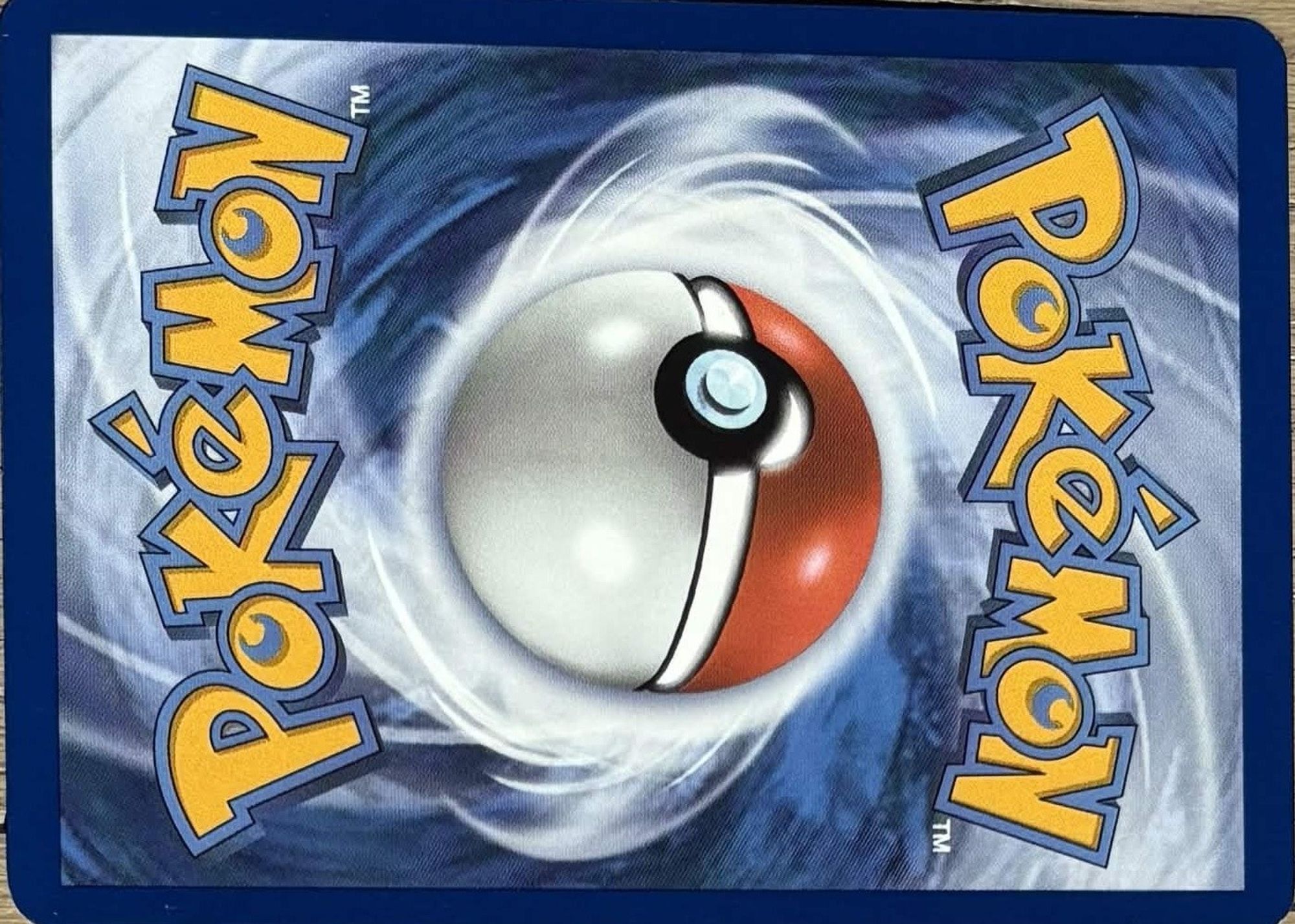 The English back, shared by every language in print except Japanese: no gold, no orbs. Photo: folio.fyi.
Japanese back versus English back
The border color is the tell you can see across a room; the rest confirms it.
| Japanese, since July 2001 | Japanese old back, 1996 to 2001 | English and every other language | |
|---|---|---|---|
| Border | Gold | None: the navy design runs to the edge, with a thin red line just inside it | Dark blue |
| Background | Pastel rainbow burst on dark blue | Navy, pale beams radiating from the ball | White swirl on blue |
| Text | Pokémon logo at the top and, upside down, at the bottom, with a registered mark | POCKET MONSTERS arched above the ball, CARD GAME on a gold ribbon below | Pokémon logo at the top and, upside down, at the bottom, with a trademark sign |
| Poké Ball | Glossy, tilted to show its white half, silver button at the top | Painted, cream lower half, large brass button | Outlined and shaded, red half up, pale blue button on the left |
| Energy orbs | Seven | None | None |
| Copyright text | None | Three red lines at the bottom, dated 1996 | None |
The seven orbs read clockwise from the top left: Grass, Lightning, Psychic, Fighting, Water and Fire, with Colorless, a white orb with a star, below the ball. They are the seven types the game launched with in 1996, which is why Darkness, Metal, Dragon and Fairy are missing. The English back has kept one illustration since 1999, its shades of blue drifting from print to print.
Dating a Japanese card, step by step
Read the back. POCKET MONSTERS arched over the ball means a card released from 1996 to 2001; a gold border with seven orbs means July 2001 or later. Anything else is a special back (below) or not a Japanese card.
For an old back, find the set. Expansion Pack cards (1996) carry no set symbol, and the print run collectors take to be the first has no rarity symbol either. The table further down lists the old-back sets and decks.
For a gold back, read the bottom of the front. A 1st Edition mark dates a card to Pokémon Card VS (2001) or later, since Japanese 1st Edition prints began there; a set code such as DP1 or BW1 appears from 2006, and a regulation mark from the Sun & Moon sets of December 2016.
Look for a reprint. Old artwork on a gold back is a reprint: Pokémon Web (October 2001) reprinted cards of the first four expansions, the Expansion Pack 20th Anniversary set (September 16, 2016) the 1996 cards in an updated layout, and the 30th CELEBRATION set (September 16, 2026) six old-back cards, described below.
The old back, 1996 to 2001
Collectors call it kyūura, the old back. The Pokémon Company named it the First Design in a 2016 trade-in campaign: any 20 Japanese cards with this back could be traded for a reprint of the Trade Please card plus a Pikachu or a Charizard promo.
Its text is in English: POCKET MONSTERS, CARD GAME and the copyright lines are all in Latin letters. No standard Japanese back, old or new, carries Japanese script; the special backs of a 2021 staff deck, below, are an exception.
The copyright block is itself a tell: three lines of small red type reading ©1996 NINTENDO inc., then ©1996 GameFreak inc. and ©1996 Creatures inc., then All Rights reserved. Neither current back carries a copyright line.
When the back changed: July 2001
The publisher's own 25th-anniversary chronicle records the change in one line, dated July 2001. Pokémon Card VS, released July 19, 2001 with 151 cards, was the first expansion with the new back, and every Japanese expansion since has used it, starting with Pokémon Web in October 2001. The last expansion with the old back was Darkness, and to Light, on April 20, 2001.
The change did not unify the backs: a Japanese card printed in 2026 still has a gold border and seven orbs that no English card has. And the date is July 2001, not the first e-Card expansion of December 2001.
Which cards have the old back
Our catalog counts 1,246 Japanese cards in 27 named sets and decks with the old back, from Expansion Pack (October 20, 1996) to Darkness, and to Light (April 20, 2001). The list covers every named set and deck in our catalog, so you can check a card by its set:
| Series | Sets and decks | Released |
|---|---|---|
| Original | Expansion Pack, Pokémon Jungle, Mystery of the Fossils, Rocket Gang | October 1996 to November 1997 |
| Gym | Leaders' Stadium, Challenge from the Darkness, six Gym decks | April 1998 to June 1999 |
| Vending Machine | Series 1, 2 and 3, peeled from sheets | March to November 1998 |
| Neo | Gold, Silver, to a New World; Crossing the Ruins; Awakening Legends; Darkness, and to Light | February 2000 to April 2001 |
| Others | Southern Islands, four Intro Packs, three Neo Premium Files | July 1999 to April 2001 |
Promos do not date by set: our catalog files 558 early Japanese promos under two collections whose date is a placeholder, so check the back of a promo itself.
 BulbasaurNo. 001
 Nidoran♀No. 029
 CharmanderNo. 004
 Brock's ZubatNo. 041
 Oddish
 Falkner's Pidgeot (1st Edition)#1
Reprints normally carry the back of their own date. The Japanese 30th CELEBRATION set of September 16, 2026 reprints six old-back cards, the 1996 Charizard and Shining Celebi among them, with the current gold back, a 30th anniversary logo on the art and a glittering gold border, so the back tells the reprint from the original at a glance.
Special backs
A few Japanese cards carry a back that is neither standard design. The best known:
- Ancient Mew has a back of its own: gold holofoil crossed by a dark blue maze of angular glyphs, with a Poké Ball at the center and seven colored gems. The Japanese card came in the pamphlet of the second Pokémon movie, sold at cinemas from July 17, 1999 (the film known in English as The Power of One); its first print misspells the copyright as Nintedo, and Japan printed it again in 2019.
- Trade Please, from a 1998 mail-in campaign, has the old back printed entirely in holofoil. It and Ancient Mew are the only two cards with a holofoil back; the 2016 reprint of Trade Please does not have one.
- Vending Machine Series 3 (November 24, 1998) added one special card to each sheet, 17 in all, most of them gag cards, rule variants or deck ideas, printed with a non-standard back.
- The 25th Anniversary Creatures deck (December 2021), 30 cards given to illustrators and staff rather than sold, carries on each back a note on one year of Creatures' history or an excerpt from an interview, in Japanese.
No genuine paper card has a metallic gold or chrome back.
Does the back prove a card is real?
Not on its own. Good fakes of both Japanese backs have passed a quick look and given themselves away only under close inspection, so compare the card with a genuine back of the same era, small print first:
- The copyright lines. On a fake they can print fuzzier and sit slightly off position. On a genuine old back, the A of All Rights reserved just touches the edge of the pale beam behind it.
- The lettering. POCKET MONSTERS, CARD GAME and the Pokémon logos are crisp on a genuine back; fakes printed from scans soften them, and on a current back a fake's whole print can look fuzzier under a loupe.
- The front. Check it as well: every card of the four Neo expansions carries a set symbol, and a fake's outlines, fonts, spelling and colors drift from the genuine card's.
Two traps remain. A fake front glued onto a genuine card keeps a genuine back, but shows extra layers in the cut edge and a thicker card. And the light test is only a first screen: genuine Japanese cards can show a blue-gray core, and card stock has changed over the years. No single test settles it; our guide to spotting a fake Pokémon card gives the full method, and a valuable card still in doubt belongs with an authentication service.
Does the back affect the grade?
Only when it is far off center: each of the three large graders allows more on the back than on the front.
| Grade | Front centering | Back centering |
|---|---|---|
| PSA 10 | 55/45 | 75/25 |
| PSA 9 | 60/40 | 90/10 |
| PSA 8 | 65/35 | 90/10 |
| CGC Gem Mint 10 | 55/45 | 75/25 |
| BGS Pristine 10 | 50/50 | 60/40 |
| BGS Gem Mint 9.5 | 50/50 one way, 55/45 the other | 60/40 |
| BGS Mint 9 | 55/45 | 70/30 |
| BGS NM-Mint 8 | 60/40 | 80/20 |
Tolerances as the graders published them in 2026.
At PSA, the back alone costs more than the step from 10 to 9 only when it is worse than 90/10. Beckett is stricter on backs than PSA, with 60/40 for its two top grades, and CGC's Gem Mint 10 matches PSA's 10, its Pristine 10 asking for 50/50.
What the back cannot tell you
- The language, beyond Japanese. A blue back means any language but Japanese, including the Korean, Chinese, Thai and Indonesian prints built from Japanese sets. Not every other card is blue-backed, though: Korean cards of 2004 were printed with the Japanese back, and a few English cards have backs of their own, among them Ancient Mew, the World Championships decks and the 1999 Trainer Decks A and B.
- The size. Japanese and English cards are the same 63 x 88 mm, as our card dimensions guide explains. The "Japanese size" printed on some sleeve boxes is the smaller Yu-Gi-Oh! format, too tight for any Pokémon card.
- Whether it can be played. No old-back card is legal in any of Japan's three official formats as of September 24, 2026: the widest, Hall of Fame, starts with the Diamond & Pearl series of 2006, plus a list of older Trainer and basic Energy cards that goes back only to the ADV series of 2003.
- What it is worth. For how Japanese prices compare with English ones, see our guide to Japanese Pokémon cards.
FAQ
What is an old back Pokémon card?
A Japanese card released from 1996 to 2001, before Pokémon Card VS, whose back shows POCKET MONSTERS arched over the Poké Ball and CARD GAME on a ribbon below. Collectors call it kyūura; the publisher calls the design the First Design.
Can you use Japanese cards in Pokémon tournaments?
Not at Play! Pokémon events: their rules, revised September 1, 2026, count Japanese cards as marked because their back differs from every other language's. Japan's own official events use them, though no current Japanese format admits old-back cards.
Do Japanese 1st Edition cards have the old back?
No. Japanese 1st Edition prints began with Pokémon Card VS and Pokémon Web in 2001, after the change, so no old-back card carries a Japanese 1st Edition mark.


