
17 cards
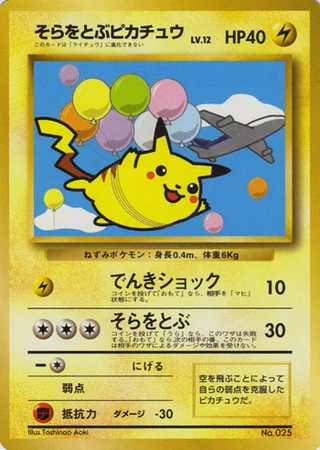
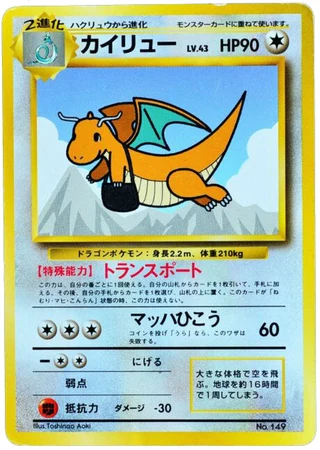
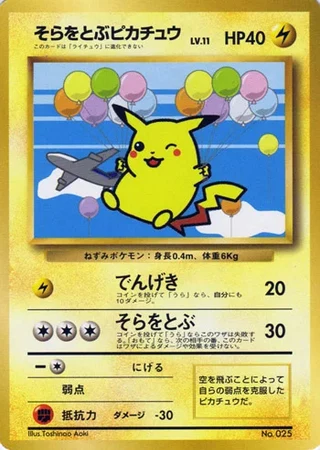
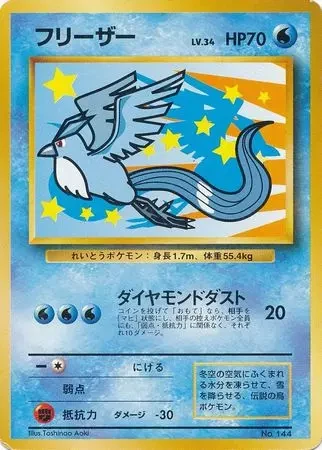
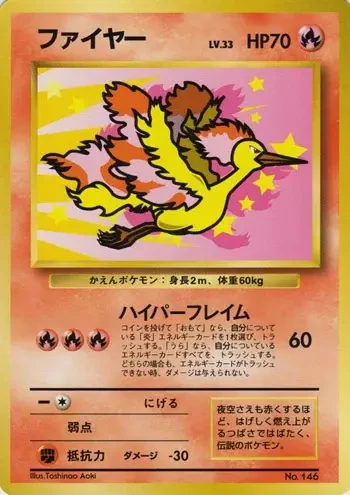
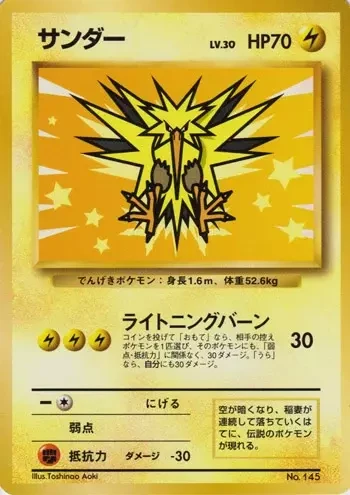
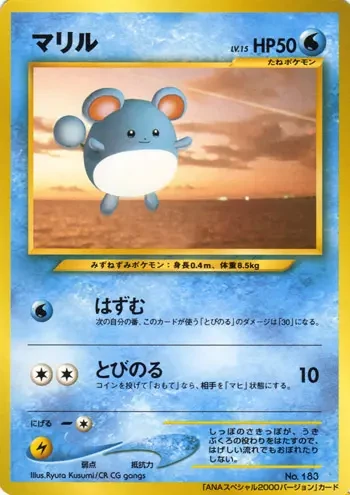
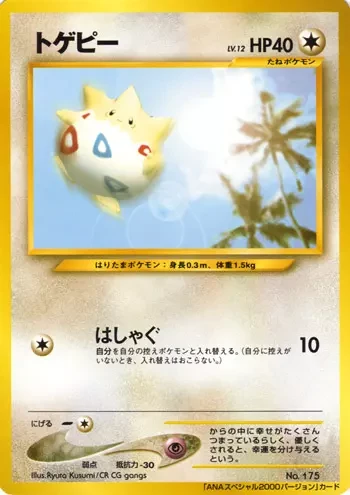


All Nippon Airways (ANA) gave away twelve Pokémon cards in five campaigns between 1998 and 2006, all in Japan. From 1998 to 2001, passengers mailed two domestic boarding pass stubs on the campaign postcard and received the cards by post; in 2006, young children were handed a pair on board. None was sold in stores, none carries the ANA logo, and four show an aircraft.
ANA has given no card since 2006: its 2026 Pokémon jets hand out a sticker. The four numbered cards are the ones with recorded sales: as of September 24, 2026, Pikachu 004/P sells for $4,075 est. in PSA 10 (2 real completed sales), and the 2006 Pikachu 153/PCG-P for $146 ungraded (11 sales).
The twelve cards, campaign by campaign
| Boarding dates and campaign | Cards | How passengers got them | Price, September 24, 2026 |
|---|---|---|---|
| November 1, 1998 to January 31, 1999: Get in a Jet! Double Chance | Flying Pikachu (airliner at right), Dragonite | Two domestic boarding pass stubs on the campaign postcard; the pair to every entrant | No sale recorded |
| June 1 to July 31, 1999: Everyone's Happy, first period | Flying Pikachu (airliner at bottom left), Articuno | Two stubs; the pair to every entrant | No sale recorded |
| August 1 to September 30, 1999: Everyone's Happy, second period | Moltres, Zapdos | Two stubs; the pair to every entrant | No sale recorded |
| July 1 to August 31, 2000: Get in a Jet! 2000, first period | Marill | Two stubs; one card | No sale recorded |
| September 1 to October 31, 2000: Get in a Jet! 2000, second period | Togepi | Two stubs; one card | No sale recorded |
| July 13 to September 30, 2001: Pokémon Card e ANA Special '01 Version | Pikachu 004/P, Larvitar 005/P | Two stubs; the pair to every entrant | 004/P: $4,075 est. in PSA 10 (2 sales), $392 est. in PSA 9 (1 sale). 005/P: $1,059 est. in PSA 10 (1 sale), $150 in PSA 9 (3 sales) |
| July 20 to August 31, 2006: ANA's Pika Summer Trip promotion | Pikachu 153/PCG-P, Sea's Manaphy 154/PCG-P | Handed out on board, while supplies lasted, to young children on domestic flights, as a pair on an ANA mount (a toy was the alternative) | 153: $146 (11 sales), $1,241 est. in PSA 9 (2 sales). 154: $56.42 (6 sales), $1,702 est. in PSA 10 (1 sale) |
Prices from real completed sales of Japanese copies, as of September 24, 2026; ungraded unless a grade is named. The site has no sale recorded yet for the eight unnumbered cards of 1998 to 2000.
The mail-in campaigns all worked the same way: two stubs glued to a dedicated postcard, handed out at airport counters, and mailed in. The 1998 campaign ran under the slogan "Dad flies, my dream", and it added a lottery of 5,000 prizes, children's Pokémon Jet jumpers or Game Boy Colors; in 2000, the lottery gave 500 digital cameras and 500 small LCD televisions. ANA's campaign announcements give no print run for the cards.
 Flying Pikachu (“Get in a Jet! Double Chance Campaign” 1998)
 Dragonite (“Get in a Jet! Double Chance Campaign” 1998)
How to recognize an ANA card
Only two of the twelve name the airline, so the art and the numbers do the work:
- The airliner. The 1998 Flying Pikachu reuses the 1997 CoroCoro illustration (level 12, balloons), with a gray airliner added at the right and the clouds redrawn around it. The 1999 card is a new drawing: level 11, a wink, more balloons, a sky in horizontal bands, and the airliner moved to the bottom left. A small plane crosses the sky above Pikachu's ears on 004/P, and an airliner's silhouette stands out against the dusk clouds on Sea's Manaphy 154/PCG-P. The other card of each pair (Dragonite, Larvitar, the 2006 Pikachu) shows no aircraft.
- The printed line. Marill and Togepi carry 「ANAスペシャル2000バージョン」カード, "ANA Special 2000 Version card", at the bottom right of the border. They are also the only photo composites of the twelve: a real sunset over the sea behind Marill, backlit palm trees behind Togepi, with the Pokémon modeled in 3D and a credit to Ryuta Kusumi / CR CG gangs.
- The numbers. Pikachu 004/P and Larvitar 005/P are Pokémon Card e cards, with dot-code strips along the edges for the Game Boy Advance e-Reader; the 2006 pair is 153/PCG-P and 154/PCG-P. The eight cards of 1998 to 2000 have no collection number: the No. at their bottom right is the Pokédex number.
- The triptych. Laid side by side, Toshinao Aoki's Articuno, Moltres and Zapdos of 1999 form one continuous picture: the blue, orange and pink grounds join up and the yellow stars run across all three cards.
 Flying Pikachu (“Everyone's Happy Campaign” 1999)
 Articuno (ANA 1999)
 Moltres (ANA 1999)
 Zapdos (ANA 1999)


The ANA art in English cards
Some of this art reached English cards, without a word about the airline, which matters if you hold the English print:
- The 1998 Dragonite is the artwork of English Wizards Black Star Promo 5, one of the four promos given with Pokémon: The First Movie tickets from November 10, 1999.
- The three birds of 1999 returned in English as secret rares 148, 149 and 150 of Supreme Victors (August 19, 2009). The English Articuno, Moltres and Zapdos promos handed out with the second movie in 2000 (Wizards Black Star Promos 21 to 23) are the same cards with new artwork.
- The 2006 Pikachu 153/PCG-P became English POP Series 5 12/17 (2007).
Neither airliner Flying Pikachu has an English print: the English Flying Pikachu, Wizards Black Star Promo 25 (2001), uses the 1997 illustration without the plane.


Not a card: the gold boarding pass
One ANA collectible often listed as an ANA Pokémon card is not one. To celebrate its first Pokémon Jet, ANA mailed an original gold boarding pass to everyone who sent in two stubs from domestic flights taken between July 18 and October 31, 1998. ANA's own announcement called it a commemorative card that could not be used to board. It has no game text and cannot be played, even though it is graded and sold alongside the cards; the first card campaign followed on November 1, 1998.
The Pokémon jets, and the years without cards
ANA's first Pokémon Jet, a Boeing 747, made its first flight on June 16, 1998 and entered service on July 2, 1998. More liveries followed: other Pokémon jets in 1998 and 1999, one of them on international routes, two jumbo liveries in 2004 (the Pikachu Jumbo among them), the Peace Jet of 2011 to 2016, and the Pikachu Jet NH and Eevee Jet NH on international routes from 2023. Only the campaigns of 1998 to 2001 and 2006 came with cards; in 2002, for instance, two stubs entered a lottery for 5,000 ANA Pokémon goods instead.
For Pokémon's 30th anniversary, ANA is adding three Pokémon jets: the Pokémon Jet Red (Boeing 787-8) on domestic routes since July 29, 2026, the Green (787-9) on international routes since September 18, 2026, and the Blue (737-800), due on domestic routes in December 2026 or later. The gift announced for their passengers is an original sticker, one per boarding, handed out for about two months after each jet's first flight and while supplies last. Our guide to Pokémon in Tokyo covers the jets alongside the city's other Pokémon stops.
Finding them today
All twelve trade second-hand only, in Japanese card shops and on auction sites; from abroad, a proxy service can buy and forward them, as our guide to buying Japanese cards from abroad explains. Japanese listings often use ANA's own names for the cards: ANAスペシャル (ANA Special) with the year, '99, 2000 or '01; the 1998 pair was simply the ANA Special Version, and the 2006 pair is filed under the name of that summer's promotion, ピカ夏旅割.
Check the airliner, the printed line or the number before buying: the English prints with ANA art and the gold boarding pass can turn up in listings under the ANA name, and none of them is one of the twelve.
FAQ
How many ANA Pokémon cards are there?
Twelve, from five campaigns: two in 1998, four in 1999, two in 2000, Pikachu 004/P and Larvitar 005/P in 2001, and Pikachu 153/PCG-P and Sea's Manaphy 154/PCG-P in 2006.
How did you get an ANA Pokémon card?
From 1998 to 2001, by mailing two domestic boarding pass stubs on the campaign postcard: every entrant received the cards by post. In 2006, young children on ANA domestic flights were handed the pair on board, while supplies lasted.
Is the ANA gold boarding pass a Pokémon card?
No. It is a commemorative gold card that ANA mailed in 1998 to celebrate its first Pokémon Jet. It has no game text and cannot be played.
Does ANA still give out Pokémon cards?
No card since 2006. The Pokémon Jets of 2026 hand out an original sticker on board, one per boarding, as of September 24, 2026.
What is the most valuable ANA Pokémon card?
Among the cards with recorded sales, Pikachu 004/P: $4,075 est. in PSA 10 over 2 real completed sales, as of September 24, 2026. The eight unnumbered cards have no sale recorded on the site yet.
More Japanese promo series: JR railway cards, Japan Post, Toyota and, for a trip to Japan, Pokémon in Tokyo.


