
15 cards


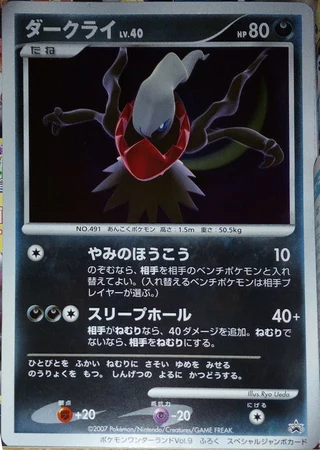
Pokémon Wonderland came with nine Pokémon cards, one in each issue from Pokémon Wonderland 2004, on sale December 20, 2003, to vol. 9, on sale July 14, 2007. Eight are numbered promos, Metang 044/ADV-P and seven PCG-P cards from 018 to 152; the ninth is a jumbo Darkrai, the only one of the nine that names the magazine. The most valuable is the Metal-type Pikachu δ 118/PCG-P: $157 est. raw (2 sales) and $12,180 est. in PSA 10 (1 sale), in real completed sales as of September 25, 2026.
Pokémon Wonderland was an irregular Shogakukan special, ¥550 an issue from 2004 to vol. 9, timed to a new Pokémon film, game or theme park. It began in 1997 as a special extra issue of Shogakukan's grade-school magazines, which had cards of their own from 2003 to 2010 (see our guide to Shogakukan's school magazine cards). Twelve issues came out: the 1997 issue and Wonderland 2 (1998, with stamps; not the vol. 2 of 2004) had no card, the nine below had one each, and vol. 10 (October 18, 2008) came with a card case instead. A vol. 11 planned for December 10, 2008 never appeared.
The nine cards, issue by issue
| Issue | On sale | Card | Number | English print, same art | Raw |
|---|---|---|---|---|---|
| Wonderland 2004 | December 20, 2003 | Metang | 044/ADV-P | Nintendo Black Star Promo 23, Stadium Challenge logo | $9.81 (3 sales) |
| Vol. 2 | July 17, 2004 | Sky-Splitting Deoxys | 018/PCG-P | none | $49.65 (7 sales) |
| Vol. 3 | December 17, 2004 | Deoxys ex | 027/PCG-P | POP Series 4, 17/17 | $52.60 (6 sales) |
| Vol. 4 | March 18, 2005 | Typhlosion | 051/PCG-P | Nintendo Black Star Promo 34 | $24.83 (3 sales) |
| Vol. 5 | July 16, 2005 | Rota's Mime Jr. | 097/PCG-P | none | $16.18 (6 sales) |
| Vol. 6 | December 15, 2005 | Pikachu δ | 118/PCG-P | POP Series 5, 13/17 | $157 est. (2 sales) |
| Vol. 7 | March 23, 2006 | Treecko δ | 131/PCG-P | POP Series 4, 15/17 | $34.37 est. (1 sale) |
| Vol. 8 | July 15, 2006 | Samiya's Chatot | 152/PCG-P | none | $40.05 (5 sales) |
| Vol. 9 | July 14, 2007 | Darkrai, special jumbo card | no number | Great Encounters 4/106, at standard size | no sale recorded |
Medians of real completed sales of the Japanese card, in US dollars, as of September 25, 2026, with the number of sales; "est." marks a median resting on one or two sales. Graded sales are recorded for two cards only: Pikachu δ at $12,180 est. in PSA 10 (1 sale) and $1,195 est. in PSA 9 (1 sale), Deoxys ex at $390 est. in PSA 9 (1 sale).
Five of the eight numbered cards were printed in English with the same art, as Black Star promos or in the POP Series packs; the three film cards never were. The jumbo is an enlarged print of the Darkrai from the Japanese Shining Darkness set, the card English players know as Great Encounters 4/106.


The July issues came out the day the film opened
All four July issues went on sale the day that summer's Pokémon film opened in Japan, each with a card of the film:
| Issue | On sale, the film's opening day | Film | Card |
|---|---|---|---|
| Vol. 2 | July 17, 2004 | Destiny Deoxys | Sky-Splitting Deoxys 018/PCG-P |
| Vol. 5 | July 16, 2005 | Lucario and the Mystery of Mew | Rota's Mime Jr. 097/PCG-P |
| Vol. 8 | July 15, 2006 | Pokémon Ranger and the Temple of the Sea | Samiya's Chatot 152/PCG-P |
| Vol. 9 | July 14, 2007 | The Rise of Darkrai | Darkrai, special jumbo card |
The names come from the films. 裂空のデオキシス, Sky-Splitting Deoxys, echoes the Japanese title of the 2004 film, 裂空の訪問者 デオキシス; Rota is the town of the Lucario film and Samiya the undersea temple of the Manaphy film. Mime Jr. and Chatot were new Pokémon, printed on cards before Diamond and Pearl came out in Japan on September 28, 2006. The films' other cards are in our guide to Pokémon movie cards.
Two other issues came out on a launch day. Vol. 4 came out the day PokéPark opened in Nagoya, March 18, 2005 (its own cards are in our PokéPark guide), with a new-art print of the Typhlosion from Golden Sky, Silvery Ocean, a card set the issue covered. Vol. 7 came out the day the Pokémon Ranger game did, March 23, 2006.


How to tell a Wonderland card from its namesakes
The eight numbered cards print no magazine name, logo or stamp, so the number at the bottom right is what identifies them. The three film cards carry a small picture from their film at the bottom right of the text box, but it is a film mark, not a magazine mark: the McDonald's Mime Jr. and the Meiji Chatot carry the same one. The Darkrai is the exception: its bottom border reads ポケモンワンダーランドVol.9 ふろく スペシャルジャンボカード, "Pokémon Wonderland Vol. 9 supplement, special jumbo card".
Five of the nine have a lookalike promo from the same years, from the World Hobby Fair, Battle Road, the school magazines, a film VS Pack, Meiji chocolate or McDonald's:
| Wonderland card | Lookalike | What differs |
|---|---|---|
| Metang 044/ADV-P | Metang 063/ADV-P, World Hobby Fair, January and February 2004 | 063 shows Metang in a forest (the art of the English EX Hidden Legends 21), with a gold WHF stamp and a bottom line naming the 19th Next Generation World Hobby Fair; 044 shows it flying over grass |
| Sky-Splitting Deoxys 018/PCG-P | Deoxys 017/PCG-P, school magazines' August 2004 issues; a lenticular Sky-Splitting Deoxys in the film's Movie Commemoration VS Pack | 017 is another Defense Forme card, with 70 HP, Barrier Attack and no film picture; the VS Pack card changes image with the angle |
| Rota's Mime Jr. 097/PCG-P | Rota's Mime Jr. 086/PCG-P, McDonald's, July 2005 | Other art, a McDonald's logo at the bottom left, and Teeter Dance (フラフラダンス) instead of Barrier Attack (バリアアタック) |
| Pikachu δ 118/PCG-P | Pikachu δ 112/PCG-P, Meiji, October 2005; 113/PCG-P, Battle Road Autumn 2005 | Other art each, and the attacks でんじは and アイアンテール instead of ビリリパンチ and ヘビーメタル; 112 carries the Meiji logo |
| Samiya's Chatot 152/PCG-P | Samiya's Chatot 143/PCG-P, Meiji, June 2006 | Art by Kouki Saitou instead of Atsuko Nishida, a Meiji logo, and one attack with no Poké-Body |
One card sometimes filed under Wonderland is not a Wonderland card: Beldum 045/ADV-P, announced the same day as the Metang, December 12, 2003, came with the grade magazines' February 2004 issues. Two other Darkrai are not this one either: the standard-size Darkrai 046/DP-P given to the first 4.2 million moviegoers of the 2007 film, and the "Wonderland" Darkrai of 2014, a video-game Pokémon handed out by serial code with advance tickets for the seventeenth film.
Buying one
The eight numbered cards trade as loose singles, raw or graded, and complete magazines with the card still inside turn up too; our data records no sale of the jumbo Darkrai as of September 25, 2026. Search by number rather than by name: a name search returns the lookalikes above and the English prints.
FAQ
How many Pokémon Wonderland cards are there?
Nine: Metang 044/ADV-P, Sky-Splitting Deoxys 018, Deoxys ex 027, Typhlosion 051, Rota's Mime Jr. 097, Pikachu δ 118, Treecko δ 131 and Samiya's Chatot 152/PCG-P, plus a jumbo Darkrai with no number. They came one per issue, from December 2003 to July 2007.
What is the most valuable Pokémon Wonderland card?
Pikachu δ 118/PCG-P, the Metal-type Pikachu of vol. 6 (December 15, 2005): $157 est. raw (2 sales), $1,195 est. in PSA 9 (1 sale) and $12,180 est. in PSA 10 (1 sale), as of September 25, 2026. The next most expensive raw are Deoxys ex at $52.60 (6 sales) and Sky-Splitting Deoxys at $49.65 (7 sales).
Is the Wonderland Pikachu δ the same card as the English POP Series 5 Pikachu?
Yes in art and attacks: POP Series 5 13/17 is the English print of 118/PCG-P. The Meiji Pikachu δ 112/PCG-P, printed in English as EX Legend Maker 93, is a different card.
Did Pokémon Wonderland vol. 10 come with a card?
No. Vol. 10 (October 18, 2008) came with a Pokémon Card Game DPt card case, and the vol. 11 planned for December 2008 never came out, so the vol. 9 Darkrai was the last Wonderland card.
More promo series from places and events: Pokémon Center, PokéPark, the Pokémon Museum, the World Championships, Celebratory Fanfare and, from magazines, CoroCoro.


