
To tell whether a Pokémon pack was resealed, check three things before you pay: the price against real completed sales for that set and format, both crimped ends under angled light, and any trace of glue, which the factory never uses. Glue is the strongest sign; a price far below the market, or two crimps on one pack that do not match, is reason enough to walk away. Proof takes more: adhesive sitting between the foil faces of a remade seal, or cards that cannot come from that wrapper.
Two limits apply to everything below. A pack can be genuinely sealed and still have been weighed, with nothing good left in it. And counterfeit sealed packs exist, so a card from a pack that looked sealed is not proven genuine: our guide to spotting fake Pokémon cards covers the cards themselves.
The first screen: four checks
In this order; the first two need no reference pack. None proves a reseal alone: they decide whether you keep looking or walk away.
- Price. A loose pack well under real completed sales for its set and format is the easiest warning to spot. Our table is below: vintage loose packs sell at 58 to 67% of box per pack, most modern ones at or above it.
- Both crimps, under angled light. The ridging should be even and the same width top and bottom, with no gloss, no melted shine, no split foil. Compare the two ends of the same pack first, then a pack of the same set and era, never a modern pack against a 1999 one.
- Glue, anywhere. The factory seals the foil with heat and pressure and uses no liquid glue. White residue or a sticky patch on a crimp or the back seam is the strongest sign on this list, and it becomes proof once you can see adhesive sitting between the two foil faces of a remade seal. An unidentified deposit on the wrapper, or the gloss of a heat seal, is not that.
- Does the story hold? A loose vintage pack with no provenance, from a seller holding many of them, is more likely to have crossed a scale: a risk to price in, not a history you can establish. Same for a new account with several boxes under market at once, or a seller who will not send angled photos.
Four things that look bad and are not
Many packs reported as resealed are just old.
- Slits on the crimp. The crimp is thicker where the spine of the pack sits behind it, so the sealing jaws can cut the foil there. A factory slit follows the crimp line and does not reach the cards.
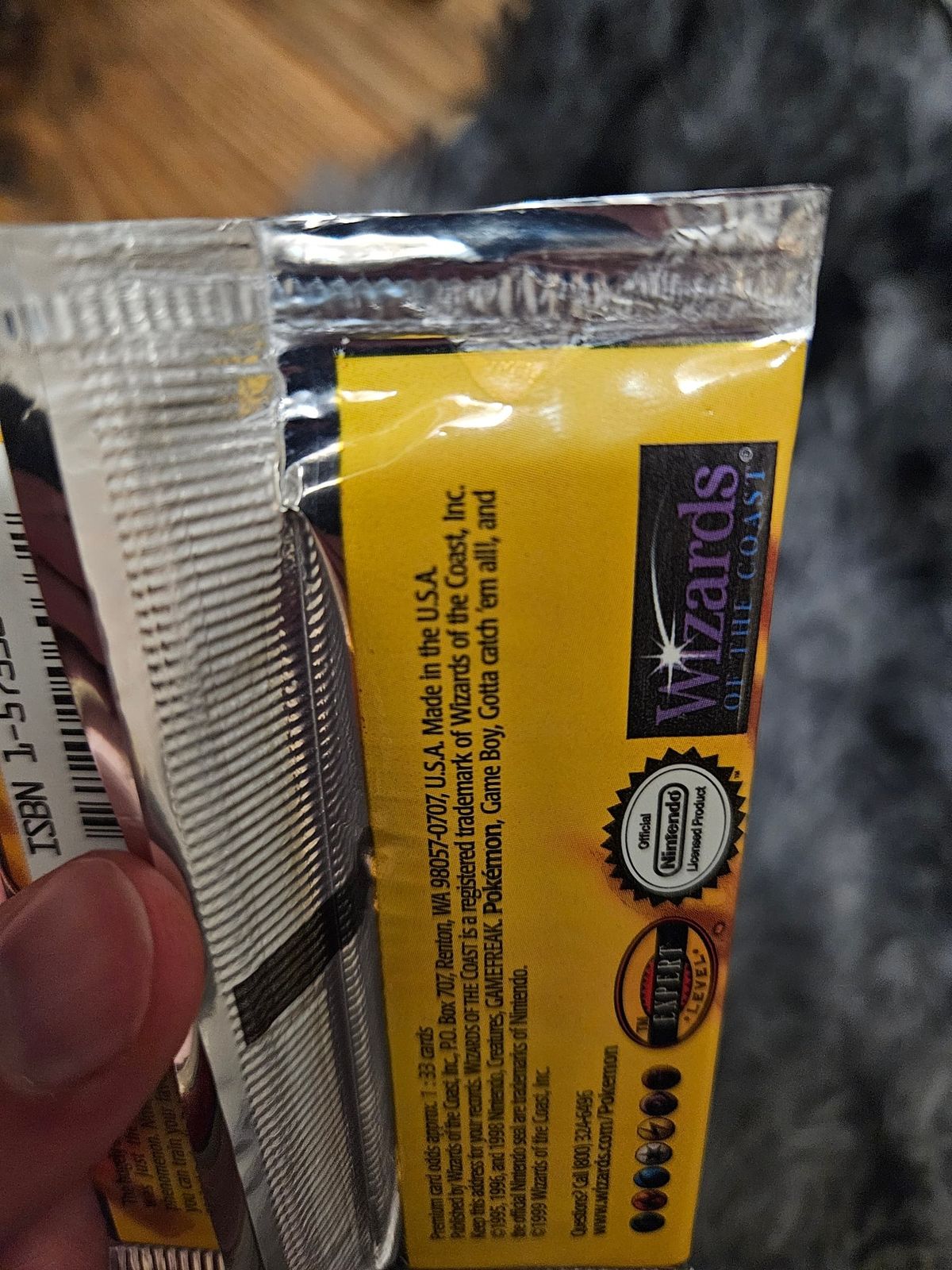
- A back flap that lifts. The long seam down the back is heat sealed, not glued, and its ends come away with age. A flap can be loose straight out of a sealed box.
- Loose or bubbled film on a modern box. Collectors have reported it on genuine modern English boxes for years, and glue-like marks on the bottom of a box can be factory too.
- Long crimp, short crimp, a punched hole. Both crimp lengths are factory variants of 1999 Base Set packs, and so is the hat-shaped hang hole punched through the center of the top crimp on the 1999 to 2000 long packs made for store pegs.
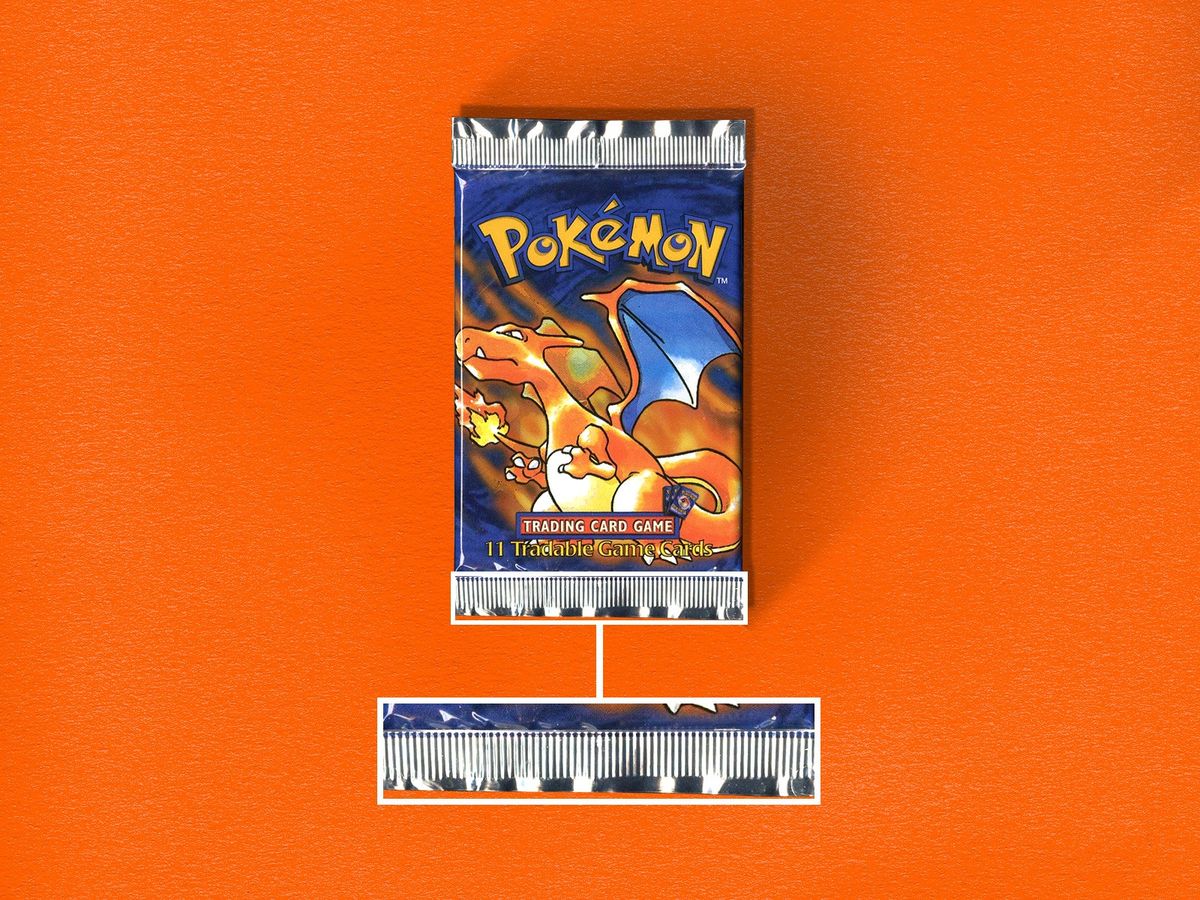 Long crimp1999 Base Set: tightly spaced lines across the full width
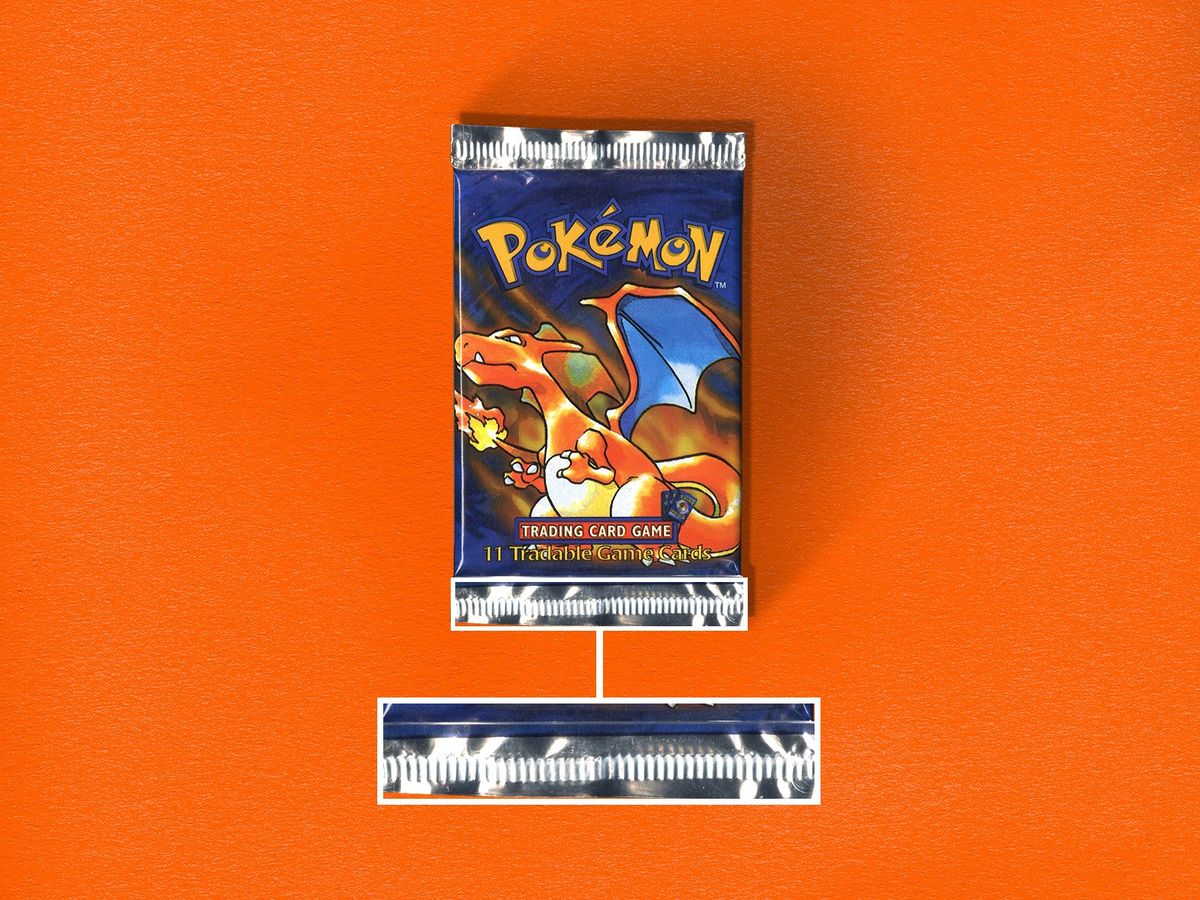 Short crimpSame set, another run: fewer, wider lines. Both are factory
Feel tests prove nothing either way: sliding cards and a tight or puffy pack vary between genuine runs, and cards stuck to the wrapper matter only as a sign of glue.
Normal, suspicious, or proven
| Level | What it looks like | What to do |
|---|---|---|
| Normal for its age | A lifted back flap, factory crimp slits, a single wrinkle, faint print on box film | Nothing. Old packs and some print runs do this |
| Suspicious | Two crimps that do not match, gloss or waviness on a crimp, an unidentified deposit on the wrapper, a price far under market, a story that does not hold, fewer cards or foils than that product holds once opened | Do not buy, or return it unopened. One oddity is variance and several are a reason to pass, not a proof: factory packing errors happen |
| Proven | Adhesive visibly sitting between the faces of a remade crimp or seam; cards inside that cannot come from that wrapper, another set or print run; a grading company stating the seal was resealed, not merely declining to authenticate | A reseal. Photograph everything and open a claim |
 Suspected resealA questioned pack beside a normal one: the crimp is splayed and glossy. Forum verdict: suspicious, and factory defects can look alike
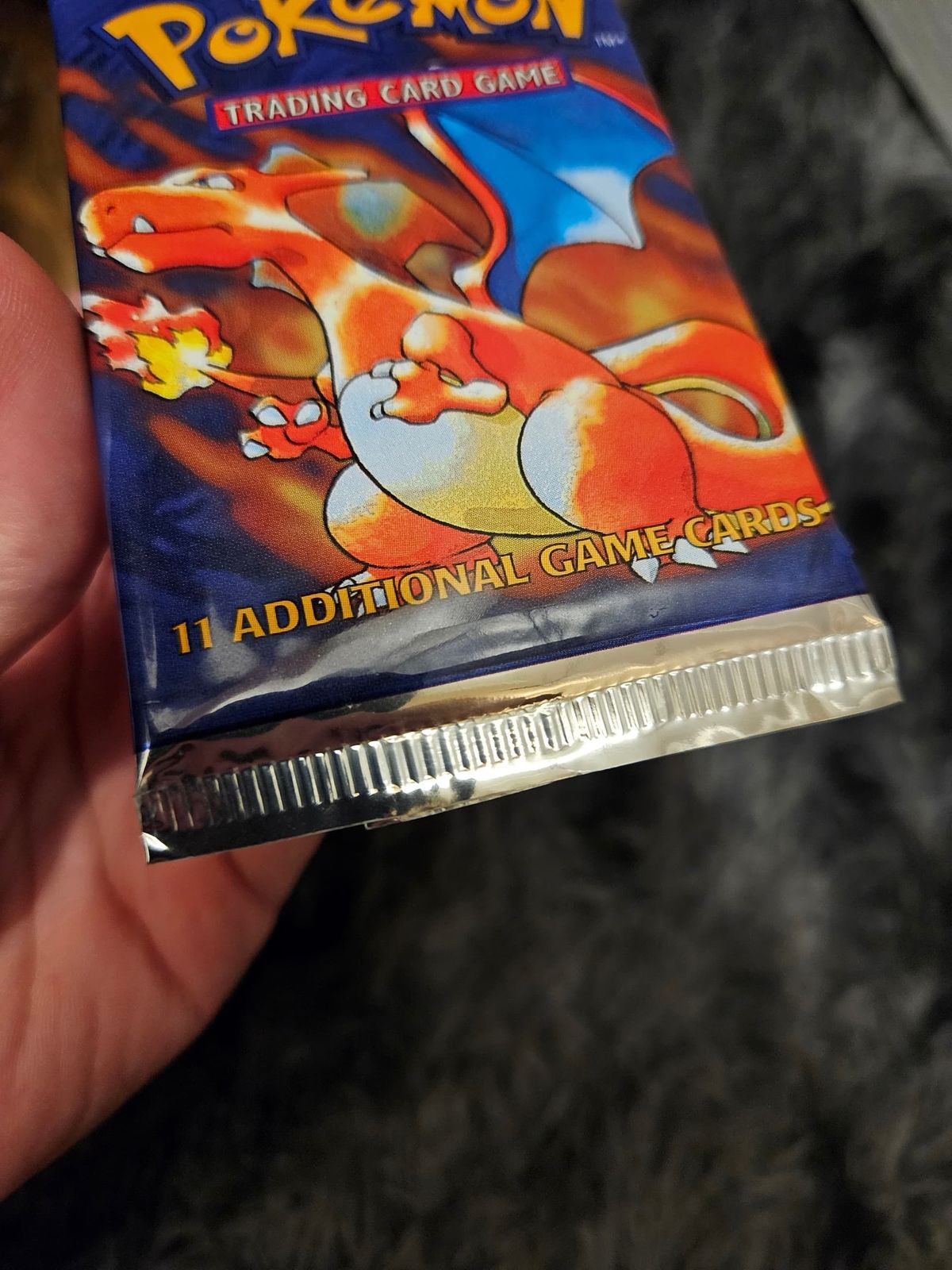 Deposit on the ridgingSame pack: a dark deposit on the crimp. The factory uses no glue, so a deposit is a reason to pass, not a proof
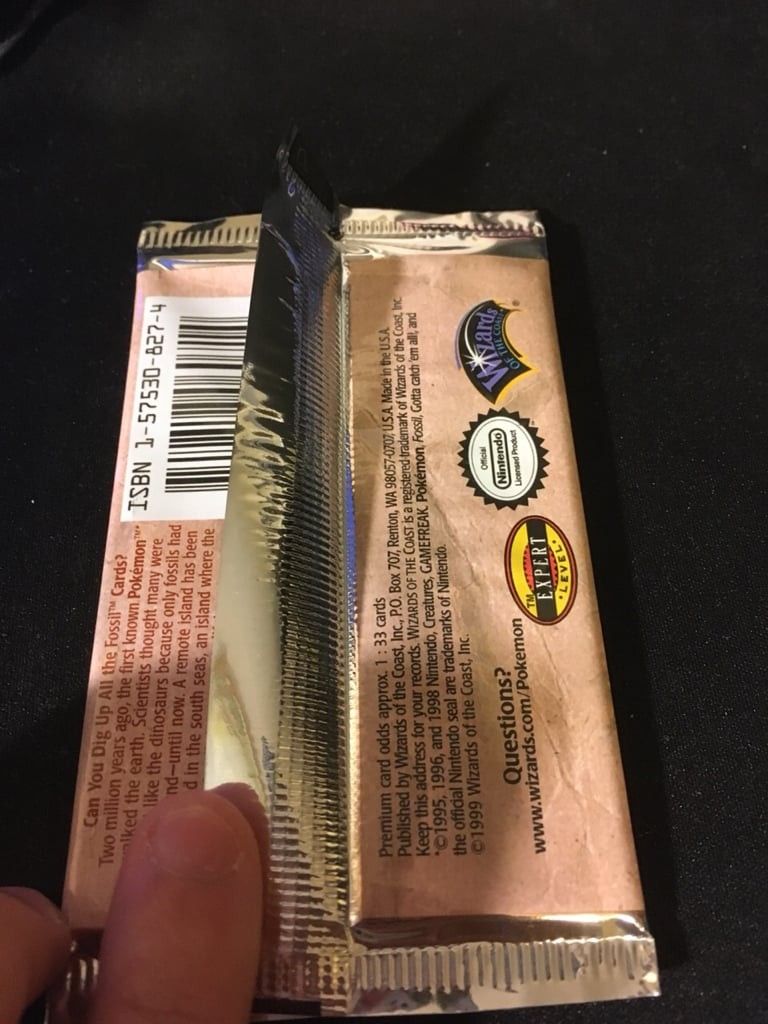 False alarmA Fossil pack with the back flap standing up. Old packs do this straight out of a sealed box
What a genuine pack holds
Once a pack is open, its contents are the strongest evidence, but only against the right product:
| Pack | Game cards | Also inside |
|---|---|---|
| English main expansion, Scarlet & Violet and Mega Evolution (2023 on) | 10: 4 commons, 3 uncommons, 3 foils, at least one of them rare or higher | A basic Energy and a code card |
| English 30th Celebration (September 16, 2026) | 5, all foil, one of them one of 30 Pikachu rares; in early openings, about 1 pack in 10 held a gold-bordered Classic Collection card | A foil basic Energy and a code card |
| Classic Collection pack (November 6, 2026) | 3 Classic Collection cards | One per Ultra-Premium Collection, Day or Night |
| Celebrations (2021) | 4, all foil, no reverse holo slot | A code card |
| English Sun & Moon and Sword & Shield (2017 to 2023) | 10, with a rare and at least one reverse foil | A basic Energy (in some Brilliant Stars to Crown Zenith packs, a VSTAR marker instead) and a code card |
| English Diamond & Pearl to XY (2007 to 2016) | 10, with a rare and a reverse holo | A code card from Emerging Powers (August 2011) on |
| English e-Card and EX (September 2002 to early 2007) | 9, including a reverse holo | No code card |
| English Base Set to Legendary Collection (1999 to 2002) | 11 (Base Set wrappers print the count); a reverse holo in every Legendary Collection pack | No code card |
| Japanese expansion pack, Scarlet & Violet and Mega eras (2023 on) | 5 in most sets, 7 in Pokémon Card 151, 10 in high class packs | No code card, usually no Energy |
| Japanese 30th CELEBRATION (September 16, 2026) | 6, all foil, one of them a guaranteed basic Energy | No code card |
Older Japanese packs, other special sets and promotional packs vary: our guide to how many cards are in a Pokémon pack covers them.
What proves a reseal is what cannot be there at all: cards from another set or print run inside that wrapper. A main-expansion pack short of a foil, or with no rare, is a strong sign, not a verdict: factory mistakes happen, and one short pack in a box is not a pattern. Which products are worth opening at all is in our guide to the best packs for rare cards.
The code card is a clue only on older packs. Around 2014, in the XY era, its design told a regular rare from a holo or better, and it still did in 2020: in 648 Sword & Shield packs, white code cards went with a holo rare or better and green ones with a regular rare. On a pack of those years, a white code card beside a plain rare means something was swapped, or a factory slip. Do not read it on newer packs: every rare has been foil since Scarlet & Violet, and Mega Evolution code cards carry artwork unrelated to the pack's contents.
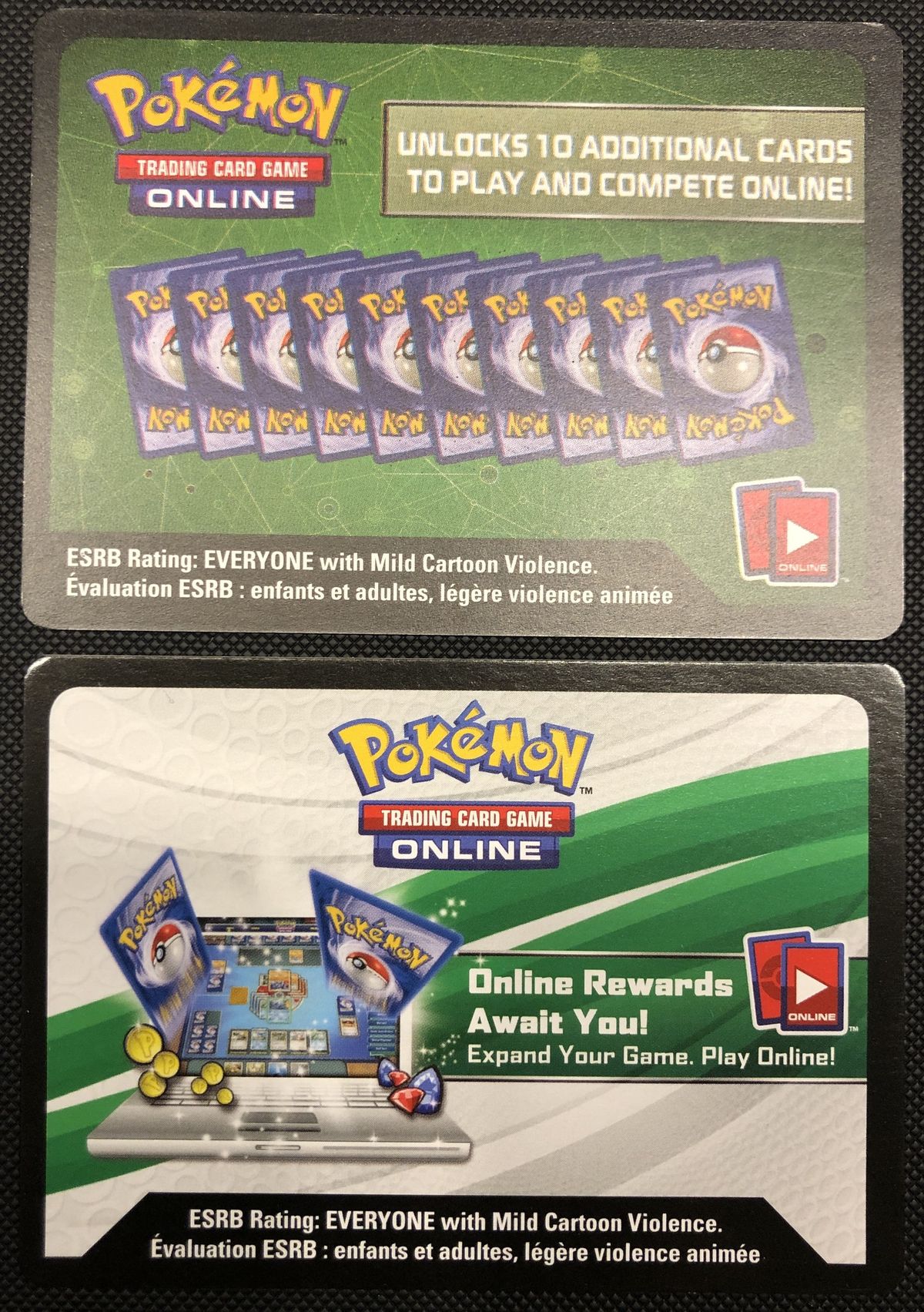 Two code card designsThe two code card backs of the XY to Sword & Shield years: green came with a regular rare, white and green with a holo rare or better. A clue to lay beside the contents, not a test
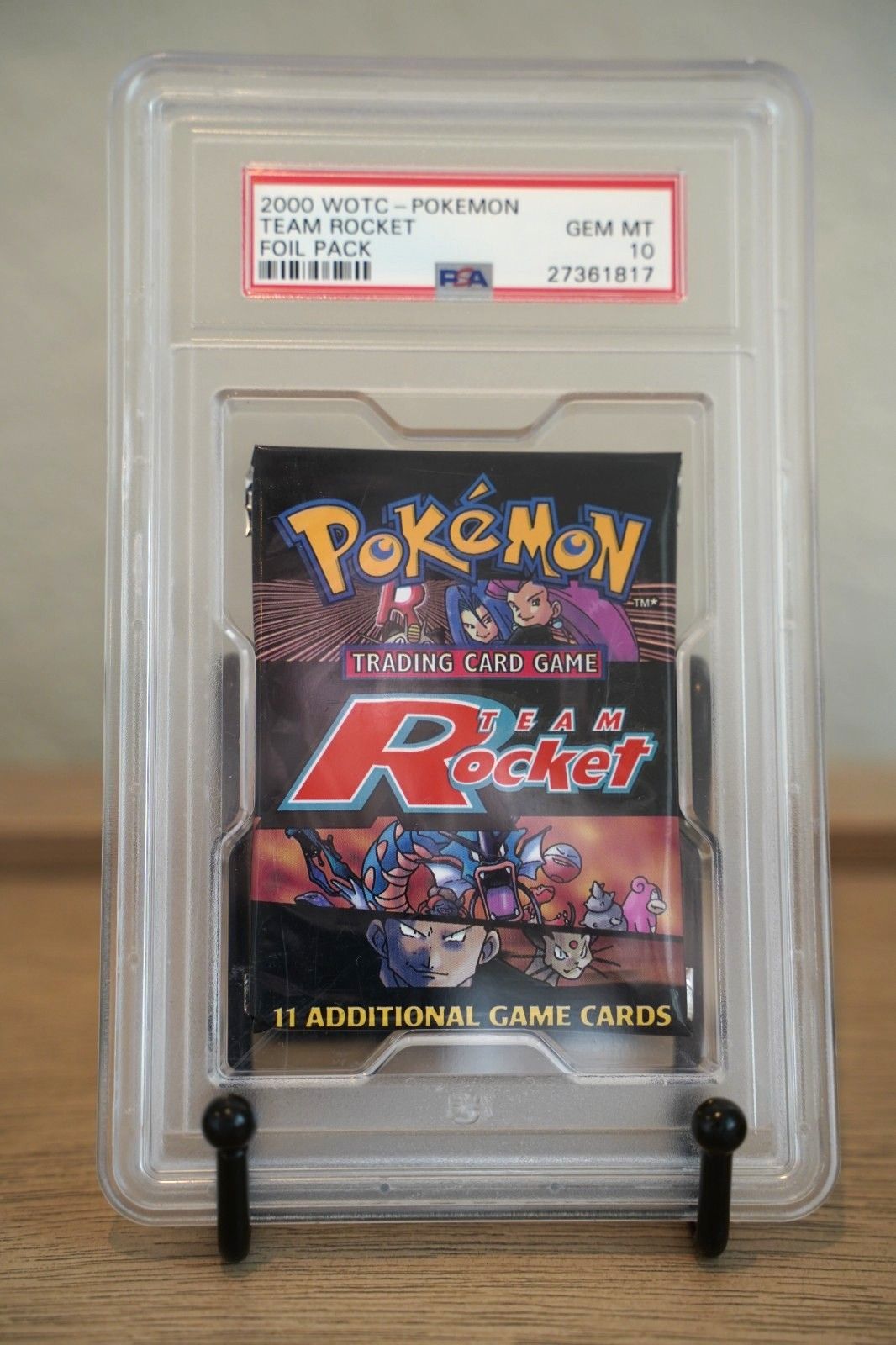 A PSA-graded packTeam Rocket, GEM MT 10. The label certifies the wrapper and its seal, not the cards inside
One confirmed reseal, and one pack that only looked like it
The confirmed case wore a grader's label. A 1st Edition Base Set pack slabbed PSA 9, bought in September 2017, was cracked open on camera: adhesive showed along the bottom crimp, and inside were worn Unlimited cards with the drop shadow and no 1st Edition stamp, which a 1st Edition wrapper cannot hold. The seller refunded. Glue where the factory uses none, and contents the wrapper cannot hold: that is proof.
The opposite case came from the same forum in 2022: a Korean Base Set pack with a flattened, discolored top crimp, called a certain reseal, held eleven pack-fresh cards, the count printed on its wrapper. Plausible contents cannot rule out a swap, so neither the crimp nor the opening settled it.
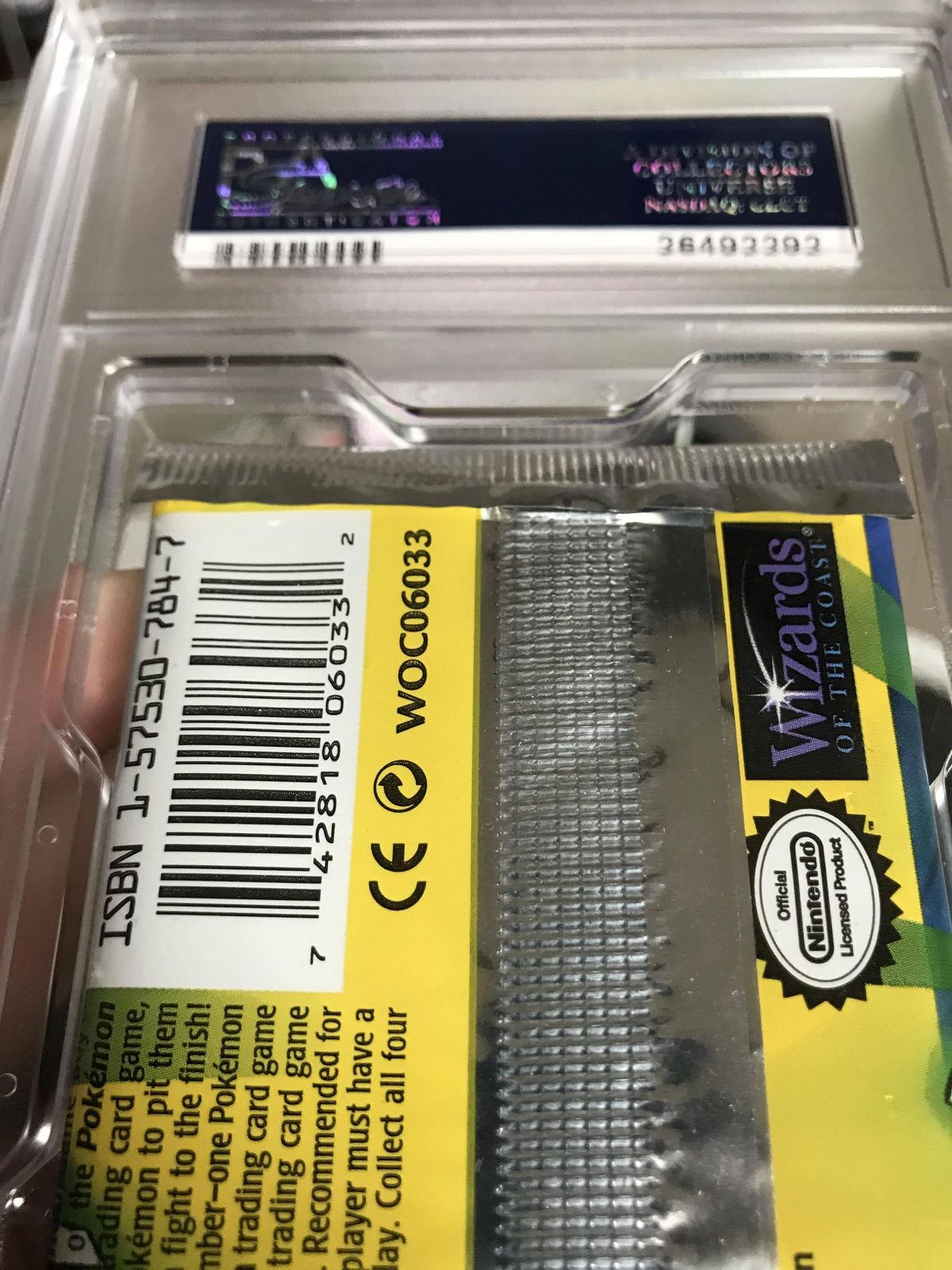 Confirmed reseal: the crimpAdhesive along the bottom crimp, visible through the PSA case
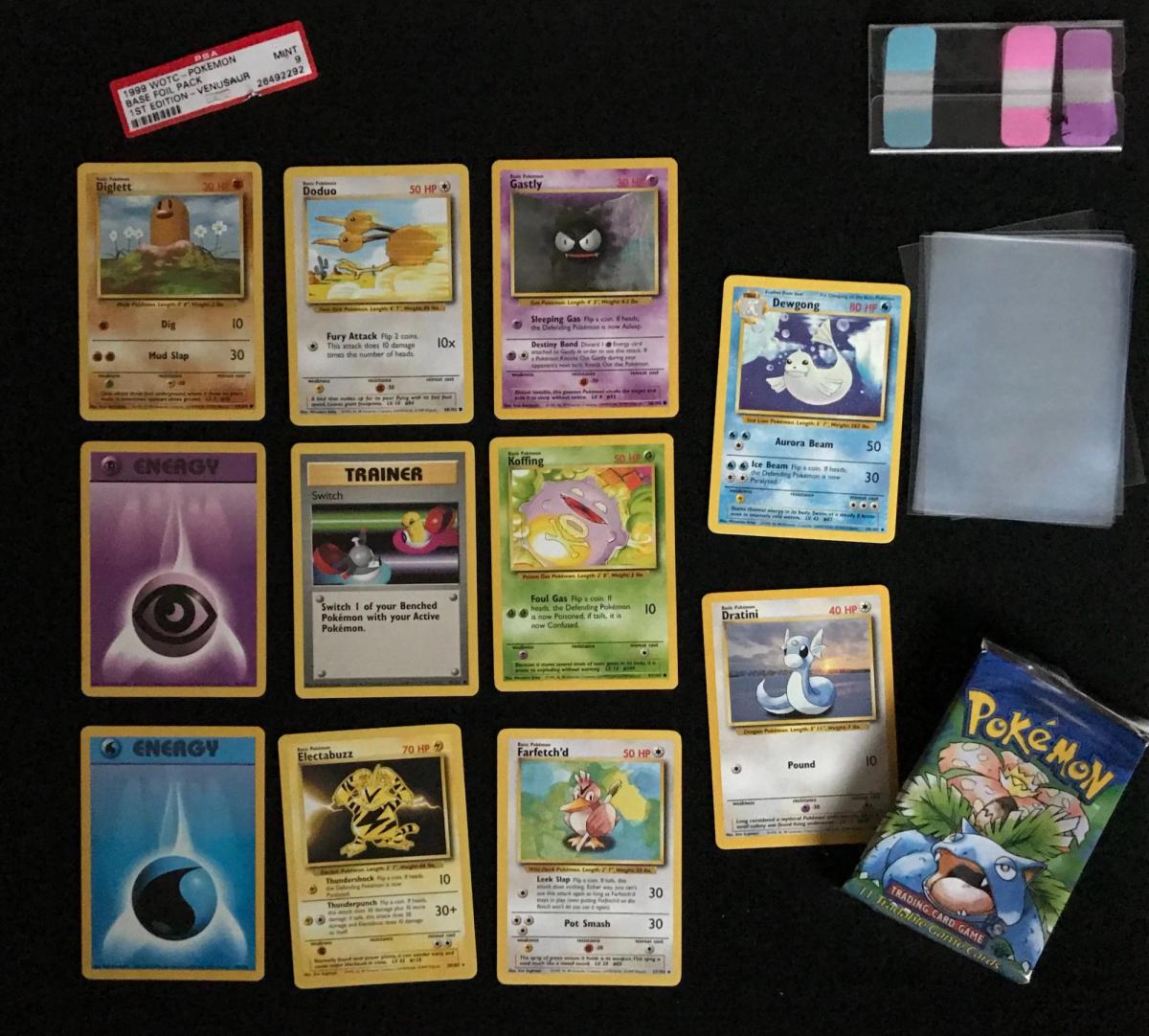 Confirmed reseal: the contentsEleven Unlimited cards, no 1st Edition stamp, out of a 1st Edition wrapper
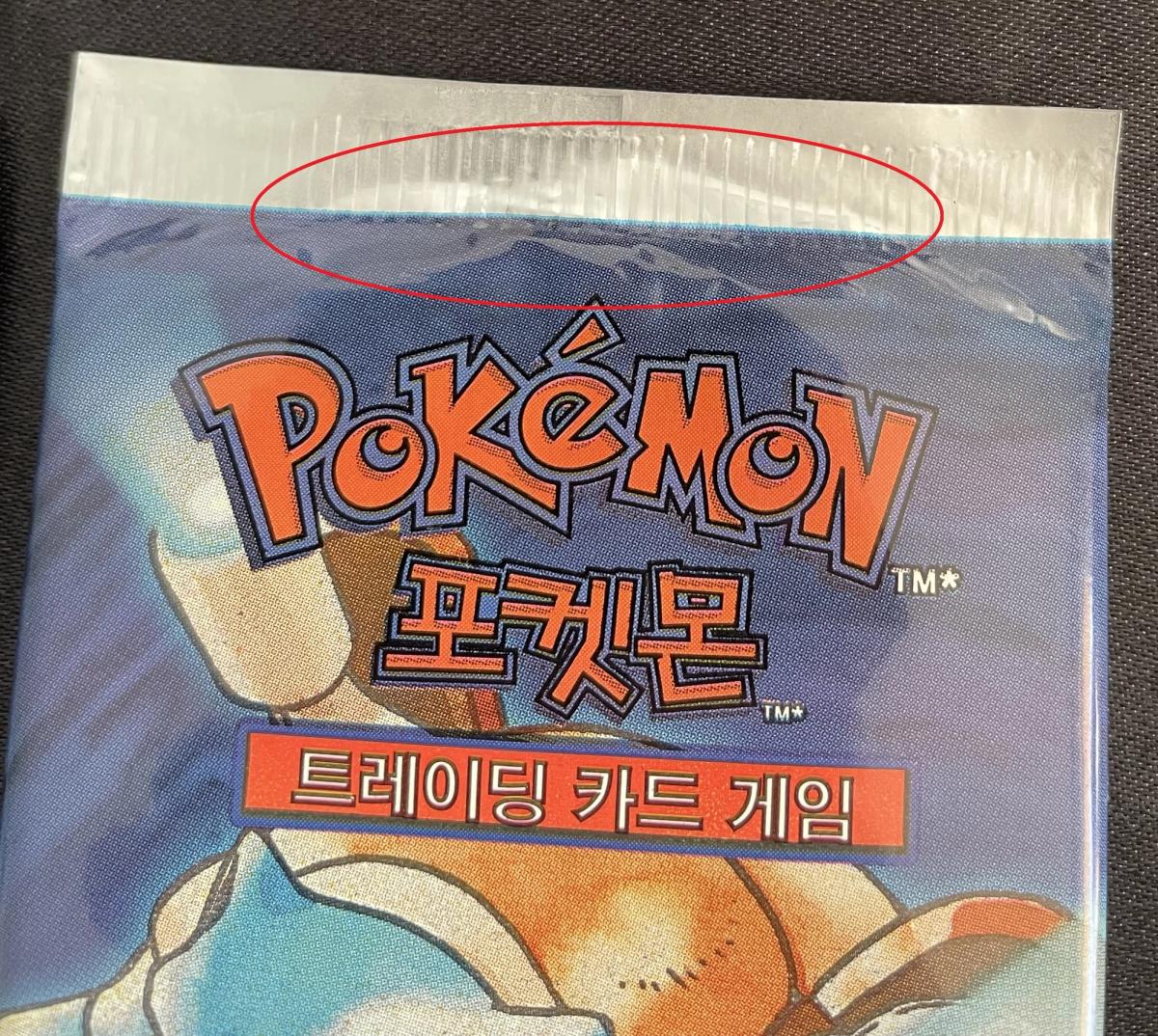 Looked resealed: the crimpFlattened, uneven, discolored. Called a certain reseal on the forum, never proven either way
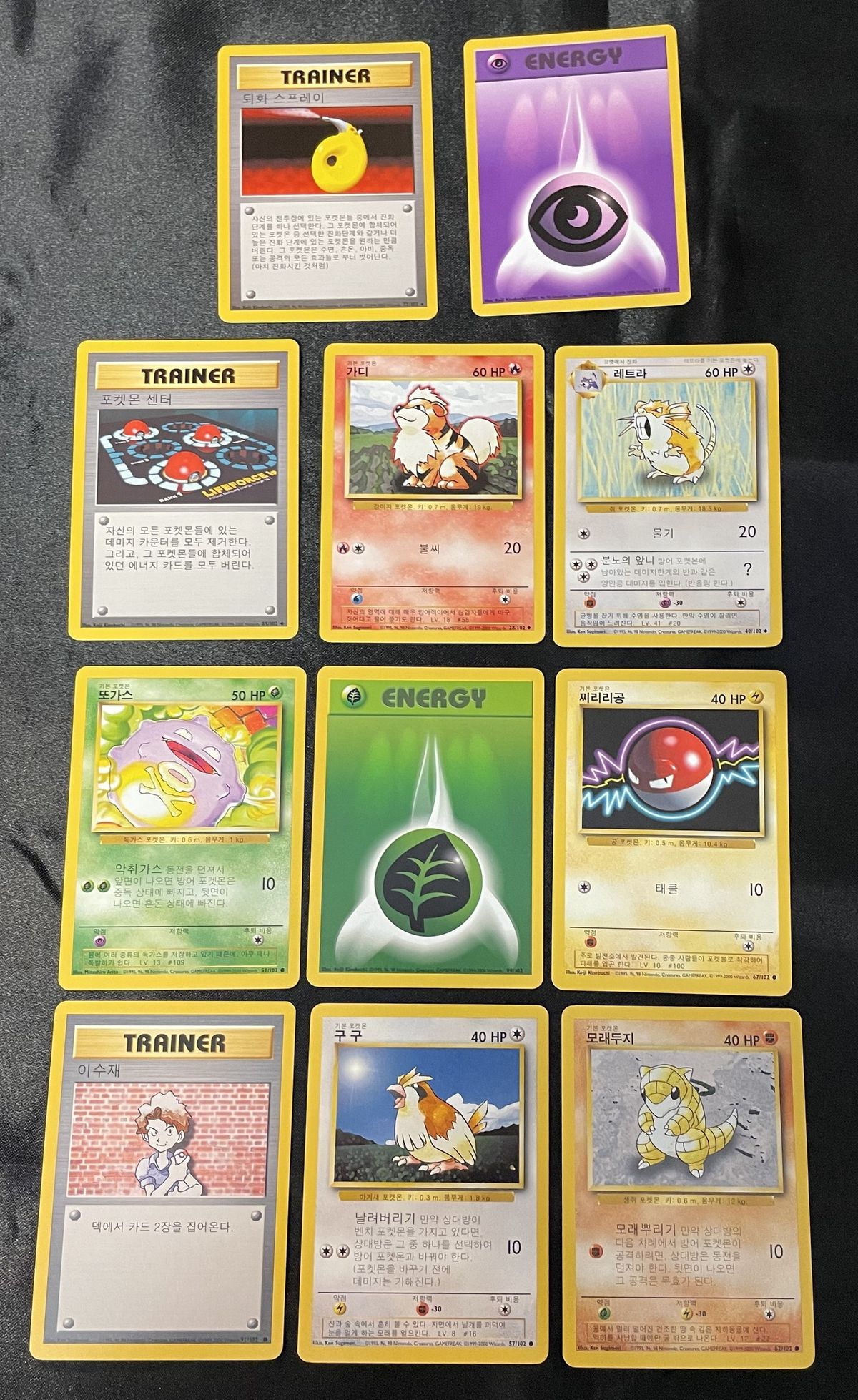 Looked resealed: the contentsEleven pack-fresh cards, the count printed on the wrapper. The owner treated it as genuine; a swap cannot be ruled out
Resealed or weighed: two problems, one word
Two different crimes, and only the reseal leaves a mark: a weighed pack is genuinely factory sealed, with the odds taken out of it on a scale.
| What you are looking at | Resealed pack | Weighed or searched pack |
|---|---|---|
| What happened | Opened, hits removed, closed again | Never opened, sorted on a 0.01 g scale |
| Factory seal | Broken, then remade | Intact and genuine |
| What the outside shows | Gloss, glue, wrinkles, odd crimps | Nothing at all |
| What finds it | Angled light on both crimps | Price, format, seller history |
| What is inside | Bulk commons, sometimes from another set | Real cards, minus the odds |
That second column is why inspection has a ceiling: nothing gives a weighed pack away. And a resealed pack can be padded to weigh heavy, so a scale is not an authenticity test.
Pack anatomy: the three seals
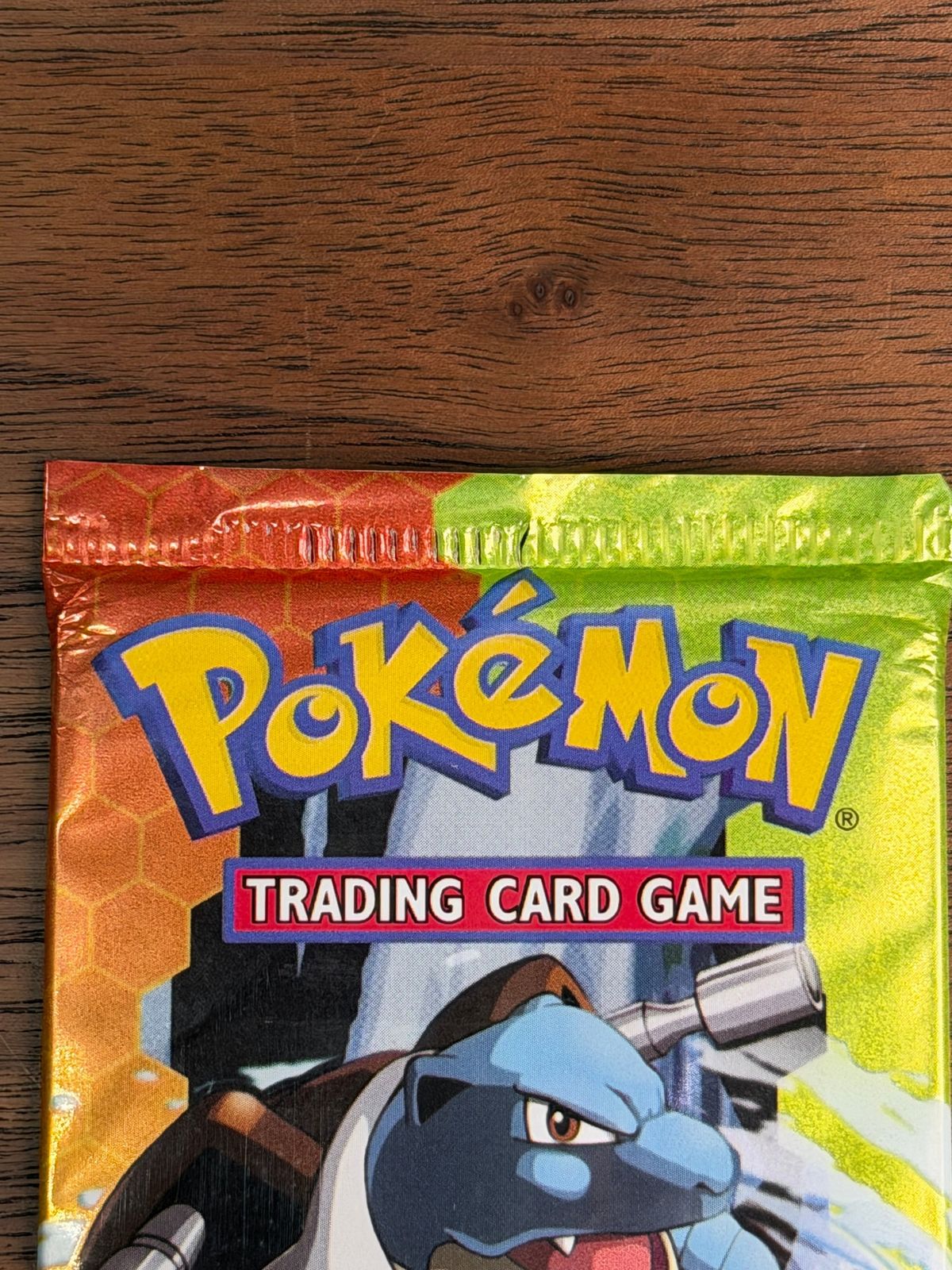 Factory crimpEven machine ridging, one constant width (EX FireRed & LeafGreen)
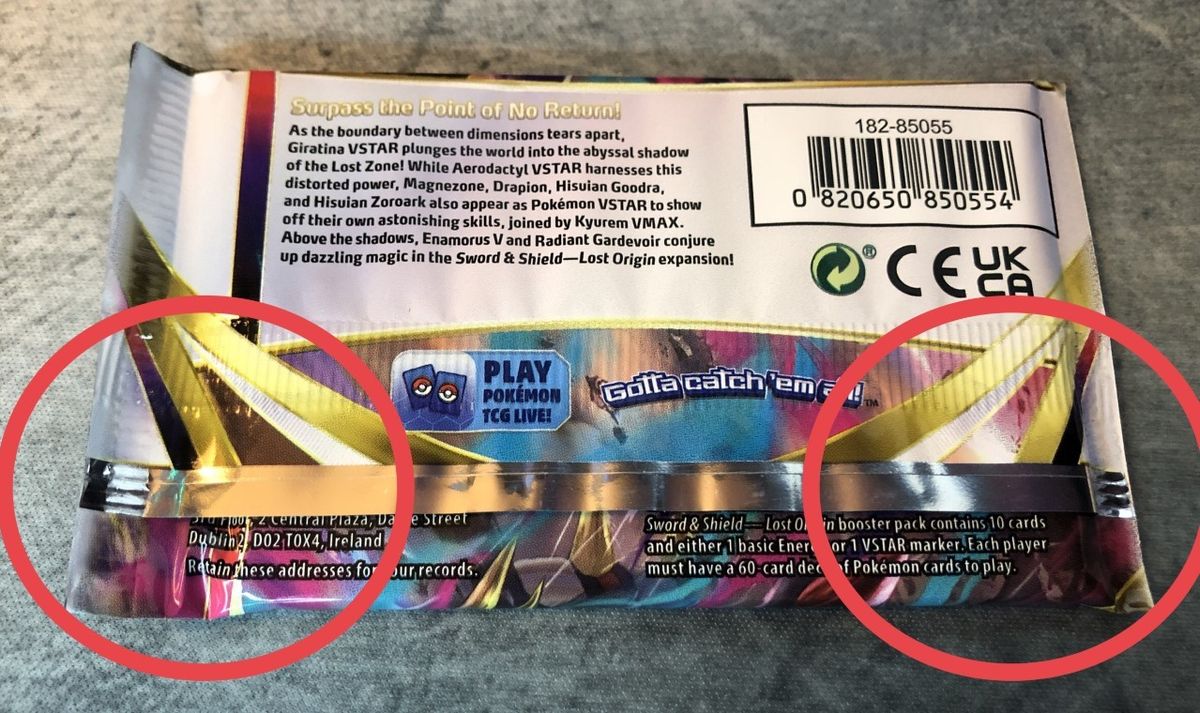 Back fin seamHeat sealed; the two ends (circled) should be lightly adhered
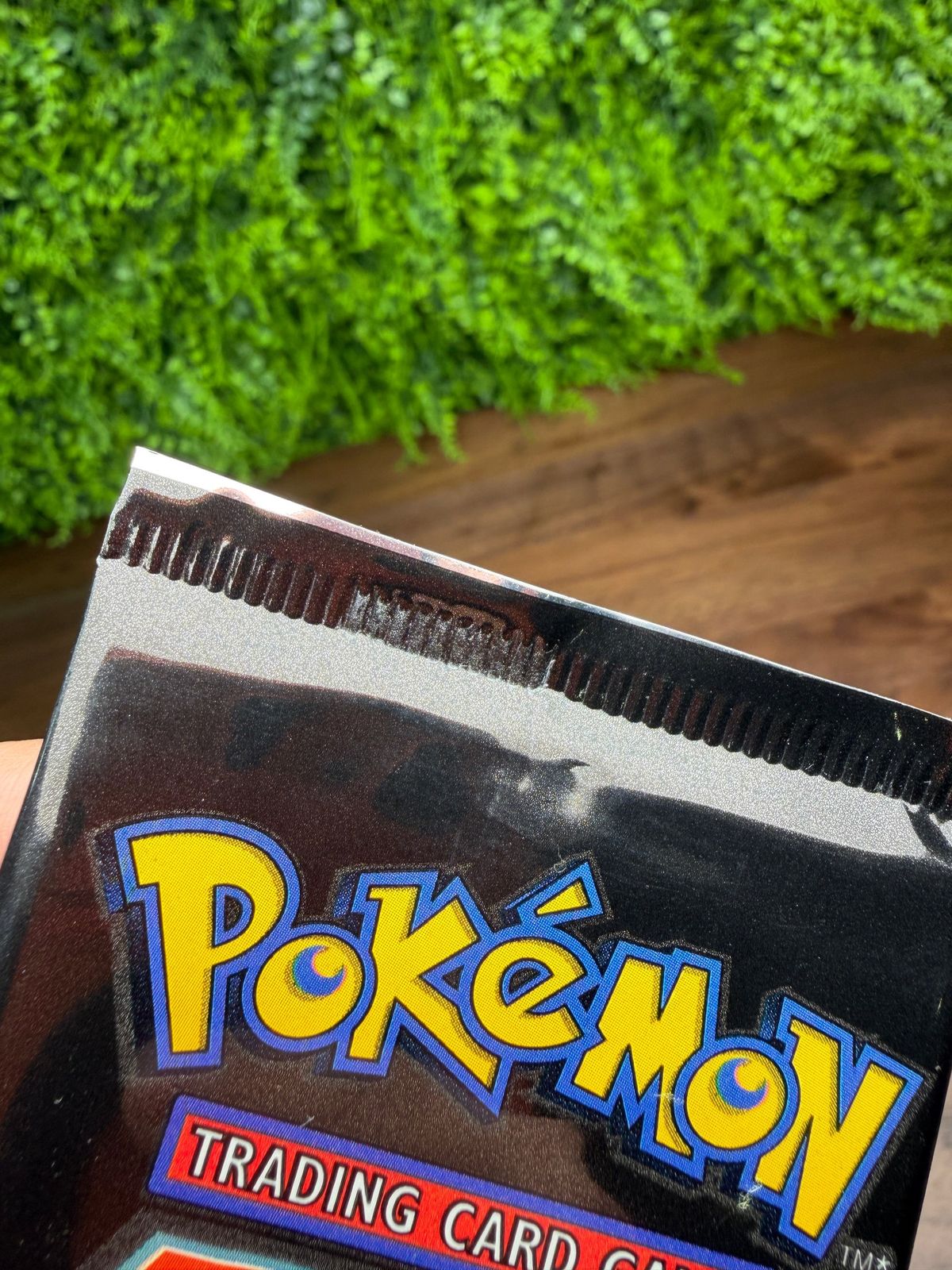 Factory crimp slitsWhere the spine sits behind the crimp the jaws can cut the foil: not damage (Team Rocket)
A booster pack is a foil tube with three seals: a crimp at the top, a crimp at the bottom, and a fin seam down the back. A genuine crimp is even and machine made, and it matches the other packs of its run, though a weak factory run can look off.
| Part of the pack | From the factory | After a reseal |
|---|---|---|
| Top crimp | Even ridging at one constant width | Uneven pressure, flattened or doubled ridges |
| Bottom crimp | Same pattern and width as the top | A pattern that does not match the other end |
| Back fin seam | Flat, lightly adhered, can lift with age | Shine, residue, a seam off its original line |
| The foil | Flat, an occasional single wrinkle | Waviness, stretching, clouding, melted gloss |
| Opening it | Tears easily | Can resist, because adhesive is holding it |
Weighing: what it found, and what it never proved
Weighing works because holo foil is heavier than paper: in vintage sets, a pack with a holo weighs a few tenths of a gram more than one without, often enough to sort a box on a 0.01 g scale and too little for a kitchen one. Sellers label the result heavy, light, middle or unsearched, and unsearched is hard to verify once a pack has changed hands.
There is no 21 g
A pack is heavy only against its own box, never against a universal number, because the band drifts from box to box with print run, era and storage. Across eight Base Set Unlimited boxes, the holo packs weighed 21.00 to 21.87 g and the others 20.43 to 21.42 g: the ranges overlap, yet inside each box the split was clean, while the whole band slid from about 20.4-21.1 g in one box to 21.3-21.9 g in another.
| Set or print run | Era | Packs weighed | Measured range (g) | Spread (g) |
|---|---|---|---|---|
| Fossil 1st Edition | WOTC | 360 | 20.54-22.67 | 2.13 |
| Base Set Unlimited | WOTC | 288 | 20.43-21.87 | 1.44 |
| Jungle 1st Edition | WOTC | 216 | 20.03-21.47 | 1.44 |
| Fossil Unlimited | WOTC | 144 | 20.48-21.44 | 0.96 |
| Gym Heroes 1st Edition | WOTC | 216 | 20.31-20.95 | 0.64 |
| Neo Genesis 1st Edition | WOTC | 107 | 20.37-20.84 | 0.47 |
| Aquapolis | e-Card | 72 | 17.49-17.77 | 0.28 |
| Legend Maker | EX | 36 | 17.04-17.28 | 0.24 |
| Plasma Blast | Black & White | 36 | 19.83-20.28 | 0.45 |
| Expedition, Japanese | e-Card | 40 | 8.50-8.86 | 0.36 |
Measured full ranges, not medians, from 2,513 packs weighed to 0.01 g while breaking sealed boxes.
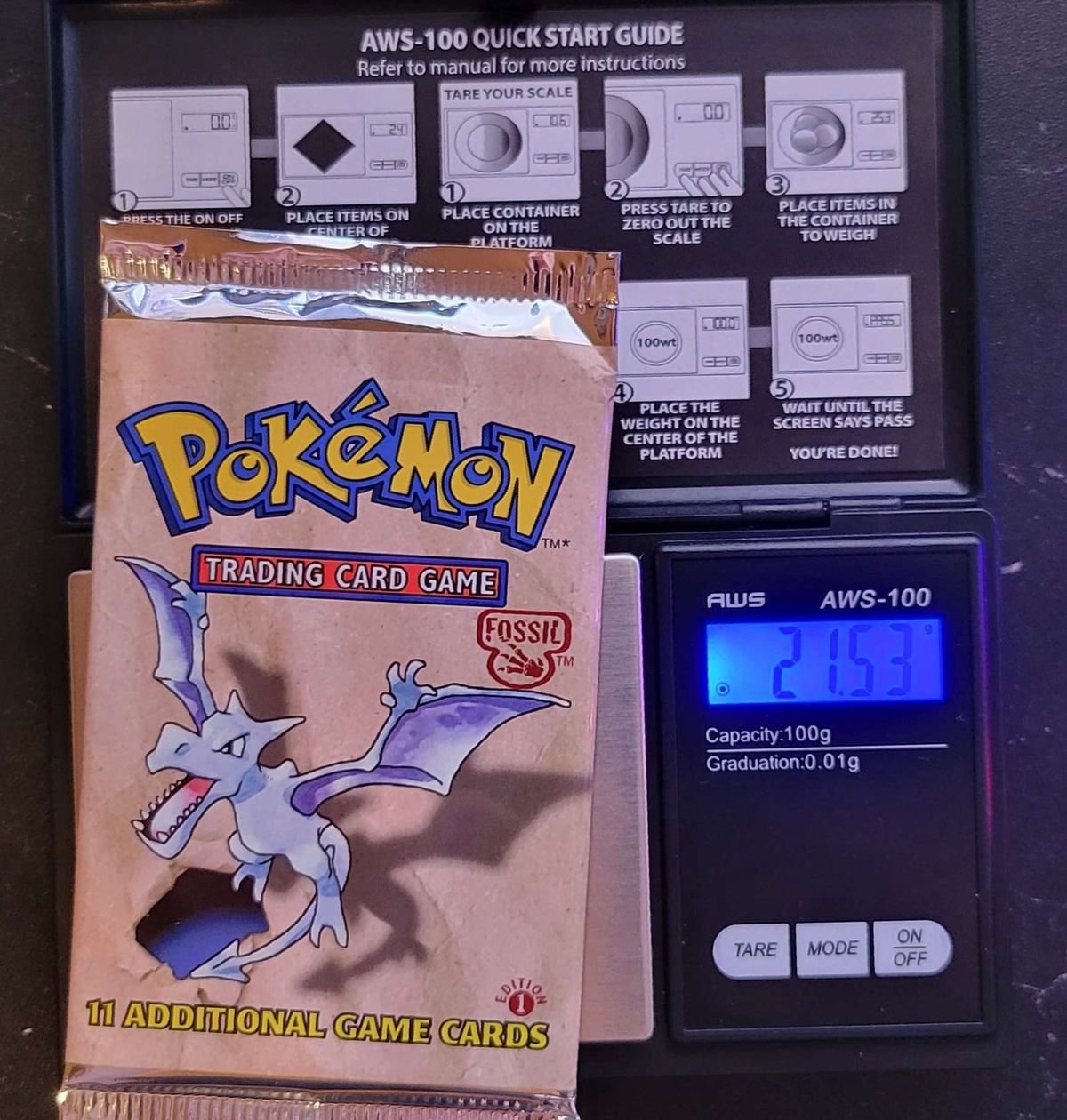 21.53 g, Fossil 1st EditionA 0.01 g scale. The gap between light and heavy is a few tenths of a gram
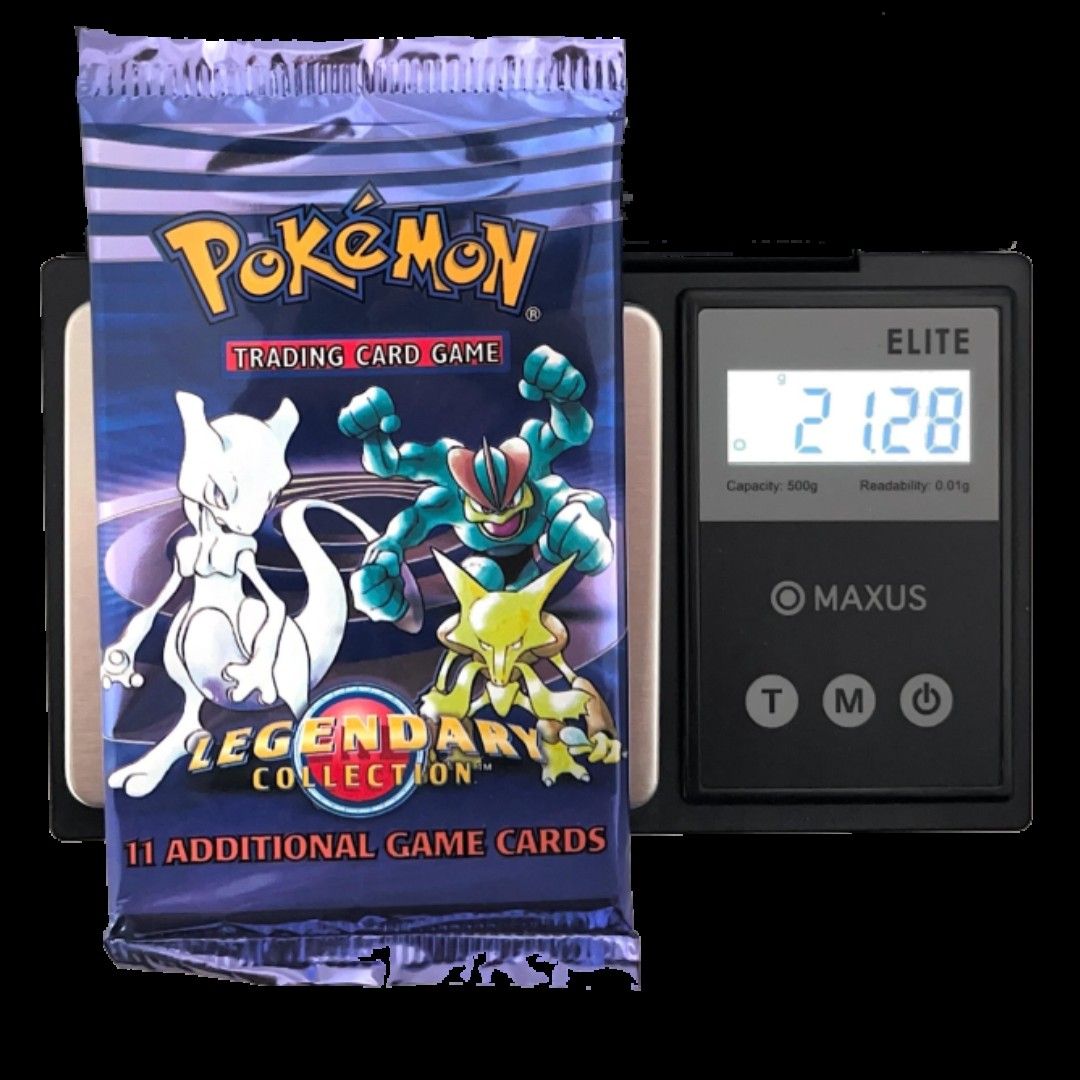 21.28 g, Legendary CollectionSold as heavy. Heavy means heavier than most of its own box, not above a fixed number
Read the spread, not the range. Fossil 1st Edition spreads 2.13 g and separated its holos cleanly in 9 boxes out of 10; Legend Maker spreads 0.24 g and does not separate at all, and Dragon Frontiers and Holon Phantoms overlap the same way. The eight Base Set Unlimited boxes held 96 holos, 12 per box of 36 packs on average, but single boxes in the same dataset held anywhere from 6 to 18.
When weighing stopped working
It works set by set, and three changes made it harder:
- 1999 to early 2002, Base Set to Neo Destiny. 11-card packs, no code card, and one foil variable, the holo. Most of the measured sets that split cleanly in every box are from these years, though some Neo sets overlap.
- From 2002, a reverse holo in every pack. Legendary Collection (May 2002) added one to every pack, and e-Card and EX packs (from September 2002) held 9 cards including one. Measured results are mixed: Skyridge, Team Rocket Returns and Deoxys still split cleanly, Aquapolis in one box of two, and five EX sets overlap.
- From 2011, the code card. Every standard English booster pack has carried one since Emerging Powers (August 2011). In 648 Sword & Shield packs weighed on a laboratory scale in 2020, the code card that came with a regular rare was thicker and about 0.18 g heavier, which offset the foil: packs averaged 22.46 g with a holo or better and 22.49 g without. A 72-pack Temporal Forces test in 2024 found the opposite: all 10 packs over 22.47 g held a hit, against 7.6% of the packs just below. Neither found a clean split like Fossil's, and neither proves a modern set cannot be sorted: treat a modern loose pack as possibly sorted.
Japanese packs
Japanese packs carry no code card and usually no Energy (the 30th CELEBRATION pack has one), and at least one Japanese set separates perfectly: in 40 Japanese Expedition packs, the holos weighed 8.77-8.86 g and the others 8.50-8.56 g. Whether a set separates depends on the set and its print run, not on the language.
Booster boxes, English and Japanese
Check the film first, then the box under it:
| On the box | Factory | Suspect |
|---|---|---|
| Film, modern English box | Printed Poké Ball and Pokémon logo pattern | Plain film, or no print at all |
| Film, Japanese box | Plain, unprinted film, or none: many Japanese shops remove it at the till | The film proves nothing either way |
| Japanese box with a perforated tear strip (since late 2022) | The strip intact along the top | A torn, lifted or reglued strip |
| Seams | One continuous seam | A second seam or an overlap |
| Tape | Never used | Any tape, shadow or adhesive shine |
| Cuts | None anywhere | Any slit in the film |
| Box under the film | Condition matches the film | Scuffed box, pristine film |
| Packs inside, once open | Modern English: standing front to back, 36 of them | Random layout, a pack short |
| Tightness | Varies by set and print run | Decides nothing on its own |
Printed logos can fade in transit, so faint is not absent. To find tape, hold the box at an angle against a bright light and look for a rectangular shadow. Tightness decides nothing: some sets leave air under the film, and resealers own equipment that pulls a tight seal. On vintage product, trust the packs' crimps over the film.
A Japanese box without film is normal: many Japanese shops remove it at the till so the box cannot be resold as sealed, most Pokémon Centers in Japan among them, and Pokémon Center Singapore began doing the same with English boxes in March 2025. The seal that counts is the box's own. Since late September 2022, Japanese expansion boxes have been moving to a perforated strip along the top that must be torn to open them: on a box that has one, intact means unopened, film or no film, and torn or reglued means opened. Older Japanese boxes open with a tuck-in flap and prove nothing once the film is gone.
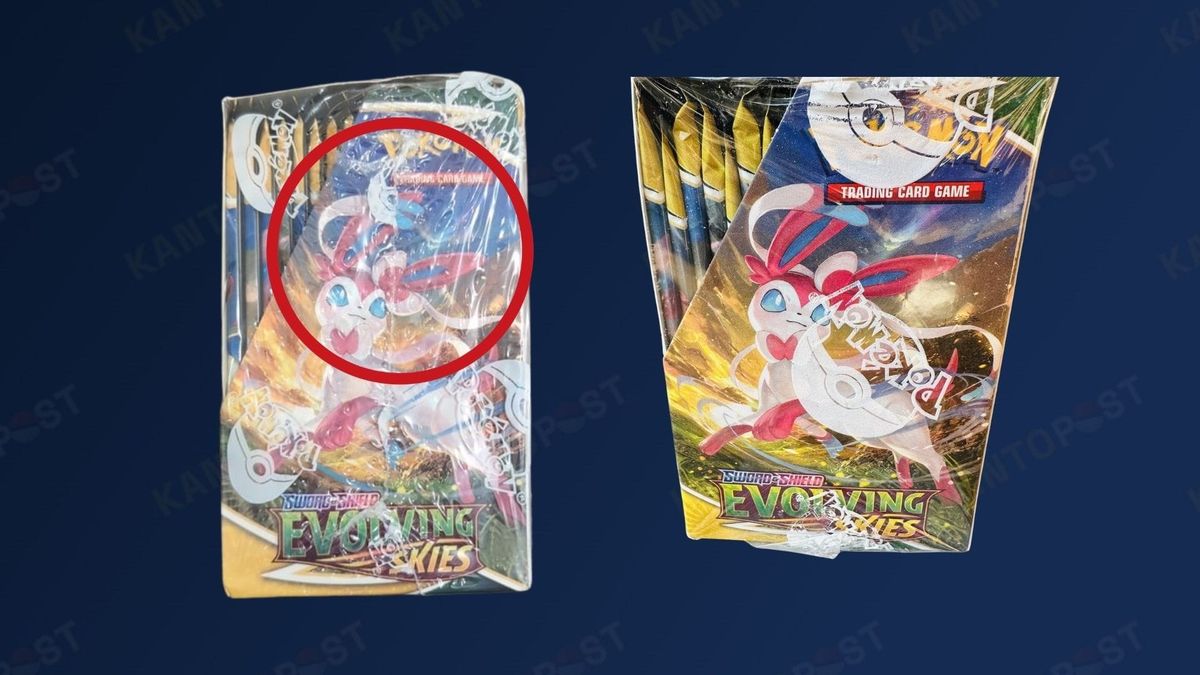 Resealed box (left) and genuine (right)Evolving Skies. The film on the resealed box is misshapen and loose; the genuine film carries the printed logo pattern
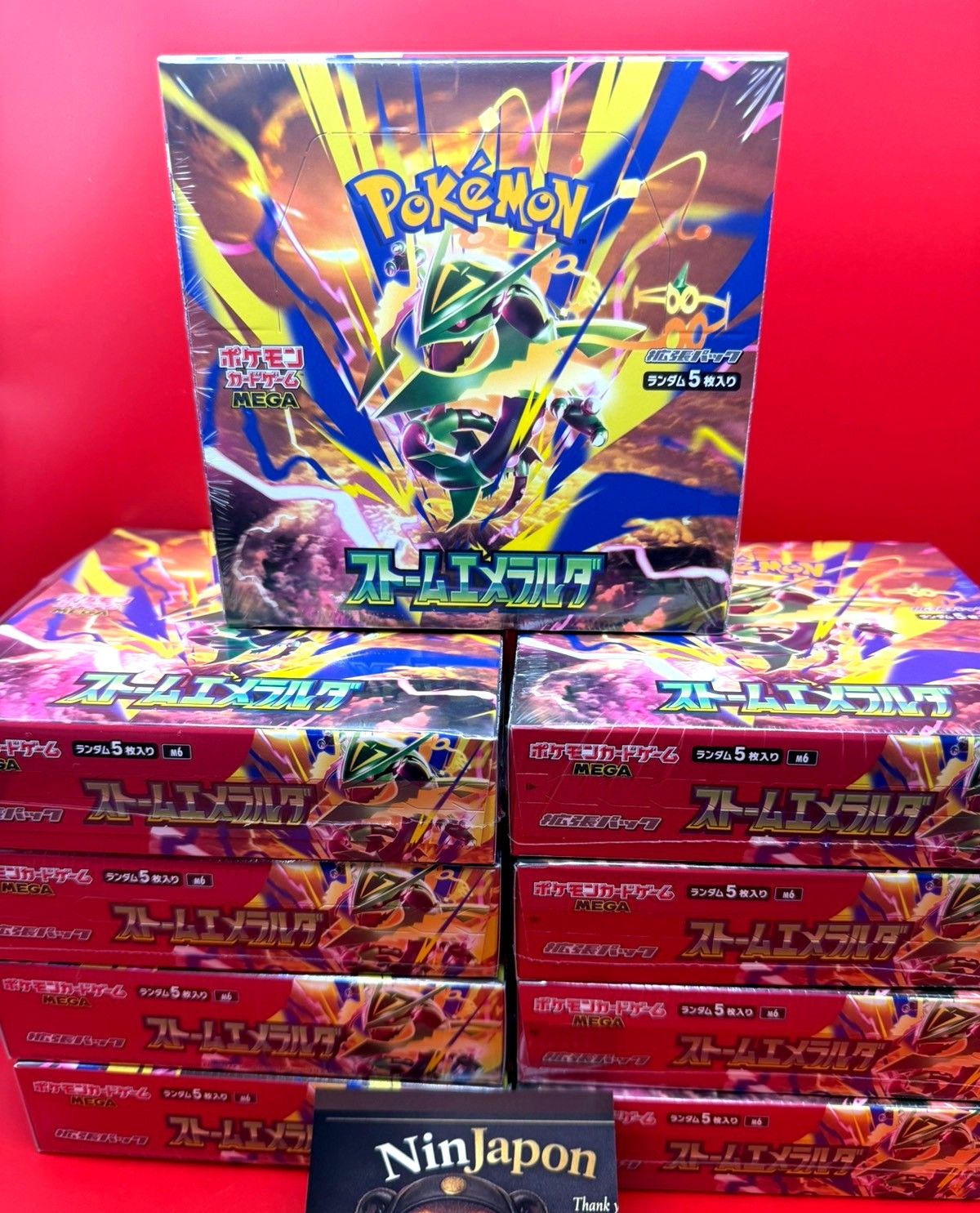 Japanese boxes, plain filmJapanese product ships in unprinted shrink, so the printed-film test only applies to English boxes
Elite Trainer Boxes, bundles, tins and blisters
- Elite Trainer Boxes, booster bundles and tins hold loose packs under an outer film, so an opened one can be refilled and rewrapped: check the film's seams, and its printed pattern where the genuine product has one.
- Blisters seal a pack under a plastic bubble on a printed card: look all the way round the bubble for lifting, glue or tape, and at the back for a cut.
- Sleeved boosters can be opened and closed again: check the cardboard sleeve's seams, then the pack's crimps.
Loose pack or sealed box: what real prices say
Vintage and modern loose packs trade against boxes in opposite directions, and the gap is what buyers pay, not a measure of searching risk:
| Set | Box or bundle, per pack | Loose pack | Loose vs box per pack | Sales behind it |
|---|---|---|---|---|
| Base Set (Unlimited, 1999) | $1,092 | $636 | 58% | 2 boxes est., 17 packs |
| Jungle (Unlimited, 1999) | $464 | $310 | 67% | 3 boxes, 6 packs |
| Evolving Skies (2021) | $62.46 | $44.71 | 72% | 28 boxes, 13 packs |
| Sun & Moon base (2017) | $22.21 | $27.59 | 124% | 5 boxes, 14 packs |
| Vivid Voltage (2020) | $8.28 | $12.17 | 147% | 18 boxes, 8 packs |
| Surging Sparks (2024) | $7.99 | $9.88 | 124% | 36 boxes, 13 packs |
| 151 (2023, 6-pack bundle) | $26.82 | $26.82 | 100% | 53 bundles, 5 packs |
| Prismatic Evolutions (2025, bundle) | $13.25 | $13.80 | 104% | 35 bundles, 5 packs |
As of September 24, 2026, medians of real completed sales in US dollars. Box per pack is the sold box price divided by 36 packs, bundles by 6. The latest sales behind the two vintage box medians date from June 2026.
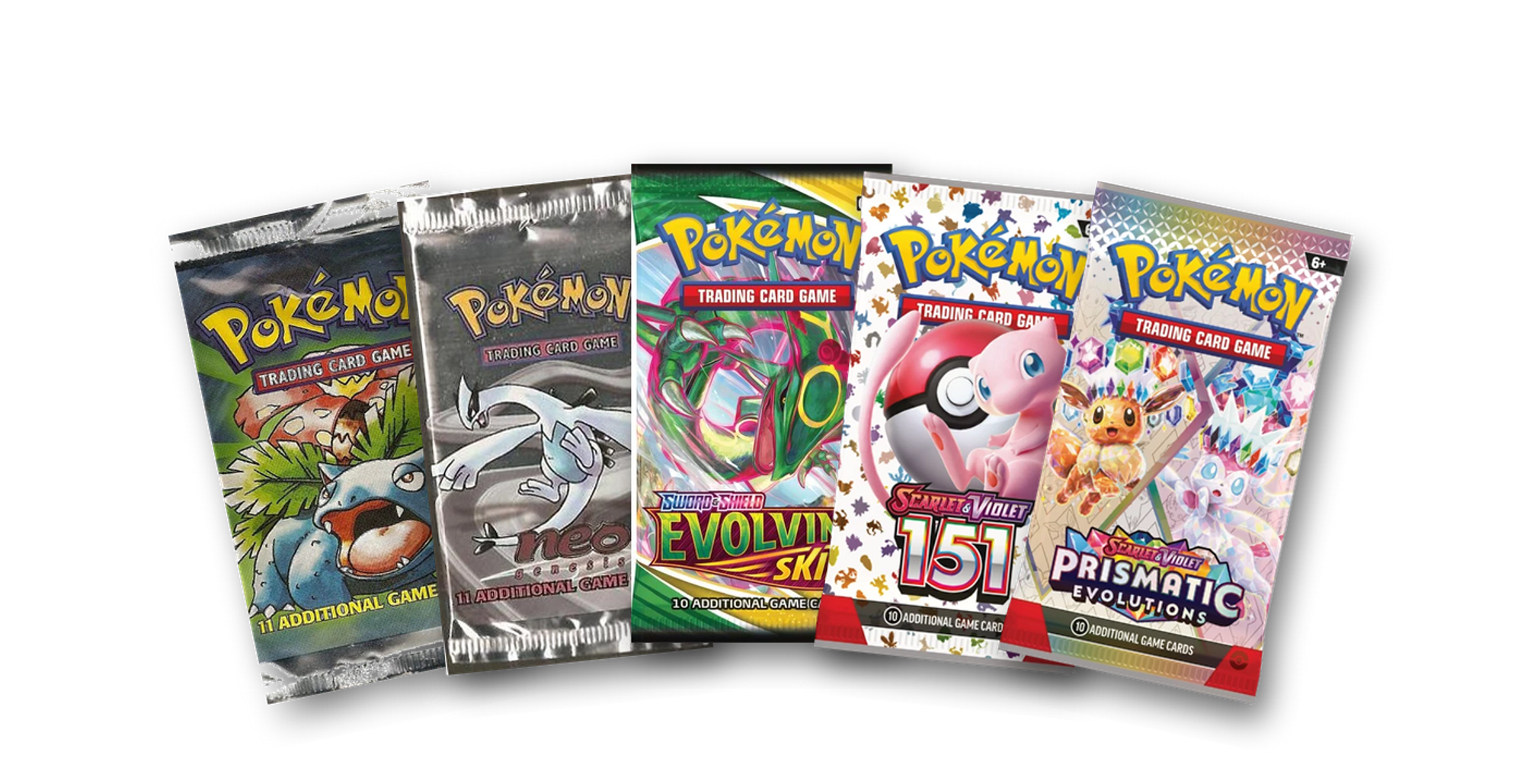 The wrapper changed, the seals changed, and so did what a loose pack is worth against a box.
Vintage loose packs sell well under box per pack. Searching risk is part of that discount, but so are the collector premium on an intact box, provenance, condition and thin samples: two box sales behind the Base Set line. Evolving Skies is the one modern set here that trades the same way, at 72%.
The other modern sets sell at or above box per pack, from 100% to 147%. So on modern product the alarm is not a loose pack priced above box per pack, which is normal, but one priced well below it. Base Set loose packs also split by print run: Shadowless $1,726 (3 sales) and 1st Edition $10,435 est. (2 sales), against $636 for Unlimited.
Each step up the ladder, loose, sleeved, blister, box, case, buys provenance: packs in a box or blister still sealed by the factory were never weighed one by one, while loose is the easiest format to cherry-pick or reseal. Channel matters as much as format: see where to buy Pokémon cards.
The graded route and its limit
PSA authenticates unopened packs before grading them: it inspects the seal for resealing, repairs, restoration and other alterations, and grades only a pack judged authentic with its seal intact. It takes wax, cello and plastic foil packs, not rack packs, and has not accepted the 1999 to 2000 long packs for grading since September 2024.
| Service | Fee per pack | Pack worth up to | Business days |
|---|---|---|---|
| Value | $29.99 | $500 | 125-140 |
| Economy | $49.99 | $1,000 | 85-95 |
| Express | $149 | $2,500 | 45-55 |
| Four premium tiers | $299 to $1,999 | $5,000 to over $50,000 | 30-35 |
PSA's US prices and estimated turnaround as of September 24, 2026.
The tier follows the pack's value, not the fee you would like to pay. Against our table, a Base Set Unlimited loose pack at $636 falls in the Economy tier, $49.99 or about 8% of its price before shipping, while an Evolving Skies pack at $44.71 pays $29.99, two thirds of its price.
PSA prints the limit itself: on packs whose cards are not visible, which means every foil pack, only the outside of the wrapper is identified, and the label does not guarantee the cards inside are as the manufacturer described. So a slab is good evidence that a pack was not resealed, not proof: the confirmed case above wore a PSA 9 label. And a slab says nothing about weighing. More in what a Pokémon slab is.
If you think it already happened
- Photograph everything before you touch it further: film, seams, both crimps, contents.
- Film expensive openings end to end: a continuous video from sealed product to opened pack is what survives a dispute.
- Do not open a suspect pack to prove the point unless you accept the loss. Opening destroys its value and settles the question only one way: cards that cannot belong to the wrapper prove a reseal, plausible contents prove nothing.
- Keep all the packaging until the dispute closes.
- Use the platform's item-not-as-described route. A shop will usually refuse an opened pack, and the publisher replaces only whole packs with manufacturing damage to more than half their cards, bought at retail within the previous 10 business days.
FAQ
How many cards are in a 30th Celebration pack?
Five foil cards, one of them a Pikachu rare, plus a foil basic Energy and a code card, so five cards is the right count for that pack, not a sign of a reseal. The Japanese 30th CELEBRATION pack holds six foil cards, one of them a basic Energy.
Why is my Japanese booster box not shrink wrapped?
Many Japanese shops, most Pokémon Centers among them, remove the film at the till. If the box has the perforated strip on top that Japan began using in late 2022, check the strip instead: intact means unopened.
How much should a Pokémon pack weigh? Is 21 g heavy?
There is no universal cutoff: Jungle 1st Edition measured 20.03-21.47 g and Fossil 1st Edition 20.54-22.67 g, so no single number sorts both sets. A pack is heavy only against the other packs of its own box.
What scale do I need to weigh packs?
One that reads 0.01 g: inside one box, the heaviest ordinary pack and the lightest holo can sit only a few hundredths of a gram apart, too close for a 0.1 g scale.
Are loose Pokémon packs worth buying?
Most modern loose packs sold at or above the box or bundle price per pack in September 2026 (100% to 147%): a convenience premium, not a bargain. Vintage packs and Evolving Skies sold at 58 to 72%, a discount that fits, among other things, the chance they were weighed.


