
Three marks tell the four English Base Set prints apart: the 1st Edition stamp, a drop shadow along the right edge of the art frame, and the copyright line at the bottom of the card. A 1st Edition card has the stamp and no shadow, a Shadowless card has neither, and an Unlimited card has the shadow but no stamp. The first two read "©1995, 96, 98, 99 Nintendo", Unlimited drops the 99, and the scarcer fourth print reads "©1999-2000 Wizards". Trainers and Energy never show the shadow, so on an unstamped one the 99 is the only reliable test.
The print is what moves the price. As of September 24, 2026, a Base Set Charizard sold for a median of $209 raw in Unlimited, $1,065 in Shadowless and $8,906 in 1st Edition.
| Stamp | Shadow | Copyright line | Charizard, raw | |
|---|---|---|---|---|
| Yes | No | ©1995, 96, 98, 99 Nintendo, Creatures, GAMEFREAK. ©1999 Wizards. | 1st Edition, the first run | $8,906 (14 sales) |
| No | No | Same as 1st Edition | Shadowless, the second run | $1,065 (13 sales) |
| No | Yes | ©1995, 96, 98 Nintendo, Creatures, GAMEFREAK. ©1999 Wizards. | Unlimited, the third run | $209 (87 sales) |
| No | Yes | Same as Unlimited, but ©1999-2000 Wizards. | Fourth print, 2000 | not tracked separately |
| Yes | Yes | Any | Machamp, or an added stamp | see Machamp below |
Medians of real completed sales in US dollars, as of September 24, 2026. Raw means ungraded, in whatever condition it sold. On a Trainer or an Energy, skip the shadow column and read the 99.
Which print is it, step by step
Check that it is Base Set. The number reads x/102 and no set symbol sits under the right corner of the art. A symbol, or another total such as 64 (Jungle), 62 (Fossil) or 130 (Base Set 2), means a later set, covered below.
Find the stamp. It is a 1 on a solid black circle (gray on a few genuine copies) with EDITION arching over it, and it moves with the card type: on the left edge just under the art on a Pokémon, in the bottom left corner on a Trainer, in the top right corner on an Energy. Looking for it at the Pokémon position on a Trainer is an easy way to miss one.
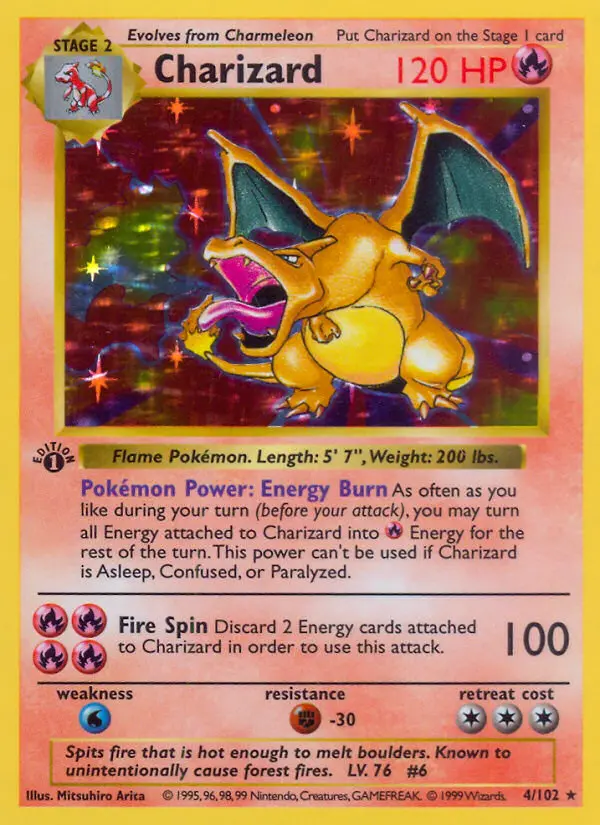


Look at the art frame (Pokémon cards only). Unlimited and fourth-print cards have a dark drop shadow along the right edge and the bottom of the frame. On 1st Edition and Shadowless cards the frame is flat yellow, and the HP and attack text are thinner.
Read the copyright line. It runs along the bottom edge, after the illustrator's name. A 99 after "96, 98" means 1st Edition or Shadowless, no 99 means Unlimited, and "©1999-2000 Wizards" means the fourth print, a UK release of 2000, often lighter in color and far scarcer than Unlimited. On an unstamped Trainer or Energy, this line is the only reliable test.
Rule out the exceptions. Machamp carries the stamp on every holo copy, other languages print their 1st Editions with a shadow, and several genuine reprints copy the art: each is covered below.
What each print is worth
Grade moves the price too. Charizard's raw medians sit at or below the price of a PSA 3 of the same print, most likely because many raw copies that sell are played: a clean raw copy can sell well above them.
| Charizard 4/102 | Raw | PSA 5 | PSA 7 | PSA 8 |
|---|---|---|---|---|
| 1st Edition | $8,906 (14 sales) | $16,803 (3 sales) | $29,443 est. (1 sale) | $31,391 est. (1 sale) |
| Shadowless | $1,065 (13 sales) | $1,871 (13 sales) | $3,165 (7 sales) | $5,077 (11 sales) |
| Unlimited | $209 (87 sales) | $434 (7 sales) | $853 (5 sales) | $1,403 (15 sales) |
The other holos follow the same order at lower prices:
| Holo, raw | Unlimited | Shadowless | 1st Edition |
|---|---|---|---|
| Charizard 4/102 | $209 (87 sales) | $1,065 (13 sales) | $8,906 (14 sales) |
| Blastoise 2/102 | $99.35 (33 sales) | $277 (11 sales) | $1,483 (5 sales) |
| Venusaur 15/102 | $69.55 (23 sales) | $206 (13 sales) | $1,230 (10 sales) |
| Mewtwo 10/102 | $25.84 (50 sales) | $129 (8 sales) | $955 (6 sales) |
Both tables: medians of real completed sales in US dollars, as of September 24, 2026. No PSA 10 of these Charizards has a current median.
Should you grade it?
Handle a possible 1st Edition or Shadowless holo by the edges, and put it in a penny sleeve and a toploader before anything else. A slab answers two questions at once: graders authenticate a card before they grade it, which usually catches an added stamp, and on a Base Set slab PSA's label names the print, adding 1ST EDITION or SHADOWLESS after the card name. A 10 is rare: PSA had given one to 123 of the 5,609 1st Edition Charizards it had graded by September 24, 2026, and since owners choose which copies to send, that share is not the chance for yours.
PSA prices a submission by the card's value after grading. As of September 24, 2026, its cheapest US tier is Standard, $59.99 a card for cards worth up to $1,000 (about 90 to 100 business days), with the Value tiers paused. Priority costs $79.99 up to $1,500, Express $199 up to $2,500, Super Express $349 up to $5,000, Premier $599 up to $10,000, and the Premium tiers start at $999 for up to $25,000. If the graded card is worth more than its tier's ceiling, PSA moves it up and bills the difference. Grades, labels and when a slab pays are covered in what a Pokémon slab is; collectors in the European Union can submit in euros through PSA's Frankfurt office.
Machamp: stamped on every holo
Machamp 8/102 never came in booster packs. It came in the 2-Player Starter Set, and every holo copy carries the 1st Edition stamp, so there is no Unlimited Machamp and a stamp beside a shadow is normal on this one card. What separates the prints is the rest:
| Machamp 8/102 | Stamp | Shadow | Raw |
|---|---|---|---|
| 1st Edition Shadowless, first print of the starter set | Yes | No | $42.12 (35 sales) |
| 1st Edition, later prints | Yes | Yes | $14.96 (57 sales) |
| 1st Edition, ©1999-2000 print | Yes | Yes | not tracked separately |
| 1st Edition Cosmos holo, 2-Player CD-ROM Starter Set (2000) | Yes | Yes | not tracked separately |
| Trainer Deck A, non-holo | No | Yes | not tracked separately |
Medians of real completed sales in US dollars, as of September 24, 2026. A PSA 10 of the common 1st Edition Machamp sold for $3,015 est. (1 sale).
The Cosmos holo shows dots and circles where the 1999 holos, Machamp's included, show starbursts, as our holo patterns guide illustrates. The Trainer Deck A copy has a red-bordered back that reads Trainer Deck A: it went to prototype Pokémon Leagues before the North American launch.
Fake 1st Edition stamps
A stamp multiplies the price of a Shadowless or Unlimited card, so adding one is a known scam. Four checks:
- The print has to match the stamp. On an English Base Set card other than Machamp, a stamp beside a shadowed frame, or with a copyright line that lacks the 99, did not leave the factory that way.
- Compare the stamp itself with a genuine stamp in the same position on the same card type. A genuine stamp was printed at the factory: flat, crisp and usually in the same black as the text around it. A few genuine Base Set copies came out with a lighter gray stamp, which graders recognize case by case, so a gray stamp alone proves nothing. An added one can sit off, show a different black or sheen, feel raised or smudge.
- Thick and thin stamps are both genuine. 1st Edition Base Set holos exist with a bolder and a thinner stamp; collectors disagree on which is scarcer, and PSA's population report does not separate them.
- Check the whole card. A convincing stamp can sit on a counterfeit card, and no single check proves a card genuine: our guide to spotting fake Pokémon cards gives the full method.
Jungle to Neo Destiny: a stamp, always a shadow
Shadowless exists only in the English Base Set. Jungle, Fossil, Team Rocket, Gym Heroes, Gym Challenge and the four Neo sets had 1st Edition runs printed with the shadow, so on those cards the stamp alone separates 1st Edition from Unlimited. Neo Destiny (February 2002) was the last English set with 1st Edition prints: a 1st Edition stamp on a later English card is not genuine, and neither is any "2nd Edition" stamp.
Two genuine errors look like warning signs: every English Unlimited Jungle holo was also printed without its set symbol (it still reads x/64), and a Shadowless Ninetales exists with the damage of an attack missing.
Base Set 2 and the anniversary reprints
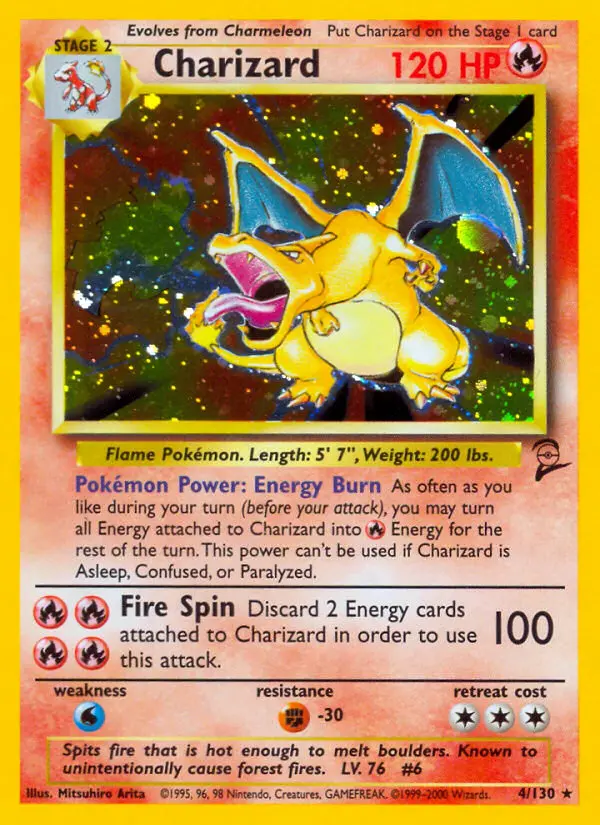
Base Set 2 (February 24, 2000) reprinted 130 cards from Base Set and Jungle. Its cards are numbered out of 130 and carry a set symbol, a 2 with a Poké Ball, under the right corner of the art; the original Base Set has no symbol. It never had a 1st Edition run, and its Charizard reads ©1999-2000 Wizards like the fourth print, so the number is the tell: x/102 with no symbol is Base Set.

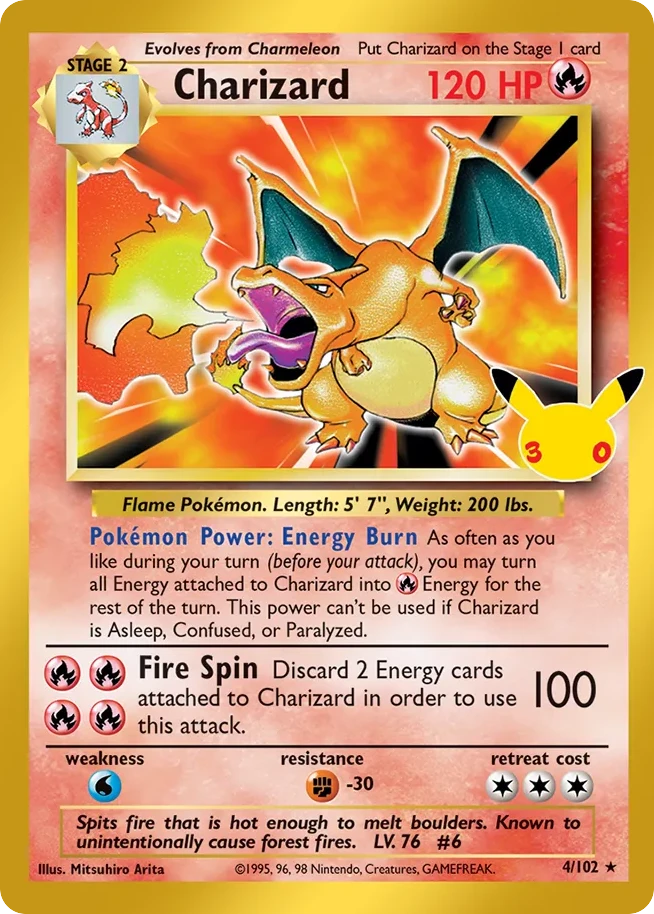
The anniversary reprints keep the original number but add a 25 or 30 logo to the art, and their Charizards stop the copyright line after GAMEFREAK, with no Wizards line; the 2026 ones have gold borders. Evolutions (November 2016) put the art on a new card, with 150 HP, new attacks, its own set symbol and the number 11/108. Their raw medians as of September 24, 2026: Base Set 2 Charizard $321 (12 sales), Celebrations $160 (35 sales), 30th Celebration $194 (180 sales), Evolutions $60.38 (21 sales).
Pikachu: red cheeks and yellow cheeks
Base Set Pikachu 58/102 was printed with red cheeks on part of the first two runs, about half of each by collectors' estimates; every Unlimited Pikachu has yellow cheeks, like the Japanese original. A red-cheeked copy without a gold stamp is therefore 1st Edition or Shadowless, and collectors generally pay more for it.
Two gold foil stamps on this Pikachu mark promos, not editions: E3, given at the E3 show in May 1999 with red cheeks and later with yellow cheeks through Nintendo Power, and PokéTour 1999, on yellow-cheeked copies only, in the top right corner of the art, from a tour of Australia.
Other languages
European prints: a stamp, but a shadow
Base Set was also printed in Dutch, French, German, Italian, Portuguese and Spanish, most of them with a 1st Edition and an Unlimited run. None has a Shadowless print: their 1st Editions have the shadow and the thicker text of their Unlimited cards, and only the stamp tells the two apart.
The copyright rule is English-only as well. Spanish non-holos of both runs were printed with ©1999 for Spain and ©1999-2000 for Latin America, so a Spanish 1st Edition can read 1999-2000; Spanish holos read 1999 only. Prices sit far below the English ones: as of September 24, 2026, a French 1st Edition Charizard sold for $1,146 raw (7 sales) and a German one for $774 (9 sales).
Japanese: No Rarity, then a 1st Edition mark
The Japanese Base Set (Expansion Pack, October 20, 1996), the game's first set, has no 1st Edition mark. Its first print has no rarity symbol at the bottom right, where later prints show a circle, diamond or star, the symbols of our rarity guide. Collectors treat these No Rarity cards as the Japanese first edition, and in March 2026 a PSA 10 No Rarity Charizard sold for $1.7 million in a private sale.
Japan printed a 1st Edition mark from Pokémon VS and Pokémon Web (2001) to Expansion Pack 20th Anniversary (September 2016): a large 1 over the word EDITION, between two lines. It sits at the lower right, by the card number, on the sets of 2001 and 2002, and at the lower left, opposite the set symbol, from 2003 on. Trainers and special Energy cards carry it too.


A Japanese card from the Sun & Moon series (December 2016) or later with a 1st Edition mark is not genuine. And for many Japanese sets the 1st Edition run was the larger one, so an Unlimited copy is often the harder one to find.
FAQ
Is Shadowless the same as 1st Edition?
No. Both lack the shadow and both read ©1995, 96, 98, 99, but only 1st Edition cards carry the stamp. Shadowless is the second run, printed after the stamp was dropped and before the shadow was added.
What does ©1999-2000 on a Pokémon card mean?
On a Base Set card numbered out of 102, it marks the fourth print, a UK release of 2000 that is far scarcer than Unlimited. The same Wizards line is printed on Base Set 2, Team Rocket, Gym Heroes and Gym Challenge cards, numbered out of 130, 82 or 132 and carrying a set symbol, and on Spanish cards printed for Latin America.
Do Jungle or Fossil cards come in Shadowless?
No. Shadowless exists only in the English Base Set: every Jungle and Fossil card has the shadow, 1st Edition included.
Do 2nd Edition Pokémon cards exist?
No genuine card carries a 2nd Edition stamp. Most English sets up to Neo Destiny (2002) came in 1st Edition and Unlimited, and Base Set also had its Shadowless and ©1999-2000 prints.


