
The first Pokémon cards ever sold were Bandai's Carddass vending-machine cards, which Bandai's own advertisement put on sale in Japan in the last ten days of September 1996. The first cards of the Pokémon Trading Card Game came two to three weeks later: a Pikachu and a Jigglypuff inserted in CoroCoro Comic, on sale October 15, 1996, five days before the game's first set, the Expansion Pack known in English as Base Set, went on sale on October 20. Which card came off a press first is not on record.
In English, the earliest known cards are Blastoise test prints that Wizards of the Coast made in mid-1998, and the first set, Base Set, went on sale on January 9, 1999. The popular answer "the 1995 Topsun cards" is wrong: those gum cards came out in 1997.
| First | Card | Date |
|---|---|---|
| Pokémon cards on sale, of any kind | Bandai Carddass Part 1 | September 21 to 30, 1996 |
| Trading Card Game cards, and its first promos | Pikachu and Jigglypuff, a CoroCoro Comic insert | October 15, 1996 |
| Trading Card Game set | Expansion Pack (Base Set), 102 cards, Japan | October 20, 1996 |
| Print of that set, as collectors believe | No Rarity cards, without a rarity symbol | October 1996 |
| English cards known | Blastoise test prints by Wizards of the Coast | Mid-1998 |
| English cards on sale | Base Set, 1st Edition print | January 9, 1999 |
| Card number 1 in English | Alakazam 1/102 | January 9, 1999 |
| English promo number 1 | Ivy Pikachu, Wizards Black Star Promo 1 | June 16, 1999 |
Bandai Carddass: the first Pokémon cards (September 1996)
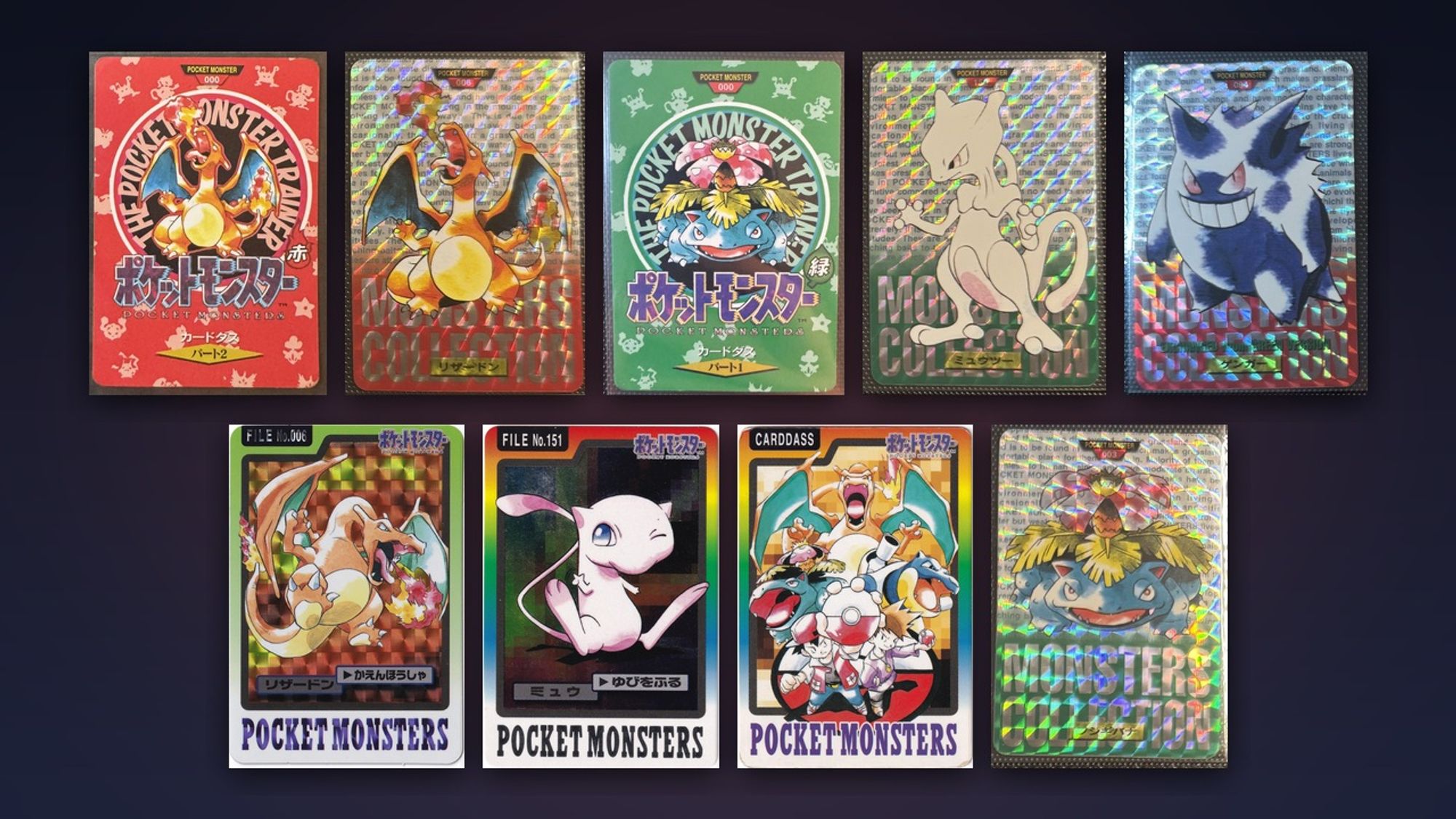
Carddass is Bandai's line of vending-machine cards: the machines sold a single card for 20 yen or a stack of five for 100 yen. Bandai's ad in the October 1996 CoroCoro, on sale September 15, announced Pokémon Part 1 for the last ten days of September and Part 2 for early October. No Pokémon card is known to have gone on sale before them.
The two parts cover all 151 Pokémon between them: 78 different cards in Part 1 and 80 in Part 2, most printed in a red and a green version to match the two Game Boy games, for 153 and 156 cards in all. Each part holds both colors; what separates them is the Pokémon, by Pokédex number and by which game each was exclusive to. The title cards and the four checklist cards come in one color only, and the backs of the title cards reproduce the town map from the game box. The fronts use Ken Sugimori's early watercolors, and eleven backs carry art by Benimaru Itoh.
Carddass cards are collectibles, not game cards: no HP, no attacks, and a slightly smaller size, 59 by 86 mm against 63 by 88. Part 1 already has a Charizard, a holographic Prism card in red and in green, weeks before the game's first Charizard.
The first game cards: Pikachu and Jigglypuff (October 15, 1996)
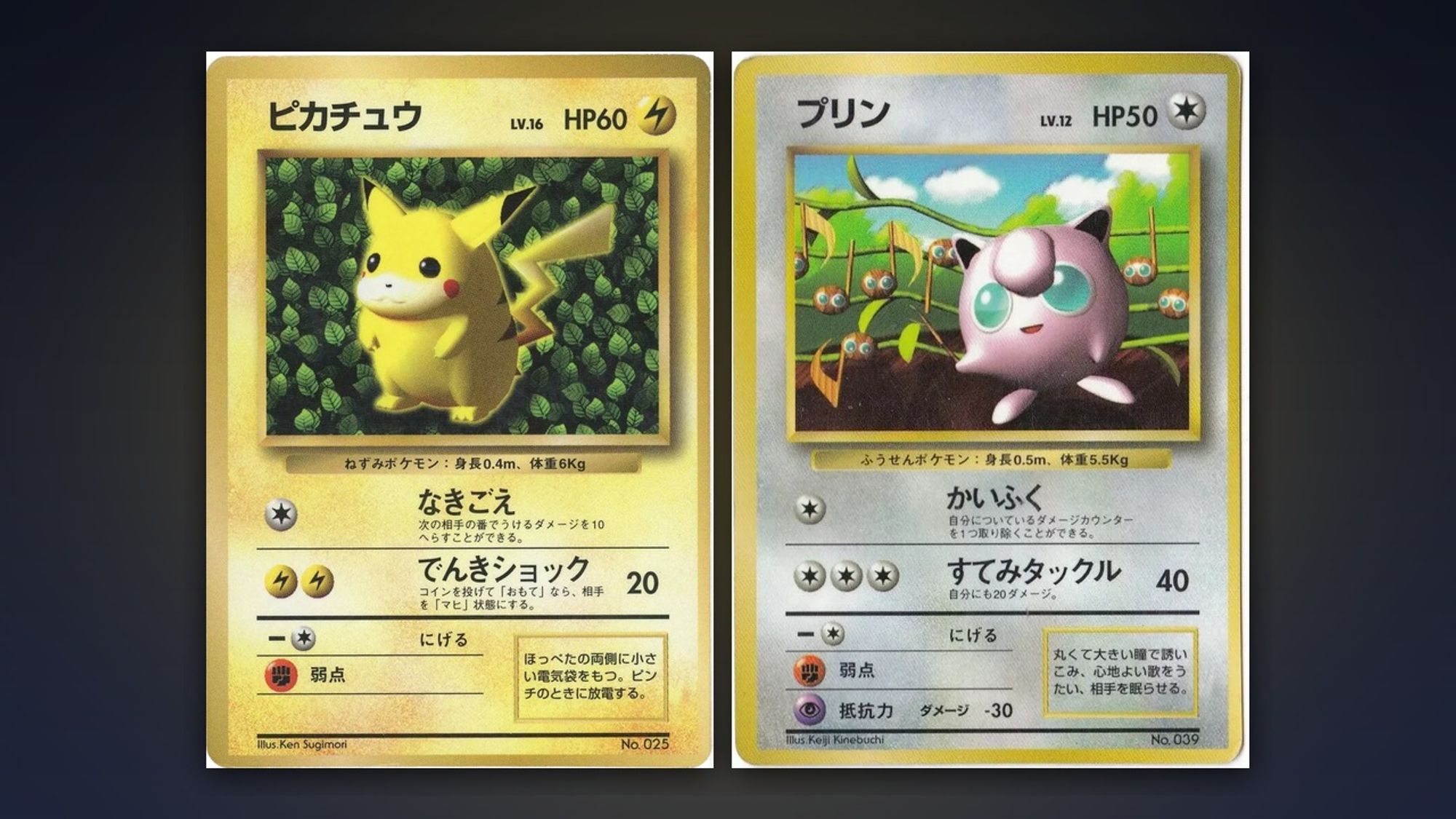
The November 1996 issue of CoroCoro Comic went on sale on October 15, 1996, with a sheet holding two cards of the new game, a Pikachu and a Jigglypuff. The sheet is its own evidence: it invites readers to try the cards in the Pokémon Card Game "that's going on sale soon", advertises the starter deck for October 20, and notes that its Pikachu is a CG version of a card that stores would sell hand-drawn. Cards of the game had been pictured in CoroCoro since the summer, which is why the first card printed cannot be named; these two were the first game cards anyone could take home.
Keiji Kinebuchi rendered both in 3D, but the Pikachu credits Ken Sugimori by mistake, and that error is how you recognize the 1996 original. Collectors call it the Ivy Pikachu, for the ivy leaves behind it. The No. 025 at its bottom right is Pikachu's Pokédex number: Japanese cards of the time carry no set number, unlike Japanese cards today. The magazine kept printing cards for almost thirty years, listed in our CoroCoro guide.
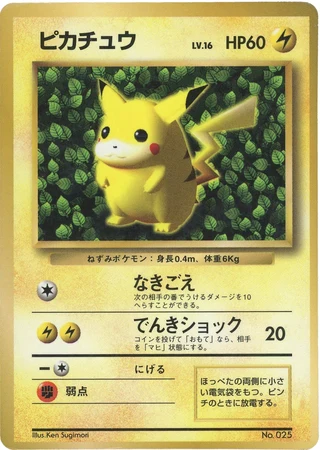 Pikachu (CoroCoro 1996)
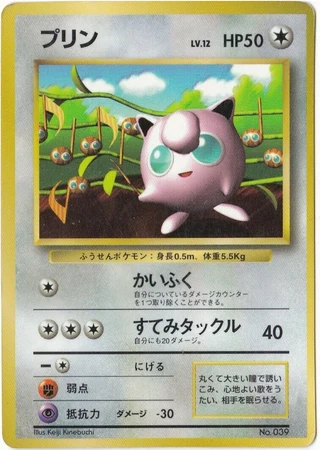 Jigglypuff (CoroCoro 1996)
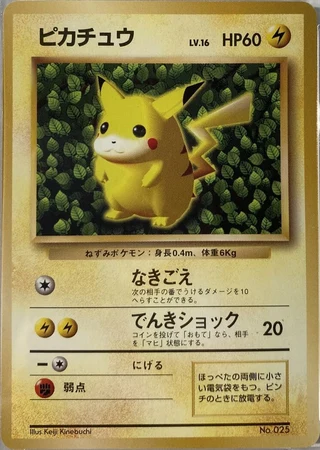 Pikachu (Easily Understand How to Play Pokemon Cards 1996)
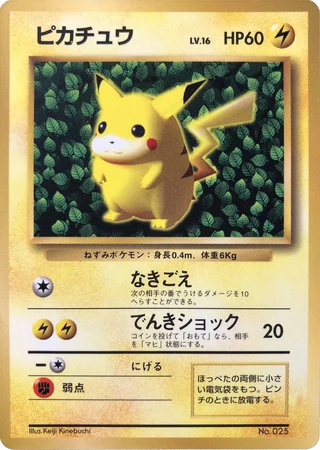 Corrected Illustrator Pikachu (CoroCoro 1998)
Which Ivy Pikachu do you have?
Five printings of this art were made in Japan between 1996 and 1999, and a glossy finish does not prove the 1996 original: check the credit.
| Printing | Released | Finish | Credit and other tells |
|---|---|---|---|
| CoroCoro insert | October 15, 1996 | Glossy | Illus. Ken Sugimori, the only one of the five with that credit |
| Marketing copy | Not released to the public; three known | Glossy | Illus. Keiji Kinebuchi; the shortest gap between tail and right border |
| How to Play booklet, with a matte Jigglypuff | November 30, 1996 | Matte | Illus. Keiji Kinebuchi |
| Mail-in prize, 2,000 winners | Late 1998 (October 1998 issue) | Glossy | Illus. Keiji Kinebuchi |
| English text, Hyper CoroCoro, sold in Japan | March 1, 1999 | Glossy | Illus. Keiji Kinebuchi; English text and a gray star with a yellow PROMO |
A glossy Japanese copy credited to Kinebuchi is therefore almost always the 1998 prize, not the original. Originals in top condition are scarce: most copies came out of the magazine with a bend along the top edge.
The first set: the Expansion Pack (October 20, 1996)
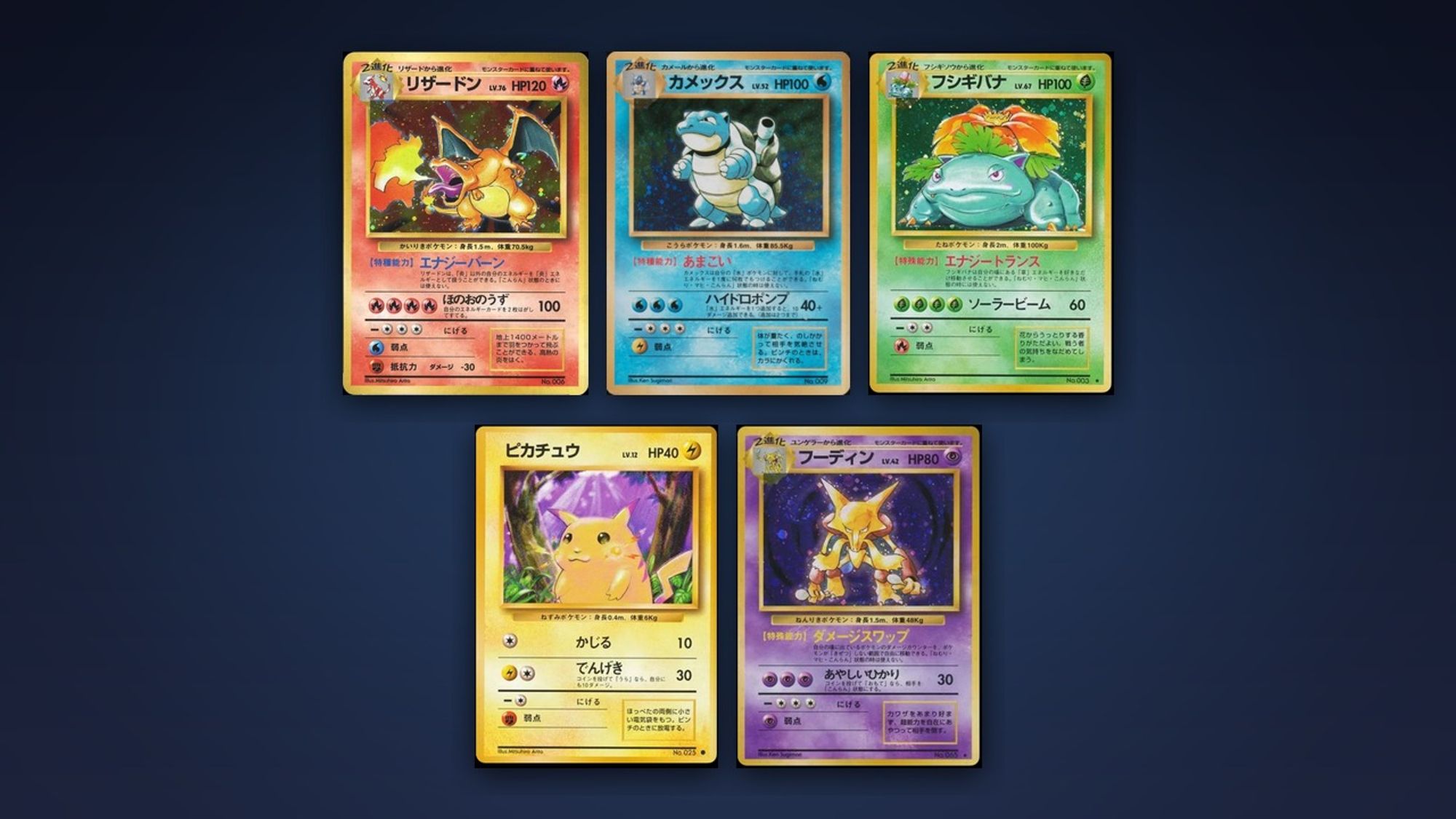
The game went on sale on October 20, 1996, published by Media Factory: a 60-card starter deck and 10-card packs, drawn from 102 cards that English players know as Base Set. Its first print has no rarity symbol at the bottom right, where later prints show a circle, diamond or star. Collectors treat these No Rarity cards as the Japanese first edition, and they carry errors that later prints corrected: the No Rarity Venusaur gives its Pokédex number as 068 instead of 003.
On March 3, 2026, a PSA 10 No Rarity Charizard sold for $1.7 million in a private sale, and on March 7 a PSA 10 copy whose case Mitsuhiro Arita had signed sold at auction for $1,232,200. Our 1st Edition guide covers the marks that date later Japanese and English prints.


The first English cards (1998 and 1999)
The earliest known English Pokémon cards are test prints of Blastoise that Wizards of the Coast made in mid-1998, before the game had an English release. Four were authenticated and graded in 2020: three have Magic: The Gathering backs, and the fourth, blank-backed, was made to show the press what an English card would look like. A black-bordered version, apparently earlier, survives on an uncut sheet of Magic cards. The presentation copy, graded 8.5, sold at auction for $360,000 on January 14, 2021.
Game stores got 24-card Demo Game packs of ordinary unstamped Base Set cards in late 1998, and the Base Set went on sale on January 9, 1999: the same 102 cards, with the 1st Edition stamp on the first print run. Card 1/102 is Alakazam, not Bulbasaur, because the English set is ordered by card type, then by rarity from Rare Holo down, then alphabetically. The Japanese checklist runs by type, then rarity from common up, then Pokédex number, which is why Bulbasaur leads it.
The Ivy Pikachu crossed over as well: an English-text print went on sale in Japan with Hyper CoroCoro on March 1, 1999, and as number 1 of the Wizards Black Star Promo series it was hidden in 1st Edition Jungle packs (June 16, 1999), then given out through the Pokémon League from July 1999.


Pikachu Illustrator: famous, but not the first

Many people answer this question with Pikachu Illustrator, but it came more than a year later. CoroCoro awarded it to winners of three illustration contests in 1997 and 1998: 39 copies in all, and at least 41 are known. Atsuko Nishida, Pikachu's original designer, drew it, and it is the only card that says Illustrator where a Trainer card says Trainer. On February 16, 2026, the only copy PSA had graded 10 sold at auction for $16,492,000, a record for any trading card at auction.
The Topsun myth: 1997, not 1995
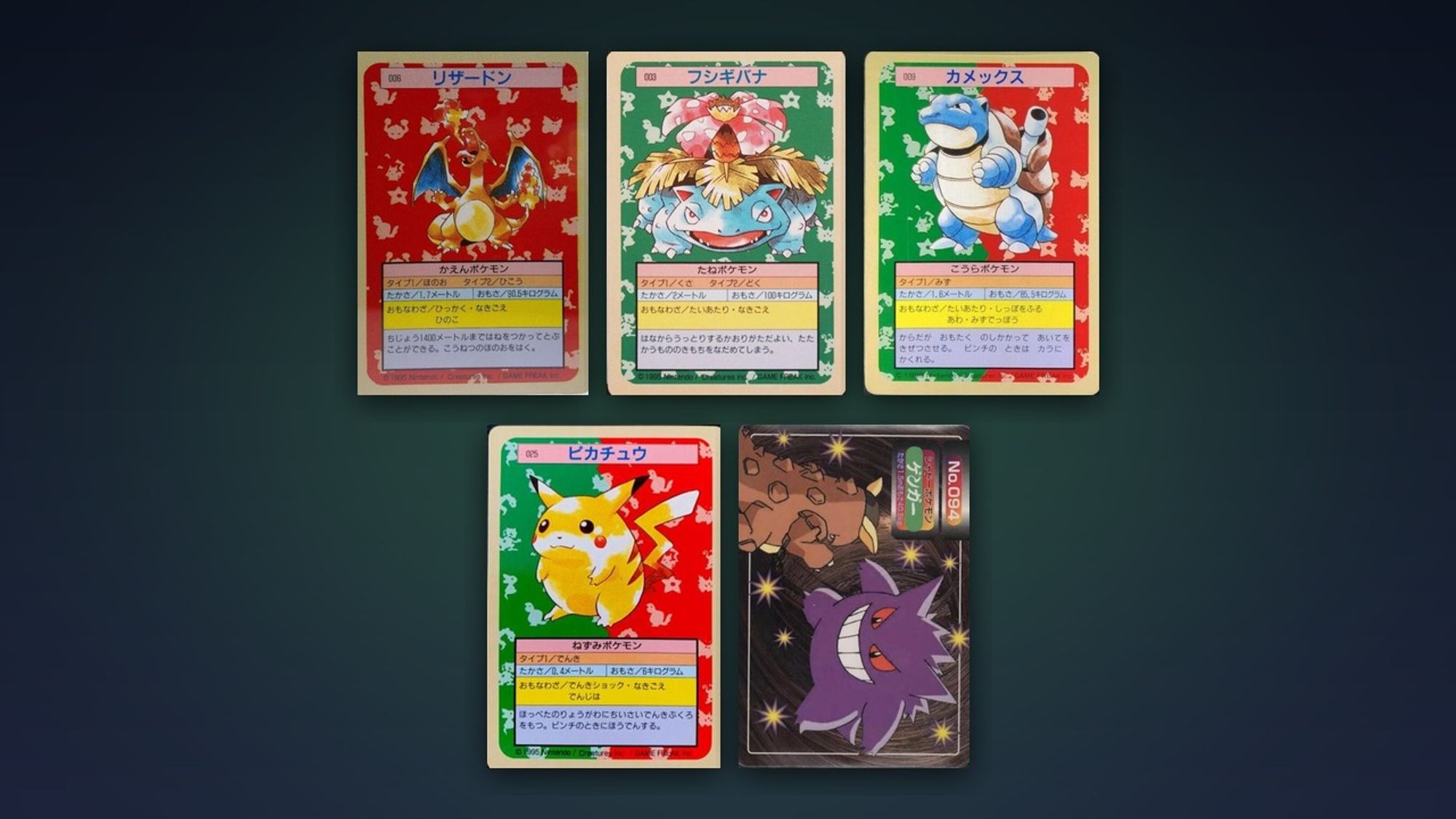
For years the usual answer was "the 1995 Topsun cards", and it is wrong. Top Seika's Topsun cards were sold with chewing gum and show 150 Pokémon, every one but Mew, with blue or green backs. Top Seika signed its Pokémon license in 1997, and the cards came out that year. The 1995 printed on them is the copyright line of Nintendo, Creatures and GAME FREAK, the owners of the franchise, not a release date. PSA labeled them 1995 until April 15, 2024, when it moved the set to 1997. Topsun therefore comes after Carddass, the CoroCoro promos and the Base Set.
What the first cards sell for
| Card | Price | Sale |
|---|---|---|
| Pikachu Illustrator, PSA 10 | $16,492,000 | Auction, February 16, 2026 |
| No Rarity Charizard, PSA 10 | $1.7 million | Private sale, March 3, 2026 |
| No Rarity Charizard, PSA 10, case signed by Mitsuhiro Arita | $1,232,200 | Auction, March 7, 2026 |
| Blastoise test print, presentation copy, graded 8.5 | $360,000 | Auction, January 14, 2021 |
| Alakazam 1/102, 1st Edition, raw | $573 (6 sales) | Median as of September 24, 2026 |
| Japanese Expansion Pack Charizard, raw | $307 (4 sales) | Median as of September 24, 2026 |
Medians are of real completed sales, in US dollars. Our catalog does not separate the No Rarity Charizard from later prints, no sale of the 1996 CoroCoro cards is recorded in our data, and Carddass cards are not in our catalog.
FAQ
What was the first Charizard card?
The earliest is the Charizard of Bandai's Carddass Part 1, a holographic Prism card of late September 1996, in red and in green. The first Charizard of the card game is the Expansion Pack's, of October 20, 1996, first printed without a rarity symbol.
What was the first Pokémon card in English?
The earliest known are Wizards of the Coast's Blastoise test prints of mid-1998. The first on sale came with Base Set on January 9, 1999, whose card number 1 is Alakazam.
Is Base Set the first Pokémon set?
Yes, for the card game: Base Set is the English release, on January 9, 1999, of the Japanese Expansion Pack of October 20, 1996. Bandai's Carddass came a few weeks earlier, but it is not a set of the game.
How old are Pokémon cards?
Thirty years old in 2026: the first Carddass cards went on sale in late September 1996, and the card game on October 20, 1996.


