
To play the Pokémon Trading Card Game, each player needs a 60-card deck. On your turn you draw a card, put Pokémon into play, attach one Energy card and play Trainer cards, then attack with your Active Pokémon, which ends your turn. Every Knock Out earns you Prize cards, and the first player to take all six wins.
You also win if your opponent has no Pokémon left in play, or no card to draw at the start of their turn. Beyond the decks you need a coin and damage counters, which most ready-made decks include. These are the rules in force on September 24, 2026.
How to set up a game, step by step
Both players set up at the same time, in this order.
Flip a coin. Shake hands, then flip a coin: the winner decides who goes first.
Draw 7 cards. Shuffle your 60-card deck and draw the top 7 cards as your opening hand.
Find a Basic Pokémon. If your hand has none, take a mulligan: show your hand, shuffle it back into your deck and draw 7 new cards, as many times as it takes. Your opponent may then draw up to one extra card for each mulligan you took beyond theirs. If neither player has a Basic Pokémon, both show their hands and start over.
Place your Active Pokémon. Put one Basic Pokémon face down in front of you. It is your Active Pokémon, the one that attacks and gets attacked.
Fill your Bench. Put up to 5 more Basic Pokémon face down on your Bench, if you want to.
Set aside 6 Prize cards. Put the top 6 cards of your deck to one side, face down, without looking at them.
Reveal and start. Both players turn their Pokémon face up, and the first player takes the first turn.
How to play a turn, step by step
Players take turns. Draw first, do the middle steps in any order and as often as each one allows, and attack last, because attacking ends your turn.
Draw a card. Every turn starts with a draw. If your deck is empty and you cannot draw, you lose the game.
Bench Basic Pokémon. Play any number of Basic Pokémon from your hand to your Bench, up to 5 Pokémon there.
Evolve. Put a Stage 1 card on the Basic Pokémon it evolves from, or a Stage 2 card on its Stage 1, on as many Pokémon as you like. The Pokémon must have been in play since the start of your turn, and it cannot evolve twice in the same turn. Evolving keeps its damage and attached cards and removes any Special Condition.
Attach one Energy card. Once per turn, from your hand to your Active Pokémon or to a Benched Pokémon.
Play Trainer cards. Play any number of Items and Pokémon Tools, but no more than one Supporter and one Stadium per turn.
Retreat, if you need to. Once per turn, discard as many Energy from your Active Pokémon as its Retreat Cost shows and swap it with a Benched Pokémon. An Asleep or Paralyzed Pokémon cannot retreat. Your new Active Pokémon can still attack this turn.
Use Abilities. Use the Abilities of your Active and Benched Pokémon as their text allows. An Ability is not an attack, so using one does not end your turn.
Attack. Check that your Active Pokémon has the Energy the attack costs, announce the attack and apply it. Your turn ends.
Pokémon Checkup. Between turns, apply Special Conditions in this order: Poisoned, Burned, Asleep, Paralyzed. Any Pokémon whose damage now reaches its HP is Knocked Out, then the next turn begins.
The first turn is different. The player who goes first cannot attack and cannot play a Supporter card on that turn. Neither player can evolve a Pokémon during their own first turn unless a card says so. The player who goes second can attack and play a Supporter on their first turn.
Damage, Knock Outs and winning
An attack does the damage printed to the right of its name to your opponent's Active Pokémon, unless its text says otherwise. When several things change the damage, work it out in this order:
| Step | What to do |
|---|---|
| 1. Base damage | Start with the number printed next to the attack |
| 2. Your effects | Add or subtract effects on your attacking Pokémon, such as a Trainer card's bonus |
| 3. Weakness | If the Defending Pokémon has Weakness to the attacker's type, apply it: ×2 on current cards |
| 4. Resistance | If it has Resistance to that type, subtract it: −30 on current cards, −20 on some older ones |
| 5. Their effects | Apply effects on the Defending Pokémon, such as "takes 20 less damage" |
| 6. Damage counters | Place 1 damage counter for each 10 damage |
So a 60-damage Fire attack does 120 damage to a Pokémon with Fire Weakness, and 30 to one with Fire Resistance of −30. Weakness and Resistance never apply to Benched Pokémon, and an attack that tells you to place damage counters ignores Weakness, Resistance and every other effect.
A Pokémon is Knocked Out when its damage equals or exceeds its HP. Its owner puts it and every card attached to it in the discard pile, the other player takes Prize cards, and the owner chooses a Benched Pokémon as the new Active Pokémon. A player with no Benched Pokémon to bring in loses the game.
| Pokémon Knocked Out | Prize cards taken |
|---|---|
| Most Pokémon | 1 |
| Pokémon ex | 2 |
| Mega Evolution Pokémon ex | 3 |
Older special Pokémon give up the number printed in their rule box: 2 for a Pokémon V, 3 for a Pokémon VMAX, for example. Knocking Out two Mega Evolution Pokémon ex (2 × 3) or three Pokémon ex (3 × 2) is enough to take all six Prize cards.
Which deck to buy first (September 2026)
Start with a ready-made deck rather than booster packs, which hold random cards, not a deck you can play. Official list prices, as of September 24, 2026:
| Product | What is inside | List price | Best for |
|---|---|---|---|
| Battle Academy (2024) | 3 ready decks of 60 cards (Armarouge ex, Pikachu ex, Darkrai ex), a two-player game board, 2 tutorial guides | $24.99 | Two people learning together |
| Mega Battle Deck: Mega Gengar ex or Mega Diancie ex (October 2025) | 1 ready 60-card deck, damage counters, a coin, a playmat | $14.99 | A first deck of your own, for games at home |
| Build & Battle Box (Perfect Order, 2026, for example) | A 40-card deck and 4 booster packs | $21.99 | Prerelease events, where decks are 40 cards |
| League Battle Deck: Mega Lucario ex (June 2026) or Team Rocket's Mewtwo ex (December 2025) | 1 ready 60-card deck, damage-counter dice, condition markers, a Pokémon TCG Live code | $29.99 | A first tournament: both are Standard-legal as sold |
The Mega Battle Decks include a few cards, such as Iono and Nest Ball, that left Standard on April 10, 2026: fine at home, but those cards must be swapped out before a tournament. Rival Battle Decks (Marnie or Steven, May 2025) are also one 60-card deck per box, so two players need two boxes, and they include Iono too. Older League Battle Decks (Dragapult ex from 2025, Gardevoir ex and Charizard ex from 2024) hold cards that left Standard, and World Championships decks are replicas that are not legal for tournament play.
On September 24, 2026, Battle Academy and the Mega Battle Decks could not be bought online at list price, either at the official store or at major US retailers, where only resellers offered them, above list price. Build & Battle Boxes sold above list price at some retailers, and both League Battle Decks were on sale. The next ready-made decks, the 30th Celebration Battle Decks (Espeon ex and Umbreon ex, 60 foil cards each), launch on October 30, 2026. Our guide to where to buy Pokémon cards covers the other places to find them.
Free ways to learn
- Pokémon TCG Live (Windows, Mac, iOS, Android) is free and uses the same rules as the card game, with Learning Lab tutorials and every card legal in Standard. Code cards from packs and decks add cards to your online collection.
- Play! Pokémon Stores, often hobby shops, run League sessions where new players can learn and play. The event locator on the official Pokémon site finds the nearest one.
- Pokémon TCG Pocket (iOS, Android) is a separate, simpler game: 20-card decks with no more than 2 copies of a card, a Bench of 3, Energy from an Energy Zone instead of Energy cards, and a race to 3 points, where a Knock Out scores 1, a Pokémon ex 2 and a Mega Evolution Pokémon ex 3. Its rules do not carry over to the card game.
The three kinds of cards
Pokémon
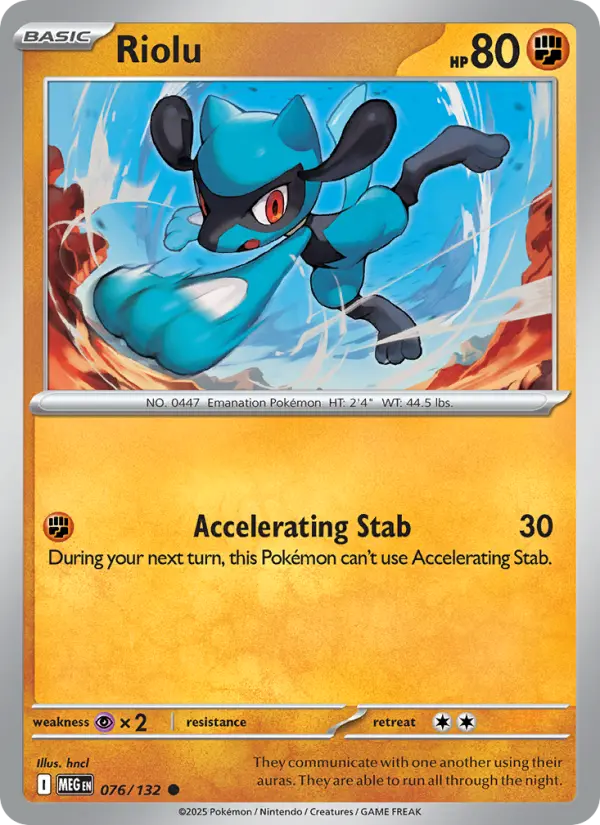
Basic Pokémon are played straight from your hand. A Stage 1 card evolves from a named Basic Pokémon and a Stage 2 from a named Stage 1; the stage and the Pokémon it evolves from are printed at the top left of the card.
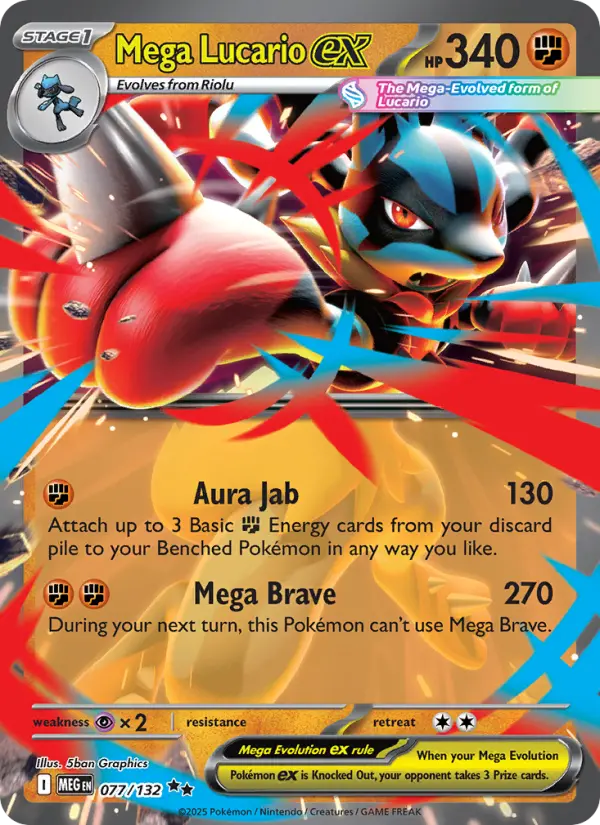
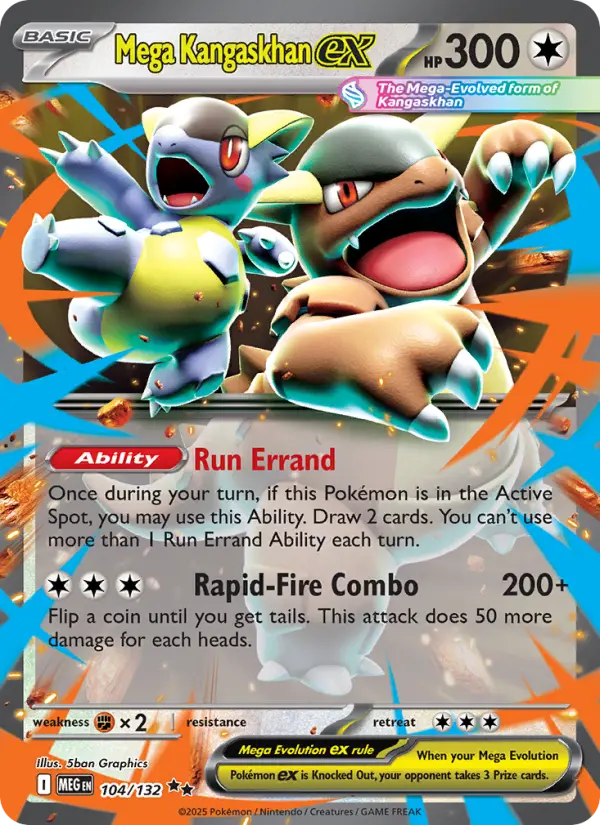
Mega Evolution Pokémon ex, printed since September 2025, are ordinary Basic, Stage 1 or Stage 2 cards with no special rule for playing them: Mega Lucario ex evolves from Riolu (not from Lucario), Mega Gardevoir ex from Kirlia, and Mega Kangaskhan ex is a Basic that goes straight onto your Bench. Playing one does not end your turn. The cost comes when one is Knocked Out: 3 Prize cards. The M Pokémon-EX of the XY series (2014 to 2016) worked differently: they evolved from a Pokémon-EX and ended your turn.
Trainer cards
Trainer cards come in four subtypes, named at the top of the card:
| Subtype | How many per turn | What it does |
|---|---|---|
| Item | Any number | A one-time effect: search, draw, heal, switch |
| Supporter | One | A stronger effect; the first player cannot play one on the first turn |
| Stadium | One, and one in play at a time | Stays in play and affects both players; a new Stadium replaces the old one |
| Pokémon Tool | Any number, one per Pokémon | Attached to a Pokémon for a lasting bonus |
ACE SPEC is a label on some Trainers and a few Special Energy cards so strong that a deck may hold only one ACE SPEC card in total.
Energy cards
Eight types of basic Energy are legal in Standard: Grass, Fire, Water, Lightning, Psychic, Fighting, Darkness and Metal, and a deck may hold any number of them. Basic Fairy Energy, the ninth, has not been legal in Standard since September 10, 2021, and there is no basic Dragon Energy: Dragon-type attacks are paid with other types. Special Energy cards add effects and count toward the limit of four copies of a card. A Colorless symbol in an attack cost can be paid with any type of Energy.
How to read a Pokémon card
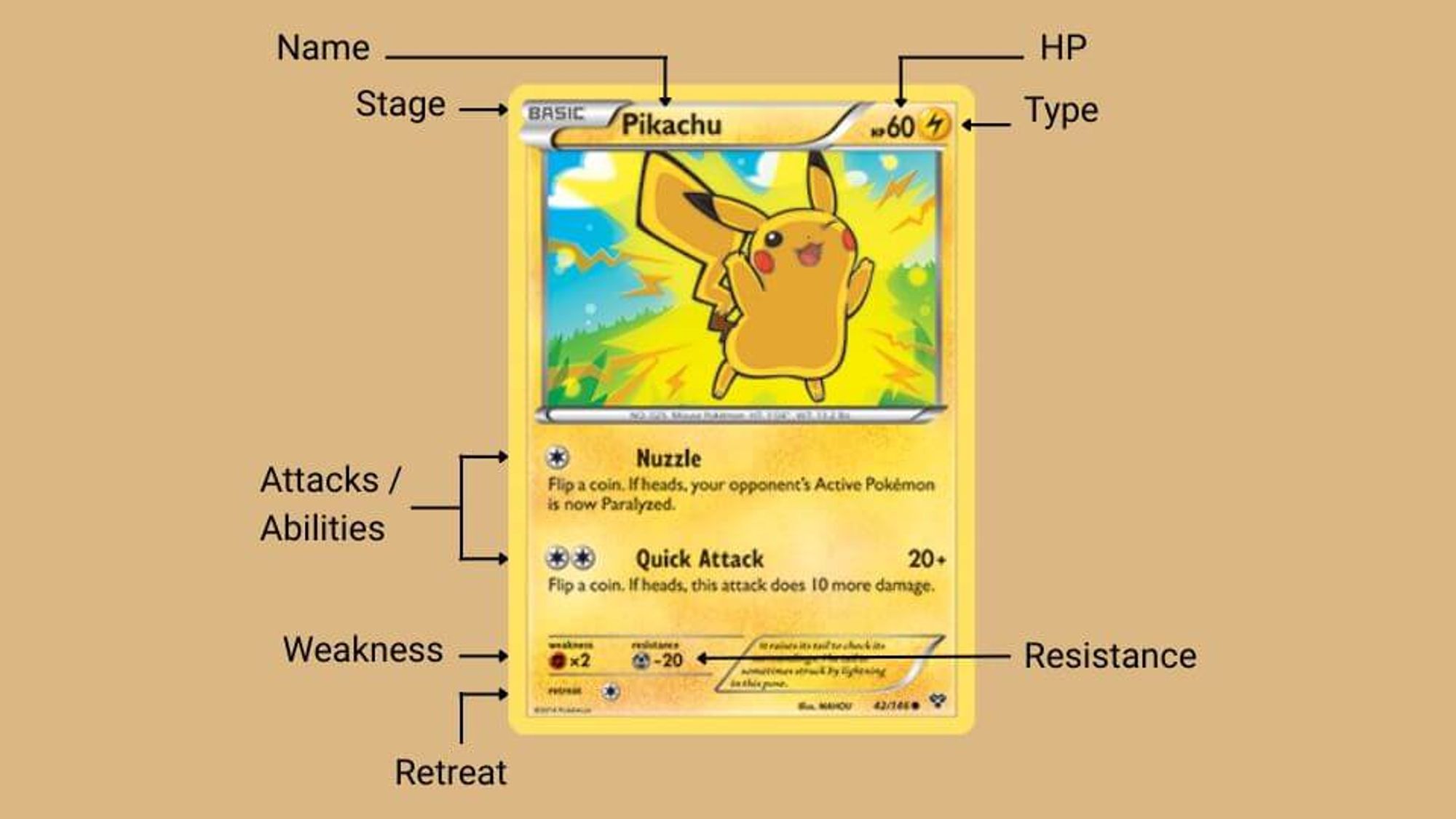
- Stage (top left): Basic, Stage 1 or Stage 2, with the Pokémon it evolves from.
- HP (top right): how much damage the Pokémon can take before it is Knocked Out.
- Type (the symbol beside the HP): what Weakness and Resistance are checked against.
- Attacks and Abilities: the symbols left of an attack are its Energy cost, and the number on the right is its damage.
- Weakness, Resistance and Retreat Cost (bottom row): this 2014 card prints Resistance −20, where current cards print −30.
- Regulation mark (bottom left, on cards since November 2019): the letter beside the set code and card number that Standard legality is based on. The symbol after the card number is the rarity, which does not change how a card plays; our rarity guide explains the symbols.
The play area
| Zone | What it holds | Rule to remember |
|---|---|---|
| Active Spot | Your one battling Pokémon | Always occupied; only this Pokémon attacks, and only it can have Special Conditions |
| Bench | Up to 5 more Pokémon | Benched Pokémon can evolve and take Energy; Weakness and Resistance do not apply to them |
| Deck | Your face-down draw pile | Nobody may look at it or change its order unless a card says so |
| Hand | The cards you drew | Hidden from your opponent |
| Prize cards | 6 face-down cards set aside at setup | You take them as you Knock Out Pokémon |
| Discard pile | Used Trainers, discarded Energy, Knocked Out Pokémon | Face up and public: either player may look through it |
| Lost Zone | Cards that some effects send there | Out of play for the rest of the game |
Your Active Pokémon changes when you retreat it, when a card effect switches it, or when it is Knocked Out and you bring in a Benched Pokémon. Boss's Orders, for example, pulls one of your opponent's Benched Pokémon into their Active Spot.
Special Conditions
Only an Active Pokémon can be Asleep, Burned, Confused, Paralyzed or Poisoned, and moving to the Bench or evolving removes every condition. Asleep, Confused and Paralyzed turn the card, so only the latest of the three applies. Poisoned and Burned use markers instead, so they can come on top: a Pokémon can be Burned, Poisoned and Paralyzed at once.
| Condition | Effect | At Pokémon Checkup | How to show it |
|---|---|---|---|
| Poisoned | None on its own | 1 damage counter | Poison marker |
| Burned | None on its own | 2 damage counters, then flip a coin: heads, it recovers | Burn marker |
| Asleep | Cannot attack or retreat | Flip a coin: heads, it wakes up | Turn the card counterclockwise |
| Paralyzed | Cannot attack or retreat | Recovers at the Checkup after its owner's next turn | Turn the card clockwise |
| Confused | Before attacking, flip a coin: tails, the attack fails and it takes 3 damage counters | Nothing | Turn the card upside down |
Tournaments: the Standard format
At home you can play any cards. The World Championships and most official tournaments use the Standard format, which since April 10, 2026 (March 26 in Pokémon TCG Live) accepts cards with the regulation marks H, I and J; J first appeared on Ascended Heroes (January 30, 2026). Cards marked G, from the Scarlet & Violet base set (March 2023) through Paldean Fates (January 2024), have left. An older card stays legal when a reprint with the same name, functionally identical text and a legal mark exists: the 2020 Boss's Orders, marked D, is legal because the 2025 Mega Evolution printing carries an I.
A 60-card deck needs at least one Basic Pokémon and no more than four copies of any card with the same name, basic Energy excepted. Our guide to how many cards are in a Pokémon deck covers the deck-building rules and which staples are legal, and the next World Championships, in Singapore on August 13 to 15, 2027, are in our Worlds 2027 guide.
The official rules
This page covers what a new player needs. For the official version with pictures, the Quick Start Rules (PDF) walk through a first game, and the complete rulebook, last updated in July 2026, is linked from the official Learn to Play page.
FAQ
How many cards do you draw at the start of a Pokémon game?
Seven. After placing your Pokémon, you also set aside the top six cards of your deck as Prize cards.
Can you attack on your first turn?
Only if you go second. The player who goes first cannot attack or play a Supporter on that turn.
Can you evolve a Pokémon on your first turn?
No, neither player can, unless a card says so. After that, a Pokémon can evolve once it has been in play since the start of your turn.
How many Energy cards can you attach in a turn?
One, from your hand to your Active or a Benched Pokémon, unless a card lets you attach more.
What happens when you run out of cards?
You lose if you cannot draw at the start of your turn. Being unable to draw because a card told you to draw more cards than you have left does not lose the game.
What happens if your Active Pokémon is Knocked Out and your Bench is empty?
You lose. A new Active Pokémon must come from your Bench, and with none there, your opponent wins.
What is the best Pokémon deck for beginners?
For two new players, a Battle Academy box, with three 60-card decks and a game board, though it could not be bought online at list price on September 24, 2026. For a first tournament, a League Battle Deck such as Mega Lucario ex, on sale and legal in Standard as sold on that date.
Is Pokémon TCG Live free?
Yes. It runs on Windows, Mac, iOS and Android, follows the same rules as the card game and includes tutorials.


