
A Pokémon TCG deck is exactly 60 cards, no more and no less. It must hold at least one Basic Pokémon and no more than four copies of any card with the same name, basic Energy being the one exception. Your six Prize cards come out of those 60: you never bring extra cards for them.
Those rules apply to the Standard and Expanded formats, on paper and in Pokémon TCG Live, as of September 24, 2026. The Limited formats and the Pocket app change the count:
| Format | Deck size | Prize cards | Copies of one card |
|---|---|---|---|
| Standard | 60 | 6 | 4, basic Energy unlimited |
| Expanded | 60 | 6 | 4, basic Energy unlimited |
| Limited: Prerelease, Sealed, Draft | 40 | 4 | No limit, unless a card says otherwise |
| Pokémon TCG Pocket (mobile app) | 20 | None: first to 3 points wins | 2 |
Most ready-made decks follow the same count: a Mega Battle Deck, a League Battle Deck or each of the three Battle Academy decks holds 60 cards. A Build & Battle Box, the Prerelease kit, holds a 40-card deck and four booster packs to tune it with, and at the event the organizer supplies extra basic Energy. The rest of this guide covers the 60-card game.
The deck-building rules
At least one Basic Pokémon. You need one to start: a player whose opening hand has no Basic Pokémon must reshuffle and draw again, a mulligan.
No more than four copies of a name. The limit counts names, not versions: four Pikachu is the maximum even if they come from four sets with four different attacks. Copies are counted by the card's English name, so a French Dracaufeu and an English Charizard count together. What is and is not part of a name:
| Cards | Same name? | You may play |
|---|---|---|
| Charizard and Charizard ex | No | 4 of each |
| Mewtwo ex and Team Rocket's Mewtwo ex | No | 4 of each |
| Meowth and Alolan Meowth | No | 4 of each |
| Charizard ex and Charizard-EX (Expanded) | No | 4 of each |
| Yveltal and Yveltal-EX (Expanded) | No | 4 of each |
| Gengar and Gengar LV.X (2007 to 2009 cards) | Yes | 4 in total |
Basic Energy is unlimited. A deck of 59 basic Energy and one Basic Pokémon is legal. Eight basic types are legal in Standard: Grass, Fire, Water, Lightning, Psychic, Fighting, Darkness and Metal. Fairy, the ninth, left Standard on September 10, 2021, after the Fairy type was dropped from new cards. Special Energy counts toward the four-copy limit like any other card.
One ACE SPEC per deck. ACE SPEC cards, such as Prime Catcher, Unfair Stamp, Secret Box or Enriching Energy, are limited to one in the whole deck, not one of each.
One Radiant Pokémon per deck. The rule still stands, but Radiant Pokémon come from 2022 and 2023 sets marked F, which left Standard in April 2025, so it matters in Expanded, not in Standard.
Matching sleeves at tournaments. Every sleeve in a tournament deck must be the same color, design, condition, size and texture. The Pokémon Center's own sleeves come 65 to a pack, enough for 60 cards and spares; sizes are in our card sleeve size guide.
How to split the 60
No rule fixes the mix of Pokémon, Trainers and Energy. Here is what the official starter advice, a ready-made deck and the best decks of the 2026 World Championships (San Francisco, August 28 to 30, 2026) actually run:
| Deck | Pokémon | Trainers | Energy |
|---|---|---|---|
| Starter guideline in the official rulebook | The rest (20 to 28) | 20 to 25 | 12 to 15 |
| Mega Lucario ex League Battle Deck (June 2026) | 18 | 30 | 12 |
| 2026 world champion (Dragapult ex) | 19 | 32 | 9 |
| Top 8, 2026 World Championships, Masters | 10 to 24 | 27 to 37 | 5 to 13 |
| 143 best-placed Masters decks, same event: median | 20 | 31 | 9 |
| Same 143 decks: middle half | 19 to 21 | 28 to 33 | 8 to 12 |
Competitive decks run more Trainers and fewer Energy than the starter guideline, and their Pokémon count sits close to 20.
Pokémon. Play your main attacker's line deep. The world champion ran 4 Dreepy, 4 Drakloak and 3 Dragapult ex; the runner-up ran 4 Abra, 4 Kadabra and 3 Alakazam, plus Rare Candy, an Item that evolves a Basic straight into its Stage 2. Watch the Prize trade: a Pokémon ex gives up two Prize cards and a Mega Evolution Pokémon ex three, so two Mega Knock Outs end a game. How Prize cards and turns work is in our guide to how to play Pokémon cards.
Trainers. They come in four subtypes. Supporters, one per turn, draw and search, like Lillie's Determination, or pull an opposing Benched Pokémon into the Active Spot, like Boss's Orders. Items have no limit: Ultra Ball, Rare Candy, Night Stretcher, Switch. Pokémon Tools are their own subtype, attached one per Pokémon, like Air Balloon. Stadiums, one per turn and one in play, change the rules for both players, like Gravity Mountain.
Energy. Enough to attack every turn, in one or two types. Some decks go far lower than the table's middle: the Alakazam deck that placed seventh at the 2026 World Championships ran five Energy. A first deck, with fewer ways to search, is safer at 12 to 15.
A complete legal 60: the Mega Lucario ex League Battle Deck
This ready-made deck came out on June 19, 2026, at a $29.99 list price, and is Standard-legal as sold on September 24, 2026:
| Part | Count | Cards |
|---|---|---|
| Pokémon | 18 | 4 Riolu, 3 Mega Lucario ex, 3 Makuhita, 2 Hariyama, 2 Lunatone, 2 Solrock, 1 Fezandipiti ex, 1 Bloodmoon Ursaluna ex |
| Supporters | 10 | 4 Lillie's Determination, 3 Iris's Fighting Spirit, 2 Boss's Orders, 1 Surfer |
| Items | 16 | 4 Fighting Gong, 4 Premium Power Pro, 4 Ultra Ball, 2 Night Stretcher, 1 Switch, 1 Secret Box (ACE SPEC) |
| Pokémon Tools | 2 | 2 Air Balloon |
| Stadiums | 2 | 2 Gravity Mountain |
| Energy | 12 | 12 basic Fighting Energy |
| Total | 60 | 18 Pokémon, 30 Trainers, 12 Energy |
Its two Boss's Orders are the 2023 Paldea Evolved printing, marked G: they are legal through the reprint rule below.
Which cards are legal in Standard (September 2026)
Since April 10, 2026 (March 26 in Pokémon TCG Live), Standard accepts cards with the regulation marks H, I and J, the letter printed at the bottom left of the card beside the set code. Cards marked G left: that covers every Scarlet & Violet set from the base set (March 2023) through Paldean Fates (January 2024), plus the G reprints found in later sets. New sets usually become legal two weeks after their US release.
The mark is not the whole test. An older card stays legal when a newer card with the same name, functionally identical text and a legal mark exists. Boss's Orders from Rebel Clash (2020) carries a D, yet it is legal in Standard because the Mega Evolution set (2025) reprinted it with an I; the Sun & Moon Rare Candy, printed before regulation marks existed, is legal for the same reason.
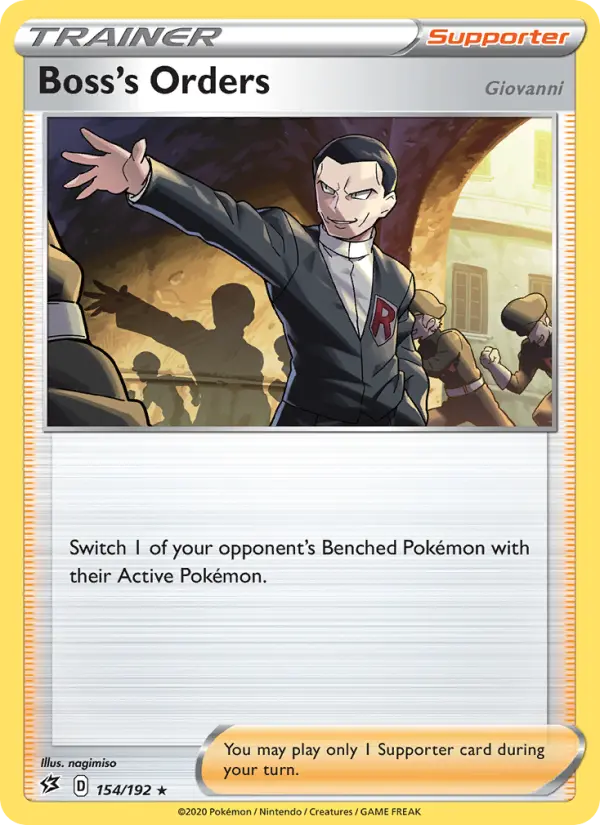
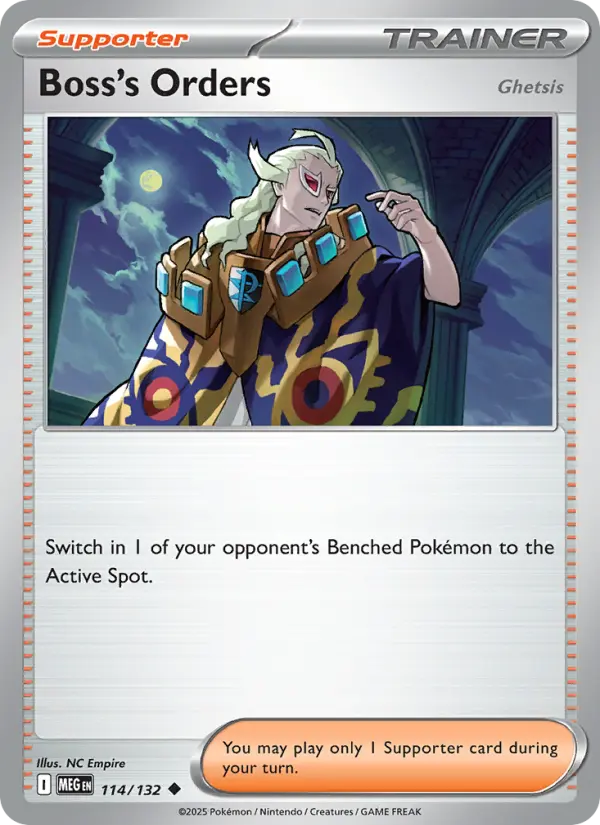
A reprint only helps if its own mark is legal. Jet Energy and Luminous Energy were reprinted as gold cards in Surging Sparks and Twilight Masquerade (2024), but those reprints are marked G too, so no printing of either has been legal in Standard since April 10, 2026.
| Card | In Standard on September 24, 2026 | Why |
|---|---|---|
| Boss's Orders, Rare Candy, Ultra Ball, Switch | Legal, older printings with the same text included | Reprinted with an I mark in the Mega Evolution set (2025) |
| Crushing Hammer | Legal, older printings with the same text included | Reprinted with a J mark in Perfect Order (2026) |
| Professor's Research, Iono, Arven, Nest Ball, Artazon, Bravery Charm | Not legal | No printing carries H, I or J |
| Jet Energy, Luminous Energy | Not legal | Their 2024 gold reprints carry G as well |
Expanded accepts cards from the Black & White series (2011) onward, minus a banned list. The World Championships play Standard, which rotates about once a year; the next rotation had not been announced as of September 24, 2026.
Pokémon TCG Pocket: 20 cards
The mobile game has its own rules: 20-card decks, no more than two cards with the same name, no Energy cards (an Energy Zone produces one Energy each turn), a Bench of three, and a race to 3 points. A Knock Out scores 1 point, 2 for a Pokémon ex and 3 for a Mega Evolution Pokémon ex, which arrived with the Mega Rising expansion on October 30, 2025. Pocket has Supporters, Items and Pokémon Tools, and Stadiums since January 2026.
FAQ
Can a Pokémon deck have 59 or 61 cards?
No. A Standard or Expanded deck must be exactly 60 cards, and a Limited deck, such as a Prerelease deck, exactly 40.
Do Prize cards count toward the 60?
Yes. You draw your seven-card opening hand from the 60, then set the top six cards of the same deck aside as Prize cards.
How many Energy cards should a Pokémon deck have?
Among the 143 best-placed Masters decks at the 2026 World Championships, the median was 9 and the middle half ran 8 to 12. A first deck is safer with 12 to 15, the official starter guideline.
How many Pokémon should be in a Pokémon deck?
About 20 in competitive play, the median at the 2026 World Championships, with four copies of your main Basic and three or four of each stage above it. Some decks go far lower: the two Crustle decks in the top 8 ran 10 Pokémon and 37 Trainers.
Can you have more than four copies of a card?
Only of basic Energy, in Standard and Expanded. Limited formats such as Prerelease have no copy limit, unless a card's own text sets one.
Can I mix languages in my deck?
Yes, if the card backs match, which rules out Japanese cards: their back differs from every other current language's, so they are not allowed at Play! Pokémon tournaments. At Championship Series events the legal languages depend on the region (English in the US and Canada, plus French in Canada; English, French, German, Italian, Portuguese or Spanish in Europe), and at Special, Regional and International Championships and at Worlds you may also play English or any language legal in your home country; at other events and League sessions the organizer decides.
Can I mix cards from different sets?
Yes. Legality follows each card's regulation mark, not its set, so any card marked H, I or J, or with a legal reprint, can go in a Standard deck.
How much does a competitive deck cost?
The Mega Lucario ex and Team Rocket's Mewtwo ex League Battle Decks are complete 60-card decks, legal as sold in September 2026, at a $29.99 list price; older League Battle Decks hold cards that have since left Standard. Built from singles, a top deck can be cheap in its regular printings: the 2026 world champion's Dragapult ex sells for $2.45 (23 sales) and its ACE SPEC, Unfair Stamp, for $11.05 (200 sales), in real completed sales as of September 24, 2026. For singles, see where to buy Pokémon cards; opening packs is the slow way to a list, since a standard booster pack holds 10 game cards at random.


